The EU’s single market was once mainly about removing barriers between member states. Under Ursula von der Leyen, it is increasingly becoming a way for Europe to strengthen its industries, reduce strategic dependencies and compete more succesfully with the US and China. The European Commission President framed that shift into a six-priority plan for the bloc’s future economy. Strip away the rebranding, and two upcoming legislative proposals are worth tracking.
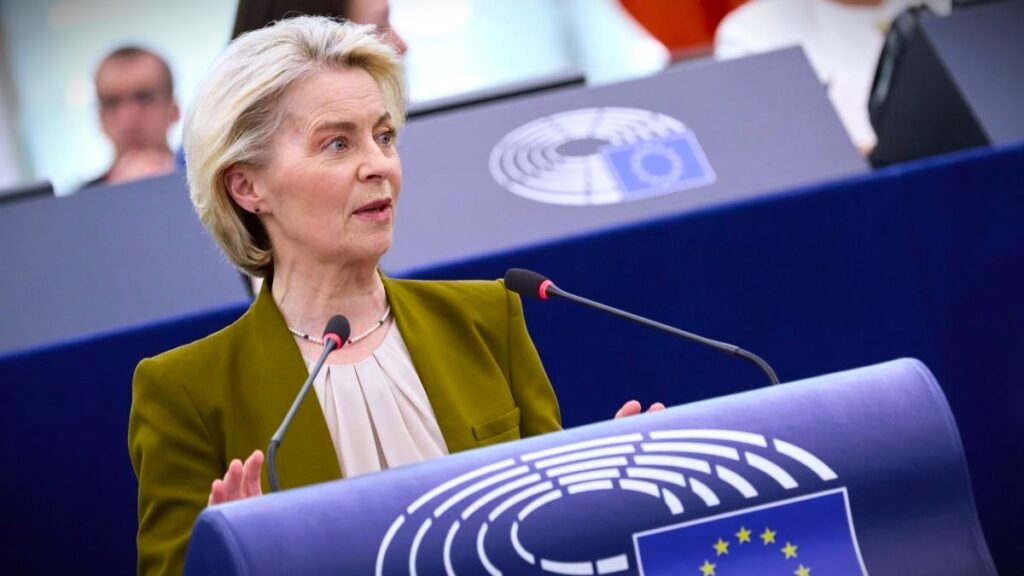
“We must finish what we started,” Ursula von der Leyen told MEPs in Strasbourg. “We must remove the barriers that still persist in our internal market.”
A European Parliament plenary debate on the single market this week gave her a platform to repackage a familiar agenda into six priorities: removing barriers, going digital by design, embedding sustainability, building European independence, ensuring inclusion, and strengthening the social dimension. It’s an agenda already in motion.
Removing barriers
The centrepiece of this priority is EU Inc., the 28th regime that would allow companies to register anywhere in the EU within 48 hours under a single set of rules, bypassing the current patchwork of 27 national corporate legal frameworks.
Whether it delivers is another question — the proposal has already drawn sharp criticism from legal scholars for defaulting to national law to fill its gaps. For now, doubts persist about whether Europe’s long-promised ‘Delaware moment’ will materialise.
Von der Leyen also invoked the ‘Terrible Ten’ — the Commission’s list of the most persistent barriers to the single market, which was identified in the Single Market Strategy in May 2025. The strategy “takes welcome steps in areas such as construction and telecommunication, but falls short of addressing structural weaknesses in enforcement and offering a bold regulatory vision,” said a report by the Brussels-based think tank Bruegel.
Gold-plating—the practice of member states layering additional complexity onto EU rules—von der Leyen also addressed as a key obstacle. “Although these practices have long been criticised, the ‘gilding’ of EU law is still commonplace, despite repeated commitments,” wrote Philipp Eckhardt in a study for the Centres for European Policy Network. The International Monetary Fund (IMF) estimates barriers equivalent to a 44 per cent tariff on goods and 110 per cent on services.
Digital by design
Von der Leyen announced a Chips Act 2.0 to strengthen Europe’s role in the semiconductor value chain, and a Cloud and AI Development Act to support the growth of a European AI ecosystem. Together, they form a bundled Tech Sovereignty Package. While both have been in the works, what is notable is the framing: von der Leyen positioned these explicitly as single market instruments, not standalone industrial policy.
Since the beginning of the pandemic, our companies have faced a long series of supply chain disruptions. Our single market can help. We must continue to leverage the scale to conclude new trade deals.
— Ursula von der Leyen, European Commission President
The Chips Act 2.0 is designed to solve Europe’s ability to own the end result. Europe produces world-class semiconductor research but lacks the manufacturing infrastructure to commercialise it at scale. The full legislative proposal is expected from the Commission next Wednesday, a proposal worth looking out for.
Embedding sustainability
“With the Industrial Accelerator Act (IAA), we are creating lead markets for clean products across our Union,” said von der Leyen. “These are basically the industries of the future, so we have to leverage our single market to create scale for exactly those industries of the future.”
The IAA, formally proposed in March, uses public procurement rules to create demand for low-carbon, ‘Made in EU’ products in sectors like steel, aluminium, and electric vehicles. This is the first time the EU has explicitly directed taxpayer money to build home markets for strategic industries.
Speaking with EU Perspectives in March, Tristan Beucler, Industry Analyst at Strategic Perspectives, called it “the first major act to emerge from the Clean Industrial Deal” and said it has “strong potential not only to bring some sectors back, but also to keep some in Europe that are at risk of leaving”. The caveat: price exception thresholds set at 30 per cent for public procurement may not be enough when the average price gap with Chinese competitors runs closer to 40 per cent.
Building European independence
“Since the beginning of the pandemic, our companies have faced a long series of supply chain disruptions. Our single market can help. We must continue to leverage the scale to conclude new trade deals,” von der Leyen said.
Europe cannot rely on the classic single market alone. It needs a wider economic strategy that supports innovation, strategic investment and economic security.
— Fabian Zuleeg, European Policy Centre
Since US President Donald Trump’s trade war began, the EU has been on an unprecedented trade deal spree, driven as much by geopolitical necessity as economic ambition. The bloc concluded deals with Indonesia, Switzerland, and Mercosur all in the last year. In January, the EU sealed ‘the mother of all deals’ with India, creating a free trade zone of two billion people.
And this week, the EU and Mexico formally signed a modernised trade agreement at a Mexico City summit, projected to increase bilateral commerce by 35 per cent over five years. It is the most concrete evidence von der Leyen has that leveraging single market scale actually works.
Ensuring inclusion
Von der Leyen called on MEPs to adopt the e-declaration—a single digital form that allows cross-border workers and their employers to comply with posting rules without navigating 27 different national bureaucracies—and pointed to a Fair Labour Mobility package, a European Social Security Pass, and digitised professional qualifications recognition as further steps.
While the framing was social, the substance is a barrier-removal agenda. The Commission’s Single Market Strategy classifies posting of workers bureaucracy among the Terrible Ten barriers.
The social dimension
Von der Leyen referenced a new anti-poverty strategy adopted two weeks prior, and confirmed the Commission is working with social partners on a Quality Jobs Act expected later this year.
The Commission has framed the Quality Jobs Act as updating EU rules “protecting workers while supporting productivity and competitiveness” — a dual mandate that has already opened a fault line between labour and industry.
General Secretary Esther Lynch of the European Trade Union Confederation warned that “having made that promise, President von der Leyen must now ensure the Quality Jobs Act meets the urgency and gravity of the situation faced by working people”.
The European Construction Industry Federation, whose members rely heavily on the posted workers and subcontracting chains the act targets most directly, is pushing in the opposite direction: more enforcement of existing rules, not new regulatory burdens.
Legal analysts have also flagged that the proposed EU Inc. regime could allow companies to operate outside national labour laws, directly undermining the Quality Jobs Act’s objectives.
Von der Leyen’s six points are a credible account of unfinished business. But as Fabian Zuleeg, Chief Executive and Chief Economist at the European Policy Centre, wrote this week: “Europe cannot rely on the classic single market alone. It needs a wider economic strategy that supports innovation, strategic investment and economic security.”