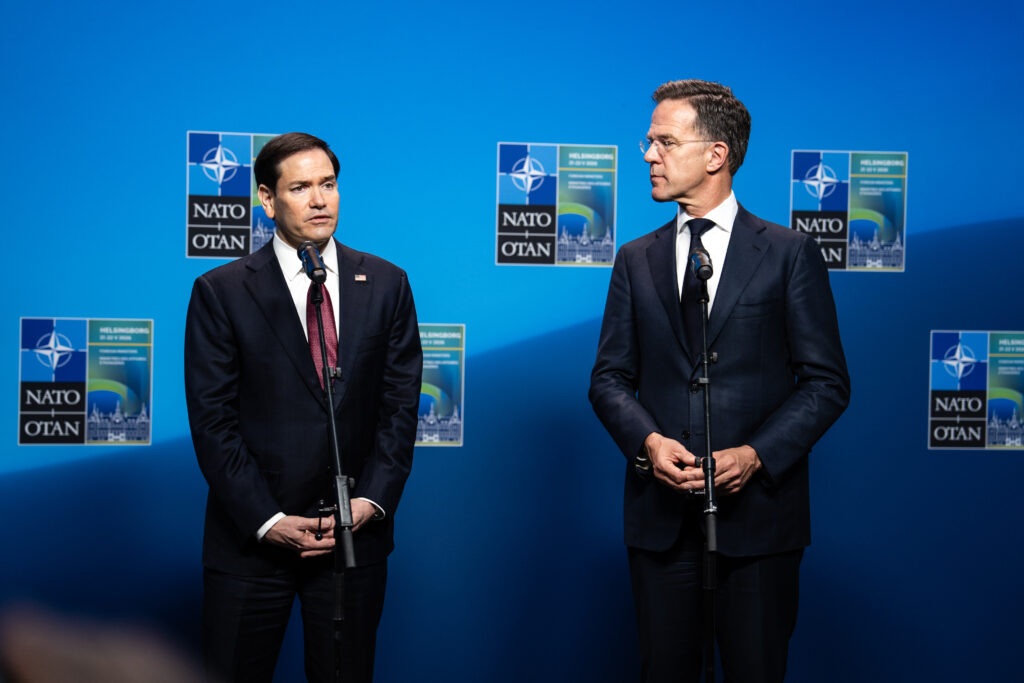
This week’s NATO foreign ministers’ meeting in Helsingborg had a clear political focus: redefining the balance of transatlantic relations ahead of the Alliance leaders’ summit in Ankara in July.
Behind discussions on military spending, industrial production and the Allies’ operational commitments, a broader issue emerged: how to strengthen NATO’s European pillar without weakening ties with the United States. The clearest message came from US Secretary of State Marco Rubio, who stressed that alliances are partnerships, not one-way relationships, while thanking Allies for meeting their defence spending commitments.
The remark encapsulated Washington’s current position: the United States is not questioning NATO’s value, but expects the Alliance to be seen as beneficial to the US as well, not only to Europeans.
Rubio described the upcoming leaders’ summit as “probably one of the most important in NATO’s history” — since Ankara would also need to address US President Donald Trump’s frustrations with burden-sharing within the Alliance.
More or less troops in Europe
Regarding the deployment of US troops in Europe — amid recent announcements of fewer troops in Germany and more in Poland — Rubio sought to downplay interpretations that Washington was punishing European allies.
The United States, he said, has “global commitments” and must continuously reassess where to deploy its forces. “This is not punitive, it’s simply something that’s ongoing,” Rubio said, adding that the process predated recent political tensions.
“I believe it’s right to end the era of American welfare toward Europe.”
— Italian Foreign Minister Antonio Tajani
Trump’s pledge to maintain a military presence in Poland reassured allies on NATO’s eastern flank. Polish Foreign Minister Radosław Sikorski thanked the US president for confirming that American troop levels in Poland would remain “more or less at previous levels”.
But the broader picture remains unchanged: Washington will continue reviewing its global military posture while expecting more consistent, predictable and measurable contributions from European allies.
Europe must do more
Italian Foreign Minister Antonio Tajani said the current geopolitical situation requires moving beyond an approach in which Europe is primarily viewed as the beneficiary of US protection.
“I believe it’s right to end the era of American welfare toward Europe,” Tajani said.
Secretary General Mark Rutte applied similar reasoning to preparations for the Ankara summit, scheduled for the first week of July. The first objective, he said, is to ensure that “the money is there” for deterrence and defence.
“The good news is that the money is actually coming,” Rutte stated, noting that many Allies are accelerating efforts toward the 5 per cent defence spending commitment agreed in The Hague.
Nordic allies strengthen NATO
Sweden, the host country and NATO’s newest member, was presented by Rubio as an example of an ally bringing added value to the Alliance. According to Rubio, Sweden and Finland contributed capabilities NATO previously lacked, rather than simply joining for protection. “When we added two countries, including Sweden, they contributed characteristics that we didn’t have before in NATO,” he said.
The Nordic enlargement of NATO is therefore seen not only as a response to the Russian threat, but also as a strengthening of Europe’s industrial, technological and military base. Ukraine nevertheless remained the Alliance’s main credibility test.
Rutte said the situation in Ukraine was stabilising and that Kyiv was regaining ground. “The Ukrainians have been ingenious in their ability to innovate; think of drones,” he observed. “If I were Russian President Vladimir Putin, I wouldn’t be happy today, because things aren’t going in the right direction,” he added.
Rutte also stressed that the flow of US military equipment to Kyiv — financed largely by European allies — was continuing, including critical air defence systems and Patriot missiles.
“It’s continuing. The Europeans are paying for it,” he said, while also calling for a more balanced distribution of responsibilities, noting that “only six or seven allies are doing the heavy lifting”.
Ankara summit to test Alliance unity
The Helsingborg ministerial meeting did not resolve all transatlantic tensions, but it outlined a possible compromise ahead of the Ankara summit: higher defence spending, greater industrial production and increased European responsibility within an Alliance that remains anchored in its relationship with Washington.
Rutte insisted that Article 5 remains “invulnerable” and said NATO intends to emerge stronger, including through greater European capacity within the Alliance.