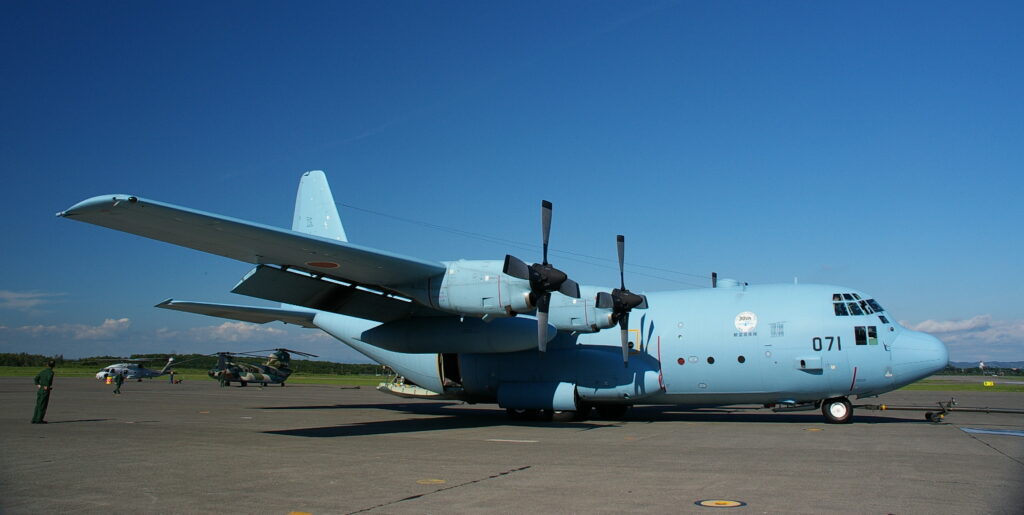
Tokyo is rearming at a pace unseen since WWII. The shockwaves are reaching Europe, forcing the Union to decide if it can keep up. (Hint: It cannot afford not to.)
When Chinese President Xi Jinping met US President Donald Trump in Beijing earlier in May, the most heated exchange of the two-day summit was not about trade, Taiwan or the South China Sea. It was about Japan. Mr Xi launched, Financial Times reports, an intense diatribe against Japanese Prime Minister Sanae Takaichi over her country’s “remilitarisation”. Notably, the subject had not even featured in preparatory talks between American and Chinese officials.
The episode was remarkable not only for its ferocity but for what it revealed. Tokyo’s defence build-up has become one of Beijing’s deepest strategic anxieties; and the reverberations of Japan’s military transformation now reach well beyond the Indo-Pacific. That includes the corridors of Brussels.
Legal tensions
Japan’s transformation did not begin with Ms Takaichi. Its roots stretch back to the post-war settlement, when the United States oversaw the drafting of a constitution that enshrined pacifism in Article 9. It renounced war as a sovereign right, forbidding the maintenance of land, sea and air forces. For decades, that clause shaped every aspect of Japanese foreign and security policy.
Yet as scholar Oliver Leicester of the European Army Interoperability Centre documents, the article was being quietly reinterpreted almost from the moment of its adoption. When Japan joined the United Nations in 1956, the UN Charter’s guarantee of the right to self-defence, Article 51, created a legal tension. Japanese politicians resolved it in favour of maintaining a military force, the Japan Self-Defence Forces (JSDF), for defensive purposes.
The decisive political rupture came in July 2014, when the Cabinet of then-Prime Minister Shinzo Abe announced a significant reinterpretation of Article 9, allowing Japan to exercise collective self-defence. Specifically, it authorised the use force to protect allies if doing so was deemed necessary to protect Japan itself.
Russia’s full-scale invasion of Ukraine in 2022 then accelerated the process further. Prime Minister Fumio Kishida updated Japan’s National Security Strategy to recognise Russia as a threat to “the very foundations of the rules that shape the international order” and, in an unprecedented move for post-war Japan, approved the provision of lethal weapons to victims of aggression — including Patriot surface-to-air missiles instrumental to Ukraine’s defence. Japan was reorienting its post-war military posture in ways that would have been unthinkable a generation earlier.
Replacing Pyongyang
A draft version of Japan’s 2026 defence white paper expresses “serious concern” over deepening military co-operation between Beijing and Moscow, and identifies China explicitly as Japan’s “greatest strategic challenge.” This is remarkable, as to top spot used to belong to North Korea for decades. Ms Takaichi has pushed that reorientation further still. “Japan must take the initiative in fundamentally strengthening its defense capabilities,” she told lawmakers in her first policy speech.
For the European Union, Japan’s transformation is not a distant geopolitical curiosity. It is a development with direct institutional, industrial and strategic consequences. The EU-Japan Security and Defence Partnership saw the light of day in November 2024. Writing in EUobserver, Europeum analyst Hugo Blewett-Mundy described the agreement as reflecting “Japan’s desire to become a major power in its own right within a new world of geopolitical competition”.
The formal architecture of that partnership is set out in the EU-Japan Security and Defence Partnership. The document is explicit about the stakes: “Europe and the Indo-Pacific are highly interconnected and interdependent. This interdependence has geo-political, economic, and security dimensions. The European Union and Japan face an increasingly challenging and interlinked security environment as demonstrated by unilateral attempts to change the status quo by force”.
The turning point
The partnership covers maritime security, cyber defence, hybrid threats, space, crisis management and defence-industry exchange. It also commits both sides to exploring a Japan-EU Agreement on the Security of Information. Mundane as it sounds, it is a prerequisite for classified intelligence sharing and, by extension, for any serious operational collaboration.
The European Defence Review has described Ms Takaichi’s February 2026 election victory as “a decisive turning point in Tokyo’s defence and security policy and, by extension, in EU-Japan cooperation,” arguing that it “marks a shift from symbolic alignment to potential operational integration between the EU and Japan — but only if Europe can match Japan’s pace.”
Russia is a threat to the very foundations of the rules that shape the international order. — Japan’s updated National Security Strategy
The review’s authors, Attilio Caligiani and Colin Thompson of FGS Global, identify the core problem with precision: the EU lacks mechanisms that allow non-EU partners such as Japan to integrate into its defence industrial programmes at scale. “The EU does not need to redesign its entire defence architecture but rather fast-track mechanisms that allow trusted non-EU partners to participate in specific projects without requiring full institutional integration,” they write.
Capacity and opportunity
The defence-industrial dimension is where the EU-Japan relationship is most immediately tangible — and most structurally constrained. Japan and Italy formalised a special strategic partnership in early 2026, linking defence collaboration with economic security, critical minerals and supply-chain resilience. The Global Combat Air Programme (GCAP) brings together the United Kingdom, Japan and Italy to develop a sixth-generation fighter aircraft for deployment by 2035, and is projected to generate 40,000 high-tech jobs in Japan alone over a decade.
Mitsubishi Heavy Industries already co-develops and produces key components for the SM-3 Block IIA interceptor alongside US firms, and Tokyo and Washington have agreed to scale up annual SM-3 production to approximately 100 missiles to replenish depleted allied stocks. Ms Takaichi’s March 2026 summit with Mr Trump saw Japan commit to the Golden Dome initiative—a next-generation multilayered missile-defence system—shifting Tokyo from passive beneficiary to front-line contributor in allied missile defence.
Employment in Japan’s defence manufacturing sector rose approximately 15 per cent between 2024 and 2026. Arms-export liberalisation, formalised in 2025, moved Japan from a highly restrictive case-by-case model to a more permissive regime allowing exports of a broader range of lethal equipment to allied and like-minded partners.
Frictions abound
A 2026 frigate upgrade programme for Australia, delivered through Mitsubishi Heavy Industries, is among the first concrete results. Japan’s defence build-up also delivers a short-run GDP boost of approximately 0.2 percentage points in 2026, though crowding-out risks emerge if private investment faces capacity constraints.
For the EU, the opportunities are real but so are the frictions. Industrial competition could intensify as Japanese firms such as Mitsubishi Heavy Industries and Kawasaki compete directly with Airbus, Leonardo and Thales in third-country markets. Technology-transfer concerns may limit co-operation, with Japan cautious over intellectual property and European partners wary of asymmetric dependencies.
Japan must take the initiative in fundamentally strengthening its defense capabilities. — Sanae Takaichi, Japan’s prime minister
China’s rare-earth export restrictions—deployed as economic leverage against Tokyo—are a reminder that deeper EU-Japan industrial integration also carries escalation risks. Beijing has already signalled that it views closer EU-Japan defence ties as a form of containment.
The EU’s structural problem
The EU’s ability to respond to Japan’s offer of partnership remains constrained by institutional design. Defence industrial integration is divided across 27 member states, with duplicated programmes, no common procurement budget and no streamlined mechanisms to integrate non-EU partners at scale. The result, as the European Defence Review puts it, “is not inefficiency but institutional incapacity.”
The operational dimension of the relationship is already developing, even if the institutional framework lags behind. In October 2025, Japan sent Air Self-Defence Force F-35s to Germany and the United Kingdom in a deployment dubbed “Atlantic Eagles” — the first such trans-regional exercise, mirroring the UK Carrier Strike Group’s 2025 port call to Yokosuka. EU member states including France, Germany, Italy and Spain regularly deploy frigates or aircraft to Indo-Pacific exercises with the JSDF.
The EU-Japan Security and Defence Partnership explicitly commits both sides to “promoting concrete naval cooperation, including through the Administrative Arrangement between the EU’s Naval Force Atalanta and the Japanese Self Defence Forces” and to “developing cooperation on maritime security through activities such as joint exercises, port calls, among others.”
Sino-Russian rapprochement
The EUobserver noted in January 2025 that “the security of Europe and of the Indo-Pacific are becoming increasingly interlinked as Russia and North Korea start to collaborate with one another,” and that “the deployment of North Korean soldiers in Russia indicates that a shared long-term interest exists between Moscow and Pyongyang to challenge US primacy in international affairs.”
That assessment has only hardened since. Japan’s 2026 defence white paper expresses serious concern over military co-operation between Beijing and Moscow. It is a concern that European capitals share entirely.
The window for deeper EU-Japan defence integration is open, but it will not stay open indefinitely. Ms Takaichi’s consolidated political leadership provides stability and continuity on the Japanese side. Constitutional sensitivities around Article 9, divided public opinion on militarisation, and budgetary pressures from an ageing economy will shape the pace and scope of Japan’s defence expansion.
Time limited
The Agreement on the Security of Information, which would unlock classified collaboration, remains unsigned. Fast-track mechanisms for non-EU industrial partners do not yet exist. Co-development priorities—missile defence, unmanned systems, maritime surveillance—have been identified, but not yet funded. The European Defence Review is direct in its assessment: “Without these steps, EU-Japan defence cooperation will remain politically ambitious and operationally hollow. The opportunity is real, but it is time limited. Europe’s choice is not whether to engage Japan, but whether it can move fast enough to make that engagement matter.”
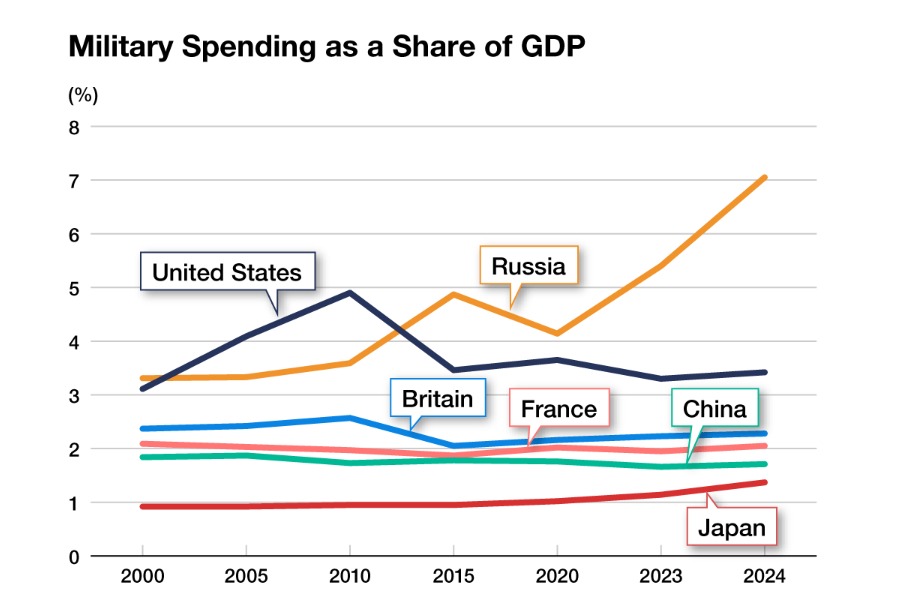
The numbers are striking. Japan’s FY-2025 defence budget reached ¥7.96tn (approximately $55bn), the third consecutive annual rise under a five-year plan to double spending. The FY-2026 budget, approved by Cabinet at ¥9.04tn (approximately $58bn), represents a year-on-year increase of 9.4 per cent and brings spending to 1.95 per cent of projected GDP, effectively hitting the two per cent target ahead of schedule.
The procurement agenda is equally ambitious. Japan has accelerated the purchase of US-made Tomahawk cruise missiles and is upgrading its domestic Type-12 missile to a range of 1,000 kilometres. It is procuring MQ-9B Sea Guardian drones and has allocated ¥160bn to research and development for AI-enabled drones to accompany next-generation fighters.
China is the worry, not Japan
The Chinese are unhappy. Christopher Johnstone, a former top White House Japan official, drew a pointed conclusion from Mr Xi’s outburst. “Xi’s lack of self-awareness is remarkable. His own actions are accelerating the emergence of a much stronger Japan,” Mr Johnstone told the Financial Times. He added: “China’s anti-Japan rhetoric has no constituency beyond its own borders… Tokyo is strengthening security ties with partners across the region—including Australia, the Philippines and even South Korea—all of whom worry far more about an aggressive China than they do a ‘remilitarising’ Japan.”
(The agreement with EU) reflects Japan’s desire to become a major power in its own right within a new world of geopolitical competition. — Hugo Blewett-Mundy, Europeum
Mr Trump, for his part, responded that Tokyo had to take a more assertive security stance because of the rising threat from North Korea. It remained unclear whether he mentioned China, Japan’s primary security concern, in the same context.
China’s foreign ministry was blunter still. “Japan’s defence budget has been increasing for 14 consecutive years, but Japanese right-wing forces are still clamouring for increasing defence spending,” it said, adding that Japan’s “country for peace mask is coming off and it is slipping towards neo-militarism.”
Weird math
Beijing’s complaint sits awkwardly alongside its own record: China, the world’s second-largest military spender, raised defence spending last year by 7.4 per cent to $336bn. It marks 31st consecutive annual increase, according to the Stockholm International Peace Research Institute. To put that figure in perspective, Japan spent $62bn over the same period.
Mr Xi’s diatribe in Beijing, whatever its intent, is making Tokyo’s choice more urgent. By railing against Japan’s remilitarisation in front of Mr Trump, he demonstrated precisely why Tokyo is diversifying its partnerships. And why Brussels, for all its institutional inertia it has been trying to overcome, cannot afford to be left behind.