A long-awaited EU expert report recommends a phased digital childhood: no independent access to “social media+” before the age of 13 and greater autonomy as children grow older. It also puts the responsibility on digital companies to make their services safer for minors.
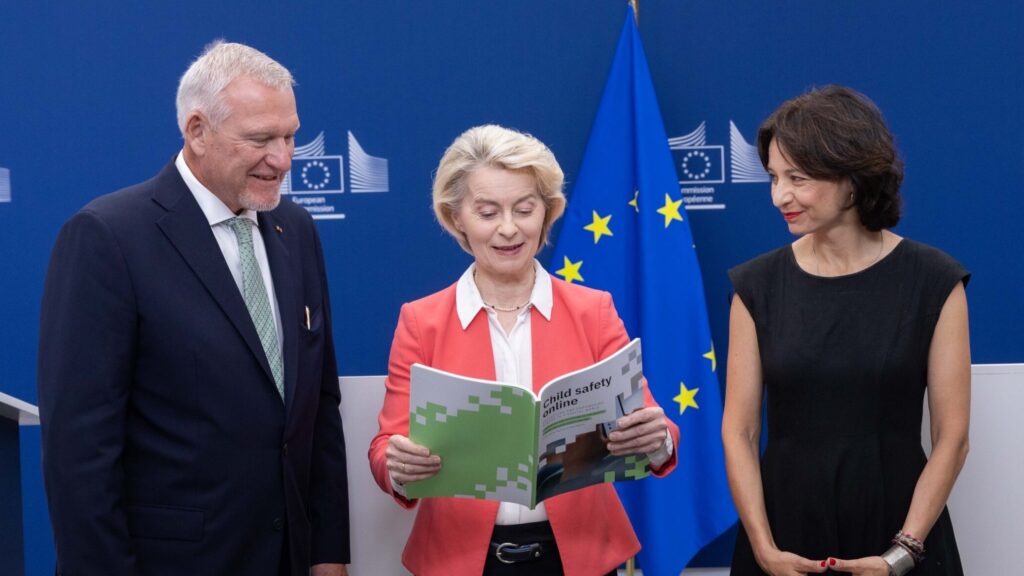
Commission President Ursula von der Leyen said that the Commission will present proposals after the summer for age-appropriate access to social media. “This report comes during a unique window of opportunity. We have heard from parents, educators, experts, and young people themselves. We have heard the experience from partners as well as our member states. Now we need action at European level,” she said.
During her 2025 State of the Union address, Von der Leyen announced the creation of the expert panel. On Monday, after roughly three and a half months, its two co-chairs, Professor Jörg M. Fegert, Medical Director of the Department of Child and Adolescent Psychiatry, Psychosomatics and Psychotherapy at the Ulm University Hospital, and Dr Maria Melchior, Research Director at the French National Institute of Health and Medical Research, shared the final recommendations following consultation with the wider group of experts.
Different age, different access
The report does not treat everyone under 18 the same. They propose a gradual transition towards digital autonomy. “I believe we need to consider phased and gradual access for different age ranges,” Ms Von der Leyen commented.
For children from birth to the age of two, parents and caregivers are advised to avoid screen use. Between the ages of three and five, digital devices should be used only with an adult present, limited in time and restricted to age-appropriate material. From six to nine, social media and video games should still be used only with parental consent and supervision, with time limits, age-appropriate content and parental controls.
The period between 10 and 12 is treated as particularly sensitive. Online participation becomes increasingly important socially, but children remain vulnerable. The report therefore recommends that children under 13 should not have independent access to social media+. But that’s also where one of the proposal’s main practical challenges is: parental supervision is uneven. Some parents have more time, digital knowledge, and confidence than others.
From age 13, adolescents should gradually gain more independence. At this stage, direct parental control becomes less effective, while guidance, conversation, media literacy and safer platform design become more important. Many major platforms already limit users under 13, like Meta. But such terms are frequently circumvented or poorly enforced.
Between 16 and 18, older adolescents should generally be able to use age-appropriate digital services more autonomously, while continuing to receive guidance and having easy access to support and complaint mechanisms. At 18, users would reach full digital autonomy.
Along with age limits, the report calls for online services to be safe by design for everyone, looking at harmful features such as infinite scrolling, autoplay, push notifications and problematic personalised recommendations.
“Social media+” goes beyond traditional platforms
The study recommendations go beyond social media. They use the term “social media+” to describe all digital services that may expose minors to inappropriate content. It can include app stores, video-sharing services, certain video games, and potentially risky artificial intelligence systems, like AI companions. For example, gaming platforms can combine addictive mechanics with the risk of sexual grooming.
Ms Von der Leyen has presented the issue as a question of scale and urgency. She said young people across Europe spend between four and six hours a day looking at screens. Parents see the consequences in the form of lost sleep, depression, anxiety, cyberbullying and exposure to harmful material. “This is not about whether children can access social media. It is about whether and when social media can access our children,” she said.
A fragmented digital age
A common minimum standard would reduce fragmentation in the single market and guarantee children a baseline level of protection wherever they live. However, EU member states are already moving in different directions.
France has pursued a threshold of 15. Greece has announced plans for an under-15 restriction, while Denmark has considered a higher threshold with possible parental exceptions. Germany, Austria, Sweden, Spain and parts of Belgium have also debated or developed different models.
The report is already generating reactions from the political groups. Renew is calling on the Commission President to declare social media a public health emergency and act on the report’s recommendations. “The real answer must be European: a harmonised digital majority, not 27 different approaches that, in reality, would primarily benefit Big Tech. I call on president Von der Leyen to transform this observation into a concrete legislative proposal as quickly as possible,” said MEP Veronika Cifrová Ostrihoňová (Renew/SVK)
“Europe believe that parents bring up our kids, and not predatory algorithms. To that end, let me be very clear: social media is not a toy. While ultimately it is up to parents to decide when children get their first smartphones, what we already have is a consensus that there needs to be a start date for the age children can join social media,” the Commission President stated.
This could create different levels of protection for children, practical enforcement difficulties and higher compliance costs for digital providers. Its proposed solution is a common European floor: no independent or unsupervised access to social media+ below 13. Member states could still introduce higher precautionary thresholds for adolescents, reflecting differences in national culture, education and digital-literacy policy.
Age verification without mass identification
A system requiring every European to upload a passport, identity card, or facial scan to several private companies would create serious privacy and security risks. It could also hand social media platforms even more information about their users.
The panel recommends that age checks should not require platforms to process identity documents or biometric data for age estimation. It specifically endorses zero-knowledge proofs: cryptographic methods that allow a system to confirm that someone meets an age threshold without revealing their identity or precise date of birth.
The Commission presented its own open-source age-verification in April as technically ready. However, its security was quickly exposed as weak. Security researcher Paul Moore demonstrated that the application could be compromised in under two minutes by modifying its configuration.
The lesson from Australia
Australia offers Europe inspiration and a warning. They were the first country to approve legislation preventing under-16s from holding social media accounts.
But early findings suggest the measure is not being effective, with more than four in five under-16s continuing to use social media three months after the restrictions took effect. Children can enter a false date of birth, use another person’s account, open a secondary profile or migrate to a service outside the law’s scope.