Your data stored in the cloud is most likely sitting on American servers. Under US law, Washington can access it at any time, without your knowledge. After three delays, the European Commission is set to present its Tech Sovereignty Package on 3 June, aiming to break Europe’s digital dependence.
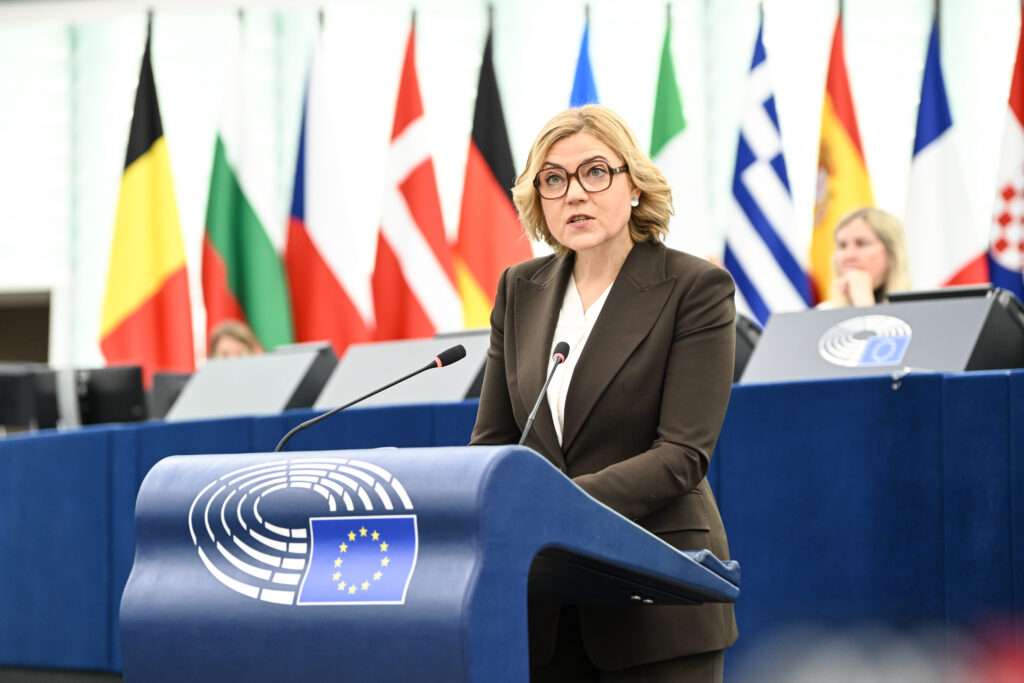
Speaking at an event marking the twentieth anniversary of .eu, European Commission Vice-President Henna Virkkunen warned that the EU depends on non-EU countries for more than 80 per cent of its key digital products, services, infrastructure. “Europe remains too dependent on technologies developed and controlled elsewhere than in Europe,” she said. “This is clearly an economic vulnerability, a security vulnerability, and increasingly also a strategic vulnerability.”
The Tech Sovereignty Package has already been postponed several times. It was first expected in March, then moved to April, later to 27 May and now to 3 June. The delays have given the file more political weight, especially as Brussels tries to reduce its dependence on US and Asian technology. Ms Virkkunen insisted that sovereignty should not be read as isolation or as “closing ourselves off”. “Reducing unhealthy dependencies does not weaken the open internet,” she said.
Sovereignty means AI, chips, and cloud
Cloud is likely to be one of the most politically sensitive parts of the package. AWS, Microsoft Azure, and Google Cloud hold about 70 per cent of the EU cloud infrastructure market. EU providers account for roughly 13 per cent. Another constraint is that under the US CLOUD Act, US-based providers can be compelled by American authorities to provide data even when it is stored outside the United States, including in Europe.
Ms Virkkunen said the Cloud and AI Development Act will define what “sovereign cloud” means. For the most sensitive sectors, European control and data localisation will not be optional. “When we speak about very critical services of our economies, we have to be able to control the information and data under services in all circumstances,” she said.
The chips element builds on the Chips Act. The EU’s target is to double its global semiconductor market share to 20 per cent by 2030, but Europe’s dependence on external suppliers remains a weakness. Chips Act 2.0 should reinforce the semiconductor ecosystem and supply-chain resilience.
Europe has around 8,000 AI start-ups, Ms Virkkunen said, but many lack access to computing capacity. To address this, the EU and member states are investing in 19 AI factories. “We have everything that is needed to be very competitive in AI,” she said, while acknowledging that Europe still struggles to turn research into scale-ups. “Last year, 50 per cent more businesses were using AI than the year before,” she added.
Open source enters the package
Ms Virkkunen called open source a “key part” of the package, saying the Commission wants to use it “more strategically”. “Using open-source technologies, we can really boost our own homegrown technologies and our companies in the European Union can get great tools by that,” she said.
The good news is that we have a lot of capital in the European Union. We have more than 30 trillion euros only in the bank.
— Henna Virkkunen, European Commission Vice-President
Ms Virkkunen said Europe does not lack money. “The good news is that we have a lot of capital in the European Union. We have more than 30 trillion euros only in the bank,” she said. The problem, she argued, is that savings are not being channelled into investment. In Nordic countries, she said, more than 50 per cent of households invest in stocks or funds. In some large member states, the share is only around two per cent.
The speech was delivered at EuroDIG 2026, where .eu now counts 3.8 million registrations, making it the fourth largest country-code domain. Ms Virkkunen called it “a very concrete example of European digital sovereignty in practice”. Questions from the floor were brief; the session closed quickly for a family photo.