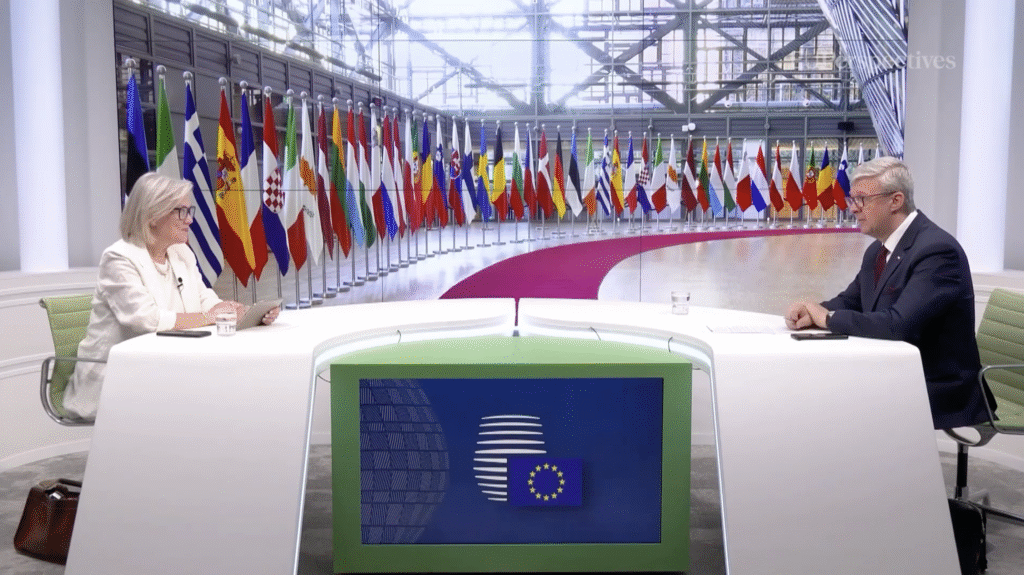
Europe finds it ever harded to compete globally. The Union must abandon its social model to revive its mojo, Karel Havlíček, Czechia’s deputy prime minister and minister for industry and trade, told the EU Perspectives’ Podcast recorded in the EU Council in Brussels.
The numbers are unforgiving. The European Union’s share of global GDP stands at 16 per cent. The United States accounts for 27 per cent. China, once comfortably behind, has now drawn level with Europe. Karel Havlíček, the Czech minister for trade, does not dress this up. “We are losing the competitiveness,” he told EU Perspectives host Jennifer Baker in a recent podcast recorded in Brussels.
Mr Havlíček’s diagnosis is blunt: Europe has relied too long on a social model that once gave it an edge but now holds it back. “We have to move from the European social system,” he said. “I understand that the system was, let’s say, the competitive advantage in the past. But we have to move much more to the market-oriented system and, of course, deregulate Europe, change the crazy system of the subsidies.”
A voluntary fix
The conversation ranged across several of the EU’s most contested reform proposals. It featured the 28th regime, the Industrial Accelerator Act, trade relations with the United States, and the United Kingdom’s place in Europe’s industrial future. On each, Mr Havlíček struck a pragmatic tone, supportive of the broad direction but insistent that the details matter enormously.
We have to move much more to the market-oriented system and, of course, deregulate Europe, change the crazy system of the subsidies. — Karel Havlíček, Czechia’s trade minister
The so-called 28th regime is a proposal to give businesses a single, unified regulatory framework they can opt into across the EU, instead of navigating 27 separate national systems. It drew qualified support from Mr Havlíček. He stressed one feature above all others. “It’s great because it’s voluntary,” he said. “From my perspective, it’s an extremely important message.” The Czech government has already approved the regime at cabinet level and is now working through the detail across individual ministries.
He did not ignore the risks. Any unified framework raises questions about member-state vetoes, and Mr Havlíček was clear that those must be respected. “There is a small threat to, let’s say, the veto,” he said. “That’s what we have to respect and we cannot underestimate it.” Still, his overall assessment was positive. “From the point of view of business, it’s a good step.”
The broader context is one of mounting frustration among European companies with regulatory complexity. Small and medium-sized businesses, Mr Havlíček argued, bear the heaviest burden. “I come from small and medium business,” he said, “and I perfectly know that the medium-sized or small companies are totally frustrated of the system, of the regulation.”
Energy prices drive companies away
On the Industrial Accelerator Act—the Commission’s attempt to build a ‘Made in EU’ industrial identity—Mr Havlíček was broadly supportive but pointed to a problem the legislation must address if it is to mean anything: energy costs. European companies are relocating to the United States, China and Indonesia. The reason, he said, is straightforward. “The energy prices are extremely, extremely high in Europe. And that’s what we have to change.”
For the Czech Republic, the answer lies in a balanced energy mix — one that combines what the minister called “unstable sources”, meaning renewables, with stable ones, above all nuclear power. He recalled presenting Prague’s nuclear programme to the European Commission several years ago and being told the technology was a relic of the past.
The mood has shifted sharply. “The same institutions,” he said, “are declaring it is the resource of future.” He cited Germany’s new Economics Minister Katerina Reiche as a sign of the change: she has indicated readiness to collaborate on small modular reactors. Mr Havlíček wants the Industrial Accelerator Act to reflect this shift and to “very specifically support the investment in nuclear”.
The engine must be private
Ms Baker noted that any new industrial framework must also be future-proof. COVID-19 and the war in Ukraine both arrived without warning and reshaped energy policy overnight. Mr Havlíček agreed, adding simply: “Energy crisis.”
Perhaps Mr Havlíček’s most consistent theme was the proper role of government. States and the European Commission, he argued, are not the source of economic growth and should not try to be. “Private sector must be the engine of the economic growth,” he said. “Not the governments, nor the states, nor the European Commission.”
First we need to support the business sector. Then we can collect the taxes. — Karel Havlíček, Czechia’s trade minister
The job of governments is narrower: “To create a comfortable environment for the business sector, which will be generating revenues, profits, added value.” Tax receipts follow from that. Only then can governments invest in defence, infrastructure or social programmes. “First we need to support the business sector,” he said. “Then we can collect the taxes.”
He praised the Antwerp Declaration—a document drawn up by business associations and major industrial producers—as the genuine precursor to the later Mario Draghi report on EU competitiveness. The private sector, he implied, had identified the problems first. Strengthening production capacity across energy, chemistry, agriculture, defence and machinery, and embedding new technologies—artificial intelligence, hydrogen, semiconductors—into those sectors, is the path forward.
Bringing London back in
On the EU–US trade relationship, Mr Havlíček was measured. He credited Maroš Šefčovič, the EU’s lead negotiator, with doing “a good job” and praised Europe’s ability to adapt to Washington’s more transactional style. “We can adapt on the US requirements and the style of communication,” he said, noting that the same shift applies to dealings with China. Adaptation, he suggested, is not capitulation — it is realism.
His most striking remarks concerned the United Kingdom. The minister described it as “a great trading partner” and “an extremely strong economy for Europe”. He acknowledged that Britain is no longer an EU member and does not enjoy the same conditions as member states.
But Mr Havlíček argued that it should nonetheless be included in future ‘Made in Europe’ projects. “They are an extremely important partner in automotive business, extremely important in energy business,” he said. “I hope and I recommend that the UK be part of the prepared projects called Made in Europe.”
It was a telling note on which to end: a minister from a country that joined the EU in 2004 arguing that the bloc’s industrial future may depend, in part, on pulling closer to the country that chose to leave it.