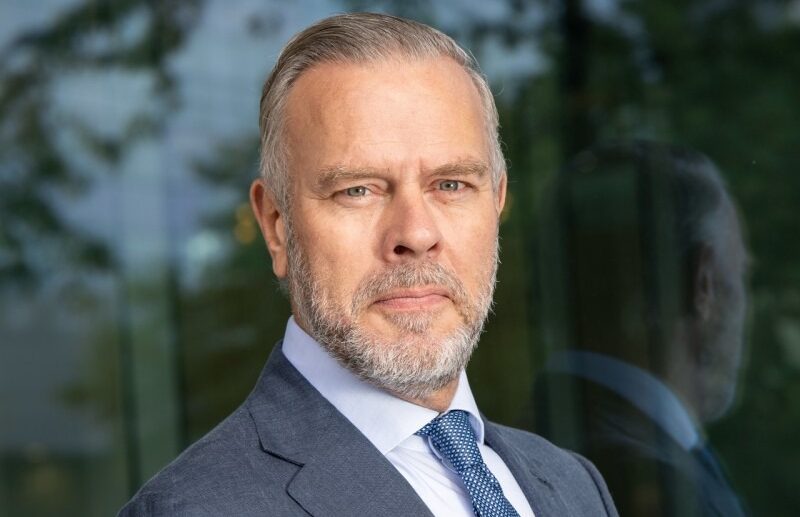
The phrase “we are supporting Ukraine for as long as necessary” is not a strategy unless we say to what end, former NATO military chief told the European Parliament’s defence committee on Thursday in an unusually blunt exchange.
Europe is just beginning to grasp what actual defence requires, the 4 June session of the Security and Defence Committee (SEDE) of the European Parliament heard during a debate that felt like a reality check. Admiral Rob Bauer, former Chairman of the NATO Military Committee (and the Alliance’s highest-ranking soldier), and Martin Sklenár of the Bratislava-based think tank GlobSec laid out the scale of the challenge.
The opening shot came from MEP Nicolás Pascual De La Parte (EPP/ESP), who argued that Europe still lacks a coherent strategy. Without a European peace plan and a post-war policy towards Russia, he said, mobilising military capabilities remains an exercise without a destination.
Strategies that do (not) exist
Admiral Bauer was direct in his reply. “I do not agree with you that we didn’t, or don’t, have deterrence. We do,” he said. “NATO deterrence worked.” He added that Russia’s invasion of Ukraine had nothing to do with any failure of NATO deterrence. “The reason why Russia attacked Ukraine was because they were afraid and are afraid that Ukraine is moving towards a democracy. That’s the only reason.”
Mr Bauer acknowledged one gap. The phrase “we are supporting Ukraine for as long as necessary” is, he said, “not a strategy, because we can’t answer the question: to do what, to what end?” There is, he conceded, “not a strategy to have Ukraine win or to have Russia lose.”
But he was equally clear that a military strategy for collective defence does exist, built from 2018 onwards and formalised at the Hague summit through agreed capability targets. He described these as a “shopping list per nation,” covering personnel, sensors, weapon systems, and ammunition across NATO’s three defined regions.
Mr Sklenár added a sharper historical frame. “The Russians have answered for us the question,” he said of the question of post-war relations with Moscow. “No matter how the conflicts end up, they will be always looking for more aggressive actions.” He saw no return to the “very idealistic and naive basis” that previously governed Europe’s relationship with Russia.
The weight of 1.3 million
MEP Sven Mikser (S&D/EST) pressed on deterrence mathematics. Russia has absorbed several hundred thousand casualties and kept fighting, a far cry from the roughly 15,000 to 16,000 killed in Afghanistan that once proved a breaking point. How, he asked, should Europe recalibrate the cost-benefit logic of deterrence when the adversary’s tolerance for loss appears almost boundless?
(Russia has) actually 1.3 million killed and seriously wounded. If we had 100 a week, we would have a serious debate in all the parliaments in our nations. — Admiral Rob Bauer, ex-Chairman of the NATO Military Committee
Mr Bauer did not soften the answer. “It is actually 1.3 million killed and seriously wounded,” he said of Russian losses, “an amazing amount of people where, if we had probably 100 a week, we would have a serious debate in all the parliaments in our nations.” The implication was plain: Europe’s political pain threshold and Russia’s are not comparable.
He also rejected the notion that Europe remains at peace. “We are partially at war in cyber, we are at war in disinformation in the last couple of years,” he said. “It is rather naive to continue to believe that we have peace in Europe.”
Why would Putin stop now?
The admiral outlined three reasons why Russia has no incentive to stop fighting: a war economy that would collapse without conflict, the failure to achieve any strategic goal, and the domestic chaos that 700,000 returning soldiers would bring. “Putin actually needs the war to continue his autocracy,” he said.
Mr Bauer also addressed why Russia’s aggression does not prove NATO is a threat. “If we are a threat, NATO to Russia, they should have responded completely differently to the accession of Finland. They didn’t send one soldier to the Finnish border, not one.”
MEP Pierre-Romain Thionnet (PfE/FRA) raised the question that hovered over the entire session: American disengagement. He noted a US Department of Defence press statement on revising Washington’s contribution to NATO and asked how that should reshape European force planning.
America, Europe, and a shifting balance
Mr Bauer turned the framing around. “It’s fascinating when people talk about the Americans disengaging from Europe,” he said. “I think Europe disengaged from the US for more than 30 years by not doing what they promised for 30 years.” The Hague capability targets, he argued, are precisely the mechanism to correct that.
No matter how the conflicts end up, (Russia) will be always looking for more aggressive actions. — Martin Sklenár, GlobSec
“If we do what we have promised, then Europe is becoming more capable, and in numbers, but also in quality and types of weapon systems that now only the US has,” he said. He placed the American recalibration in a wider context. “Everything we see in the world is about the tectonic plates of power that are shifting,” he said. “If tectonic plates shift, you have earthquakes. And if the tectonic plates of power do that, you have conflicts and wars.”
Mr Sklenár agreed that recalibration need not mean a capability gap. Eastern flank countries, he noted, cannot match Russia and Belarus by themselves, which is “the main case for collective defence in Europe.” But he added that European nations are close to replacing specific US capabilities being considered for withdrawal, and that “the collective defence as it stands, the requirements will be covered.”
Industry, land, and the long horizon
MEP Mārtiņš Staķis (Greens-EFA/LVA) identified what he called a “chicken and egg” problem: industry demands long-term guarantees before expanding capacity, yet the security environment makes sustained demand obvious for decades. Mr Sklenár was precise. “The only guarantee that they accept is the contract,” he said. He noted that average lead times of 5.2 years mask companies with eight-to-ten-year delivery backlogs.
He argued that the demand signal must reach sub-prime suppliers, not just large integrators. If contracts keep stacking up at the prime level, “delivery times will be longer and longer, which is a very good situation for the main companies,” he said, “but it doesn’t fit with the urgency that we feel is necessary now in the environment.”
MEP Lucia Yar (Renew/SVK) asked how a strategic public-private partnership could help overcome the protectionist instincts of large member states, including France and Germany. Mr Sklenár described a new relationship in which governments do not merely procure products but “buy the relationship”. That means a continuous innovation partnership, scalable rapidly when needed, modelled in part on what Ukrainian drone producers have demonstrated on the battlefield.
The reality check Europe needs
Mr Bauer framed the industrial challenge in explicitly societal terms. “If there is no security and stability, there is no economy,” he said. He pointed to a concrete model for faster factory construction: governments acquire land, arrange permits, and offer plots to industry in advance. “The moment the peak demand signal comes, here is the piece of land you can have your factory on, there’s all the permits, go,” he said. “Then they build a factory, they find the people, they find the latest and greatest tools, and they start producing probably within a year and a half instead of six years.”
Mr Bauer’s closing argument was the sharpest. Europe’s assumptions about economic interdependence preventing war were not just wrong, they were a category error. “The way we thought about the world is how we would like it to be instead of how it actually was,” he said. “There’s bad people out there. We need to protect ourselves against it.”
It’s fascinating when people talk about the Americans disengaging from Europe. I think Europe disengaged from the US for more than 30 years by not doing what they promised, for 30 years. — Admiral Rob Bauer
On drones, he cautioned against treating them as the whole story. “Drones themselves are not the innovation, it is the AI, it is the software,” he said. He also warned against assuming NATO would fight Russia as Ukraine has had to. “We will, on the first day, attack the drone factories in Siberia if we’re smart,” he said. “Ukraine was unable or was not allowed to do that. So we will fight the Russians differently.”
The session ended without resolution, but with unusual clarity about what the problems are. Europe has a military strategy. It has money. It has, at last, a capability target list. What it still lacks, as Mr Bauer made plain, is the habit of acting on what it already knows.