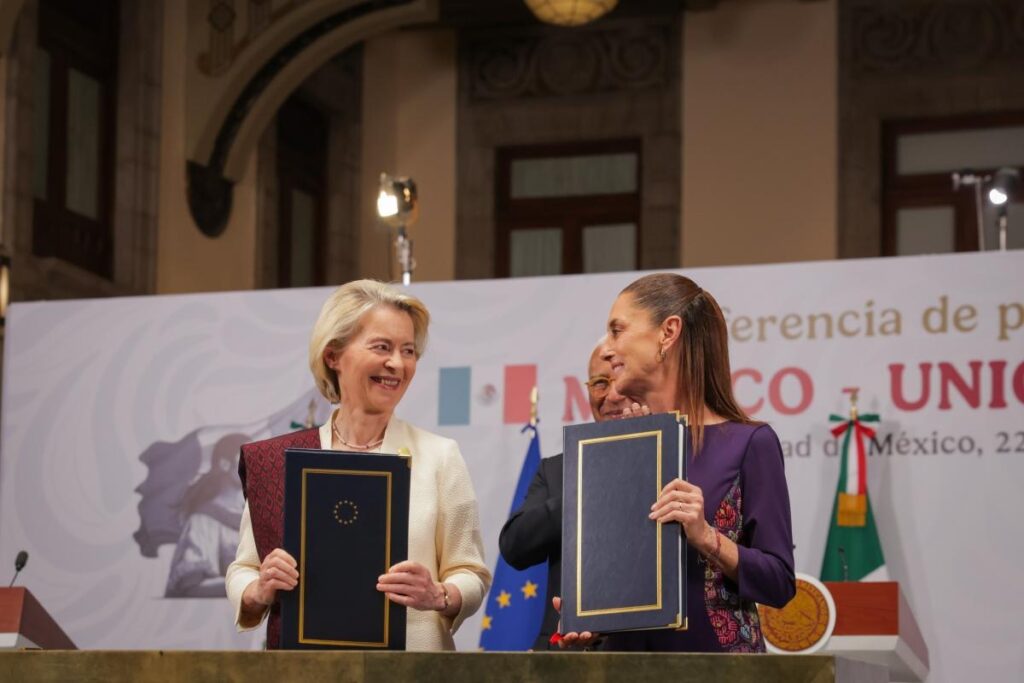
The EU and Mexico signed their modernised trade agreement to considerable fanfare. But beneath the proclamation of economic diversification is a shadow of what the deal set out to do almost a decade ago. Now, the two sides are offering each other less than they once hoped, but are bound by fear of American instability.
At the May EU-Mexico summit — first one in more than a decade — the EU and Mexico signed their Modernised Global Agreement. The new agreement expands the 2000 trade deal, which covered only industrial goods, to include services, government procurement, digital trade, investment and farm produce.
“The goal here is very simple: we want to create more jobs and more value on both sides of the Atlantic,” European Commission President Ursula von der Leyen said at the Summit.
It’s a very watered down agreement compared to what was negotiated in 2018.
— Dr. Lorena Ruano Gómez
She was not alone in singing praises. “The EU-Mexico Agreement comes at exactly the right time,” said MEP Anna Stürgkh (Renew/AT). “Europe must become more independent and reduce strategic dependencies, and stronger trade partnerships with like-minded countries are an essential part of that effort,” she said.
New deal old deal
But experts paint a different picutre. “It’s a very watered down agreement compared to what was negotiated in 2018,” said Dr. Lorena Ruano Gómez, a Spanish-Mexican professor of international relations at Universidad Complutense de Madrid who has studied the agreement for years.
The agreement Brussels is now hailing is, in large part, an old one. Negotiations to modernise the 2000 deal launched in 2016 to come to terms with the relationship that now existed in the context of the Lisbon Treaty’s expansion of EU investment powers, the rise of digital trade, and a wave of newer agreements both sides had signed with other partners, such as the EU’s deal with Canada and Mexico’s entry into the Comprehensive and Progressive Agreement for Trans-Pacific Partnership (CPTPP).
For the EU, the central prize was the liberalisation of Mexico’s energy sector, opened to private investment under President Enrique Peña Nieto’s 2013 reforms. A more independent competition watchdog for the long-monopolised telecommunications sector was another draw.
At a time when authoritarian regimes are increasingly using trade and critical resources as political leverage, Europe needs strong partnerships with democratic allies.
— MEP Anna Stürgkh (Renew/AT)
That prize, however, is now largely gone. In March 2025, President Claudia Sheinbaum enacted a reform reversing the 2013 liberalisation and restricting private participation, reserving at least 54% of grid electricity for the state utility. The final round of EU-Mexico talks, concluded in January 2025, was explicitly reopened to accommodate those energy reforms.
Between then and now, the deal was stuck. It reached its first “agreement in principle” in April 2018, months before Andrés Manuel López Obrador won Mexico’s presidency, though the terms on public procurement were not settled until 2020. Under López Obrador, who was not a fan of Mexico-EU relations, the deal drifted for his six-year term. Sidelined first by his focus on renegotiating the United States-Mexico-Canada Agreement (USMCA) with Washington, then by the pandemic, and finally by the energy reform that forced negotiators back to the table.
In February 2022, he called for a “pause” in relations with Spain — Mexico’s largest European investor — accusing Spanish energy firms such as Repsol and Iberdrola of committing actions reminiscent of the colonial-era plunder. Spain rejected the comparison. López Obrador then set off unwinding the 2013 energy reforms that had drawn Europe back to the table. By the time he left office in 2024, that counter-reform was bound for the constitution, where his successor would lock it in.
What made it
Mexico’s Economy Ministry projects the deal could lift Mexican exports to the EU from around €21 billion a year to €36 billion by 2030. In the past decade, trade between the two has nearly doubled, from €43.6 billion in 2014 to €82.3 billion in 2024 — though the balance tilts toward Brussels, which runs a goods surplus of close to €24 billion.
A second look at the numbers, however, exposes the limits of what either side can realistically expect. The EU accounts for 7.4% of Mexico’s trade, behind China at 11.5% and far behind the United States at 60.8%. No agreement can change that quickly.
The three things that made Mexico so attractive are no longer there.
— Dr. Lorena Ruano Gómez
But the agreement does advance a lot. It creates duty-free treatment for nearly all goods, opens Mexican agricultural markets from the previous tariffs, gives first-time access for European firms to state-level public procurement, and protects hundreds of EU food and drink names. The European Parliamentary Research Service calls it a way to “enhance their supply chain resilience and hedge against the unpredictability of their most important trading partner.”
Ruano is sceptical of the potential scale this deal really offers. “I don’t think that diversification is gonna happen very much,” she said. The existing agreement was already substantial, it kept Europe’s share of Mexico’s foreign trade from falling.
The real prize she describes, was always investment. “That doesn’t come from an agreement, it comes from Mexico being an attractive place to invest,” she said. “And that is no longer the case.”
Backsliding Mexico
In 2024, Mexico passed a sweeping judicial overhaul that made judges at every level stand for popular election, removing the courts of their independence and leaving them exposed to political pressure including from the cartels.
By May 2026, credit rating company Moody’s cut Mexico’s credit rating to Baa3, the lowest rung of investment grade, citing a weakening fiscal position and pushing the country a single notch above junk status.
“The three things that made Mexico so attractive are no longer there,” Ruano said. “You don’t have legal security, you don’t have security, and access to the American market is no longer clear.”
The Trump effect
Why this deal has sailed through now is primarily due to Trump. Mexico sends roughly 80% of its exports to the United States and is locked in a fraught renegotiation of the USMCA. The EU is similarly exposed, spending the last year absorbing tariff threats from a second Trump administration.
A deal that had gathered dust for the better part of a decade suddenly became useful — not for its economics but for its signal. “At a time when authoritarian regimes are increasingly using trade and critical resources as political leverage, Europe needs strong partnerships with democratic allies,” said MEP Stürgkh.
USMCA Access?
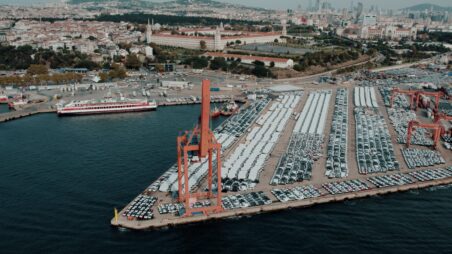
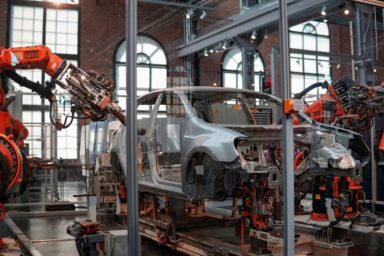
One of the more concrete cases for the deal, is the potential entry it offers for European business to the American market. European carmakers have manufactured in Mexico for decades to reach the US market duty-free, and one argument for the modernised agreement is that it lets European firms use Mexico as a production base inside the USMCA bloc.
But Ruano cautions that this logic may be narrowing. The USMCA is itself being renegotiated, and she expects its regional content rules — which currently let goods qualify as North American — to tighten toward US content specifically. Whatever advantage the EU won on autos, she argues, will count for little if Washington rewrites the rules of origin to favour American production.
When the energy chapter was reopened, negotiators also trimmed EU quotas for Mexican beef, poultry and ethanol, and adjusted local content rules to make it easier for European firms to export electric vehicles and batteries into Mexico than the other way around.
Yet, for all the limits of what the deal will deliver between Europe and Mexico, it does place Europe in a more advantageous position. With the Mercosur agreement now in provisional force, “the EU has free trade agreements with all Latin America except Cuba, Venezuela and Bolivia,” Ruano noted. “The US does not,” she says.
The most telling thing about the deal may not be what’s in it, but where it leaves Europe on a map the United States once expected to command.