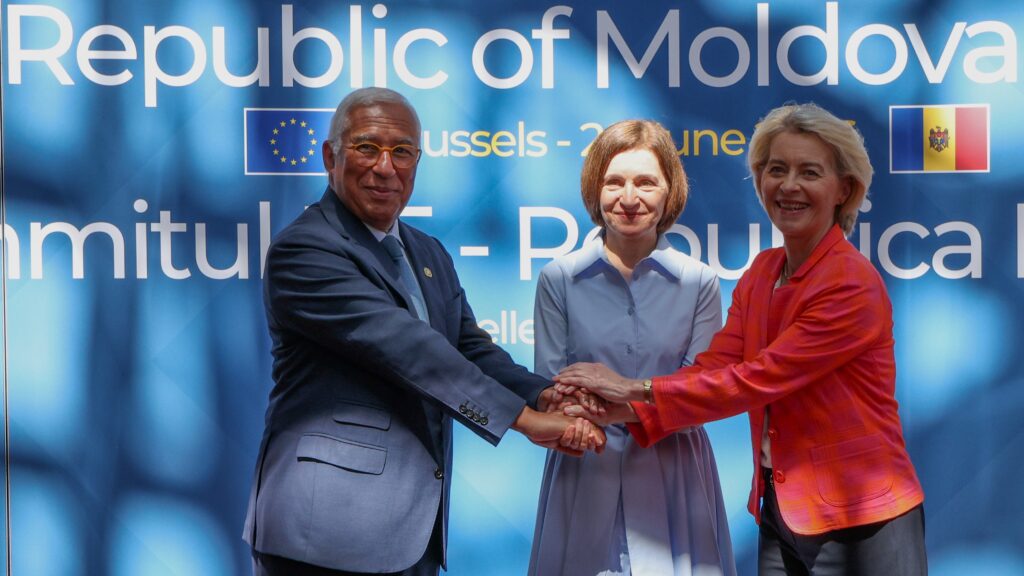
Moldova has already ticked off 93 per cent of the reforms on its road to the EU, and Brussels is now signalling that the final stretch could be covered at record speed. That was the underlying message from Monday’s summit, where the question of the country’s membership felt less like “if” and more like “how fast”.
Just a few years ago, Moldova was widely seen as one of Europe’s most vulnerable countries. It was among the continent’s poorest states, almost entirely dependent on Russian energy, and struggling with corruption and weak institutions. Today, Brussels is talking about Moldova’s future EU membership not as a possibility, but as a certainty.
The second EU–Moldova Summit, held in Brussels on Monday, delivered one of the strongest political endorsements yet of the country’s European trajectory. Coming just a week after the opening of the first cluster of accession negotiations, the meeting sent a clear message: the EU wants Moldova’s journey towards membership to keep moving at speed.
The people of Moldova have chosen Europe. — António Costa, European Council President
“Moldova’s place is in the European Union. The courage, determination and commitment of its people are bringing the country closer to our Union every day,” European Commission President Ursula von der Leyen declared after meeting Moldovan President Maia Sandu and European Council President António Costa.
The opening of the first negotiating cluster last week was hailed as a historic milestone. The Commission has already recommended opening all the remaining clusters, and throughout the summit EU leaders repeatedly stressed their desire to advance the process as quickly as Moldova’s reforms allow.
“The people of Moldova have chosen Europe,” Mr Costa said, praising the pace at which the country has met the conditions required for accession.
Ukraine changed Brussels’ calculations
Moldova’s reform efforts tell only part of the story. The summit made clear that Brussels now sees Moldova’s future membership through a much broader strategic lens. Russia’s war against Ukraine hovered over nearly every discussion, turning enlargement into a matter of security as much as economics or governance.
“Moldova’s security is Europe’s security,” Ms Von der Leyen said. According to the joint declaration, Moldova is on the “front line” of hybrid attacks linked to Russia’s aggression against Ukraine. EU leaders condemned cyberattacks, disinformation campaigns, energy coercion, and attempts to destabilise the country. The statement also mentions repeated violations of Moldovan airspace.
For Brussels, Moldova has become a test case in how Europe responds to pressure from Moscow beyond Ukraine’s borders. Mr Costa put it bluntly. “Enlargement is the most important geopolitical investment Europe can make,” he said.
Breaking free from Moscow
Energy security featured prominently throughout the summit, and for good reason. Few countries have undergone such a dramatic shift in such a short time. Ms Sandu reminded reporters that Moldova’s energy transformation would have seemed almost unimaginable only a few years ago. “Four years ago, Moldova relied entirely on Russia as its single supplier. Today we stand free of that dependency,” she said.
For decades, the country’s energy system was tightly tied to Moscow. Since Russia’s full-scale invasion of Ukraine, however, Moldova has accelerated efforts to connect with European markets, diversify supplies, and expand renewable energy.
President Sandu described the transformation in striking terms. “We turned our greatest vulnerability into a strength.”
The EU plans to deepen that shift. A key project is the Vulcănești–Chișinău high-voltage power line, which will strengthen Moldova’s energy security and further integrate the country into the European electricity market.
Reforms opening doors
European leaders repeatedly stressed that Moldova’s progress ultimately depends on Moldova itself. According to Ms Von der Leyen, the country has already completed 93 per cent of the reforms required so far under the EU-backed Growth Plan — a figure she called extraordinary.
On the rule of law, the change is real. — Maia Sandu, President of Moldova
Ms Sandu used the summit to showcase concrete results in justice reform and anti-corruption efforts. Moldova has climbed 25 places in Transparency International’s Corruption Perceptions Index over the past five years and improved its standing in global rule-of-law rankings. “On the rule of law, the change is real,” she said.
One of the most ambitious reforms has been the vetting of judges and prosecutors, aimed at rebuilding public trust in the justice system. “People who believed they stood above the law have learned that the law applies to everyone.”
Enjoying some of the benefits already
Full membership may still be years away, but many of the practical benefits of European integration are already arriving. Moldova has joined SEPA, making euro transfers faster and cheaper. Since January, Moldovans have been enjoying EU-style roaming, allowing them to use mobile phones across the bloc without additional charges.
Brussels wants to go further. The Commission is backing Moldova’s closer association with Erasmus+ and plans to extend the DiscoverEU rail pass scheme to young Moldovans.
Ms Von der Leyen pointed to these developments as proof that gradual integration is more than a slogan. “Moldova is moving closer to the European Union, and citizens and businesses are already feeling the difference.”
Billions behind the promise
Political support is being matched by financial muscle. Through its Growth Plan for Moldova, the EU has committed €1.9 billion — the largest support package the country has ever received from Brussels. Around €504 million has already been disbursed.
At the summit, leaders also announced a new €232.7 million investment to rehabilitate the road linking Porumbrei and Comrat. If Moldova meets all reform targets due this year, it could unlock another €528 million in EU funding. The money will go towards infrastructure, energy projects, schools, healthcare and business development.
Future is within the EU
There are concerns about possible political obstacles, particularly after recent debates involving Hungary over the pace of enlargement. Yet both Ms Von der Leyen and Mr Costa projected unusual confidence.
They insisted that Moldova is advancing at remarkable speed and that the accession process remains firmly merit-based. “A merit-based process does not mean a slow process. It means a fair process,” Ms Von der Leyen said.
Four years after gaining candidate status, Moldova now finds itself closer to the EU than at any point in its modern history. The mood in Brussels suggested that many European leaders have already moved beyond debating whether Moldova belongs in the Union.
As Ms Sandu put it: “Our joint declaration is clear: Moldova’s future is within the European Union.”