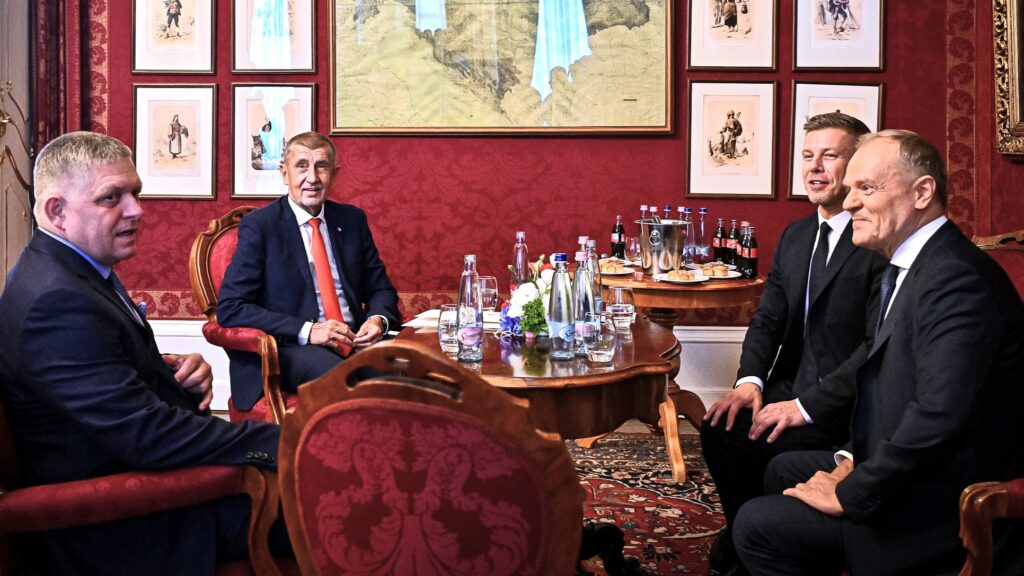
Written off by some as a casualty of the war in Ukraine, the Visegrád Group is staging a comeback. The leaders of its four member states—Czechia, Poland, Slovakia and Hungary—agree they want to rebuild trust, cooperation and give Central Europe a stronger voice in the EU.
The Visegrád Group is seeking to reassert itself on the European stage. At a summit in the Hungarian town of Gödöllő on Tuesday, the prime ministers of the Czech Republic, Poland, Slovakia and Hungary agreed to deepen coordination and work together more closely inside the European Union.
“The V4 is back,” Hungary’s new prime minister, Péter Magyar, declared after hosting his counterparts Andrej Babiš, Donald Tusk and Robert Fico. “The heart of Europe is beating in Central Europe today.”
The four leaders agreed to meet in the V4 format before every major EU summit, aiming to coordinate positions and advance common interests wherever possible.
A new tone from Budapest
Magyar, whose centre-right Tisza party won a two-thirds parliamentary majority in April, has promised to end the confrontational EU approach pursued by his predecessor, Viktor Orbán. He says Hungary will pursue constructive cooperation abroad while continuing to defend its national interests.
All four countries are committed to strengthening Visegrád cooperation, Magyar said after the meeting. He wants a V4 that can “deliver tangible results” and speak with a stronger voice in Europe. He argued that Central Europe is now one of the EU’s most dynamic regions, citing its industrial strength, innovation potential and highly skilled workforce.
The four countries have a combined population of around 65 million. Magyar noted that together they conduct more trade with Germany than Germany does with France.
The other leaders struck a similarly upbeat tone. Czech Prime Minister Andrej Babiš said he was pleased the four countries were “back in the same boat”. He described the Visegrád Group as “the future of Europe”.
Polish Prime Minister Donald Tusk stressed that the four countries did not need to agree on every issue. What mattered, he said, was recognising their shared interests. “If we always understand that what unites us is stronger than what divides us, then Europe will begin to listen to us,” Tusk said. He also argued that the V4 could serve as a “beacon of hope” for countries aspiring to join the EU.
Speaking with one voice
Slovak Prime Minister Robert Fico said the group should focus on areas where its members can work together rather than on issues that divide them. “We will not put divisive topics on the table,” he said. “There is a large agenda where we will be stronger if we reach agreement.”
According to the leaders, those areas include energy prices, agricultural policy, and migration, where V4 has already shown in the past efforts to advance common positions. “One success of the V4, for example, was the resolution on illegal migration,” said Fico.
The next seven-year EU budget for 2028–2034 featured prominently in the talks. The leaders agreed that cohesion funding and the Common Agricultural Policy should remain central pillars of EU policy and regional development.
Magyar said all four governments shared the view that Europe’s future prosperity depends on a competitive economy. Affordable energy, he argued, will be a key part of that equation. Babiš argued the V4 should push for a definitive easing of emissions trading rules by January 2027. And also seek the best possible outcome from negotiations on the EU’s next budget, because “it always comes down to money”.
Magyar also floated the idea of a high-speed rail link connecting the capitals of all four countries — Warsaw, Prague, Bratislava, and Budapest. He spoke of expanding cooperation in culture as well and strengthening a shared Central European identity.
Recovering from years of division
The renewed enthusiasm follows a prolonged period of tension within the Visegrád Group. Relations between the four countries deteriorated sharply after Russia launched its full-scale invasion of Ukraine in February 2022. Differences over how to respond to the war exposed deep divisions within the bloc.
Magyar argued that the policies of Viktor Orbán’s government had played a major role in weakening the group. He pointed to Budapest’s cooperation with Moscow despite the war in Ukraine and to growing tensions with Poland.
At the same time however, Czech and Slovak prime ministers Andrej Babiš and Robert Fico are both considered Orbán allies. Following his example, they reduced or halted weapons deliveries and financial assistance to Ukraine after taking office.
Differences remain
The four leaders acknowledged that disagreements have not disappeared entirely. Magyar and Fico nevertheless expressed confidence that Slovakia and Hungary could resolve their bilateral disputes, including longstanding disagreements over the status of Slovakia’s Hungarian minority.
Magyar recently argued that Hungary must stand up for “fellow citizens whose property is still being confiscated under the Beneš decrees”. Budapest has also criticised last year’s amendment to Slovakia’s criminal code, under which people who challenge the decrees can face up to six months in prison.
The leaders said they were not considering a permanent expansion of the Visegrád Group. However, Magyar suggested that other countries could occasionally be invited to discussions on specific issues. In that context, Fico welcomed Babiš’s proposal to invite German and Austrian chancellors for talks on migration and energy policy.
Hungary’s rotating presidency of the Visegrád Group ends this month and will pass to Slovakia. “The Slovak presidency will take place during demanding and difficult times,” Fico said. He intends to do everything possible to restore the bloc’s influence and ensure it once again becomes a strong regional player, he added.