The European consortium Aether is to build two of the continent’s flagship AI gigafactories near Strasbourg. But while Europe scrambles to close Europe’s compute gap with the US, it still does not know how many centres it actually needs.
Only a few weeks earlier, the EU scaled back its gigafactory development programme, abandoning its original plan for five gigafactories as funding tightened and interested consortia thinned, roughly from 70 to 10. It was an unexpected retreat for a bloc so far behind. And yet, one of the programme’s own architects argues, the problem was never the building.
The EU hosts 2,269 data centres, around 42 per cent of the American total of 5,427. Germany alone, with 529 facilities, has more data centres than China. Add the UK and the wider European figure rises to roughly half the US level. Europe seems to have plenty of data centres, and yet, it is still not enough, and nobody seems to have clarity on how much is actually enough.
Two questions in one
Those thousands of European facilities are overwhelmingly ordinary colocation and enterprise sites. These support the basic use of everyday internet, storing files and serving websites. They are not the data centres that the new global economy is clamouring for. The genuinely AI-capable ones number a few dozen.
‘How many data centres’ is really two questions. Training centres which build the large language models (LLM) need one vast facility somewhere remote and power-rich. Then there are inference centres, which run for users, requiring many small facilities, always powered on, and close enough to users to keep responses fast.
On AI compute overall, the gap is closer to 12-to-1: the United States operates around 17.3 gigawatts to Europe’s 1.4, according to the Europe 2031 report. At the level of individual facilities, it is even more challenging. The largest AI supercomputer in the United States runs at 1,250 megawatts. The largest in Europe runs at 83.
Part of the challenge is the language spoken for development. The EU talks in buildings and euros. A tripling of capacity under the Cloud and AI Development Act saw €200bn mobilised. At its centre sat five AI gigafactories. They have since pared back, but are still the reference point for the debate. But industry talks in megawatts and rack densities.
The proposals under the Cloud and AI Development Act translate to “some five or six thousand buildings”, in the estimate of Michael Winterson, secretary-general of the European Data Centre Association. This would be mostly the ordinary facilities that serve cloud demand, not the frontier campuses.
Demand is the limit
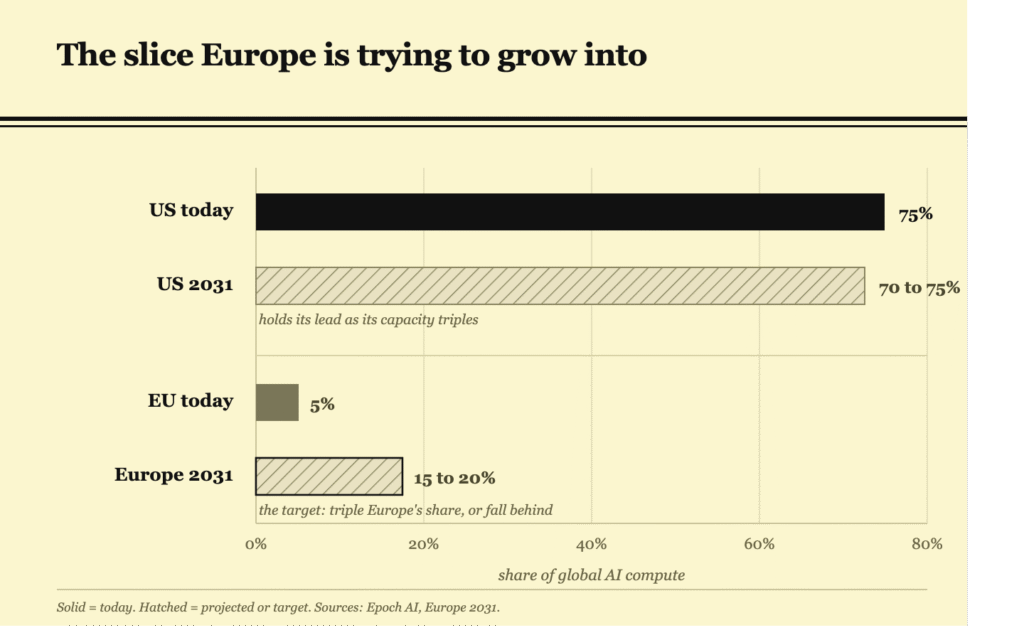
The authors of Europe 2031, an influential scenario report published in June, argue in an ideal world, Europe should reach 15 to 20 per cent of global AI compute—tens of gigawatts, up from around five per cent today—with anything less leaving Europe strategically dependent on the US.
Bart Kubiak, who spent a year helping design the gigafactory programme, questions whether European demand could even fill the five potential facilities however. “The problem of Europe is not supply but demand,” he says. “This is the limiting factor.”
Europe could assemble a Stargate (the US new AI Manhattan Project)-scale project tomorrow from Iberian sun, Finnish grid and Polish offshore wind, he says — “but what for? You’re gonna use twenty percent of it.” The risk, as he puts it, is to “Build something with taxpayer money for a non-EU company.”
The answers vary as Europe has yet to decide what it is measuring, or what the measurement is for. Europe 2031’s 15 to 20 per cent of global AI compute is the number seen as enough compute to serve most of Europe’s own customers on its own infrastructure. That is preferable to renting capacity from American hyperscalers.
The right number
The figure would draw on the growing demand in Europe, which is substantial. Just under a third of working-age Europeans used generative AI in 2025, mostly for personal use. McKinsey projects European data centre demand rising to around 35 gigawatts by 2030 (roughly triple today’s load) driven overwhelmingly by AI.
Europe 2031, arguing from sovereignty rather than demand, lands in the same tens-of-gigawatts territory by a different route. No matter how it is cut, the destination dwarfs the roughly 1.4 gigawatts of AI compute Europe runs today.
Serving Europe’s own users by 2030 would mean not five gigafactories but a continent-wide build-out. That means thousands of ordinary inference sites near users, topped by a handful of frontier campuses for training.
Mr Kubiak’s argument is that Europe is measuring against the wrong target. The American approach is “Tesco’s in this equation”, which chases a mass product for everyone. He argues Europe would lose that game and chase a target it doesn’t need should it seek to emulate it.
The opening he sees is specialised models for regulated industries such as healthcare or security, sectors where “regulation is a competitive advantage”. That is where a European product can be “EU made, EU powered, EU hosted, EU trained”.
These smaller, dedicated models need far less compute than general-purpose ones. A model built to do one thing well—parse medical records, say, or navigate a single body of law—doesn’t carry the vast scope of a system trained to answer anything. Mr Kubiak points to “mixture-of-experts” architectures, where one model routes each query to a specialised sub-network. To him, it is as a sign of where the field is heading. He argues Europe should build those specialist pieces directly, rather than chase the everything-machine it can’t win.
Where do they go?
But once Europe finds a number, it does not become any easier to begin building, because then becomes the question of ‘where’. “There is no Arizona,” Mr Kubiak says.
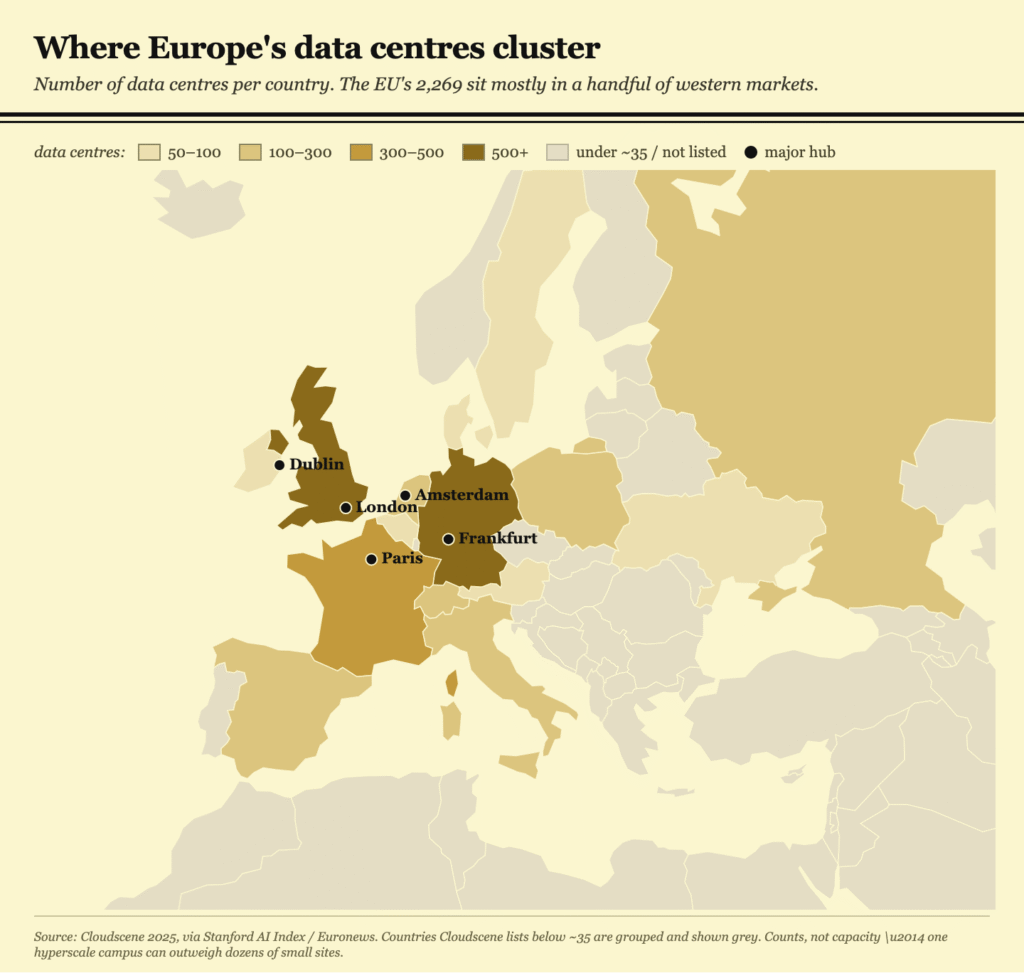
Europe has no empty desert to fill, and its density means every large site competes with people and industry for power. He frames the trade-off starkly: in a strained grid, connecting one hyperscale data centre can mean “turning off ten factories” to free the electricity.
The map of workable sites is short and every entry is closed. Ireland (where data centres already draw over a fifth of national electricity) only reopened its grid to new builds in late 2025. It was only for those that generate their own power. The Netherlands still corrals hyperscale sites into a few northern locations. Spain has the empty space but, in regions like Aragón, not the water.
The wrong metric?
That leaves the edges: depopulated Western Pomerania in Poland, near enough to Berlin to matter, springs to mind. So does offshore wind off the Bay of Biscay, or the Nordics, cold and power-rich, where waste heat can warm homes through district heating. These locations are remote enough to build, yet still close enough to be useful. These spaces are scarce.
It is unclear how many data centres Europe actually needs and it may not be the most important metric. “Everybody wants to just cut the ribbon on the largest data centre in the region,” Mr Kubiak says. “But that’s not the point. This is not how Europe can win this game.”
Count the buildings and Europe looks a solid second to America; count the compute power and it barely registers. The right number is unknowable because the real question is not ‘how many’. It is ‘for what’, to which Europe has yet to decide.