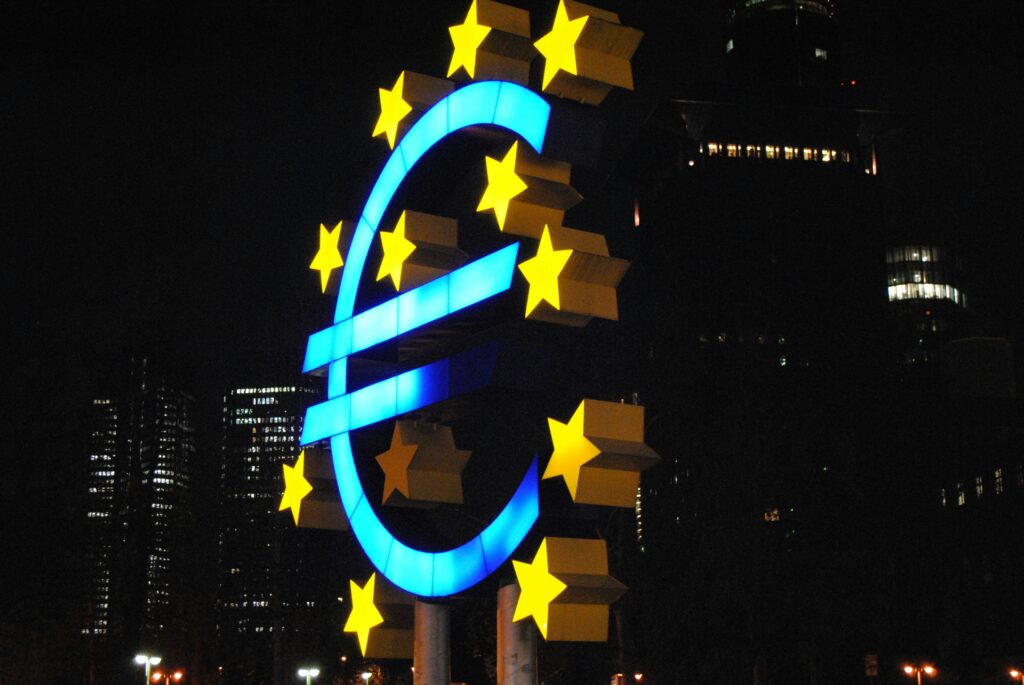
Europeans could soon pay with a digital coin issued by the European Central Bank, with MEPs demanding full data privacy protections. The Economic and Monetary Affairs Committee voted 43 to 14 to back a digital euro, setting out Parliament’s position ahead of negotiations with the Council.
The vote in the European Parliament’s Economic and Monetary Affairs Committee (ECON) on Tuesday sets out Parliament’s position for trilogue negotiations with the Council and the European Commission, following months of lengthy talks.
What is the digital euro?
The European Central Bank (ECB) would issue the digital euro as a new electronic form of money, with the main goal of reducing Europe’s reliance on non-EU payment providers.
Visa and Mastercard currently handle around 70% of all European card payments. US companies or national systems that do not work across borders handle most of the remainder. Some 13 EU member states have no domestic payment scheme of their own. If negotiators reach an agreement this year, the ECB says it could issue the digital euro as soon as 2029.
Sovereignty and accessibility
Damian Boeselager, Volt MEP and Greens/EFA shadow rapporteur, said the trilogue was unlikely to prove contentious. “We do not see any big controversies for the upcoming trilogue,” he said.
“Overall, we are very happy with the compromise that has been reached in the negotiations. When it comes to transaction fees for merchants, our group has pushed for even lower fees and a permanent model instead of the provisional one now agreed on. But we still believe the outcome is very acceptable,” Mr Boeselager added.
Jonás Fernández, S&D spokesperson on economic and monetary affairs, highlighted the three main objectives of the negotiations. “Sovereignty, accessibility, and privacy have been the three objectives throughout the lengthy negotiations on this package,” he said.
Of these, accessibility proved the most difficult, specifically when it came to online versus offline payments. “This was the most difficult part of the negotiations,” said Mr Boeselager. For the digital euro to be truly useful, it must work seamlessly with or without an internet connection.
“There is a good reason to limit offline payments to face-to-face situations: We have to make sure that the system does not allow for easy money laundering. That is why I supported a proximity-only model for offline payments,” Mr Boeselager said. The final text says offline payments will follow a proximity model, using local storage devices such as two smartphones or a smartphone and a payment terminal.
The text requires EU member states to establish at least one public distributor, such as a post office or a public bank. Other payment service providers, e-money providers, and regulated crypto-asset providers can also distribute the digital euro across the EU. Most businesses must accept it, with exceptions for the self-employed and small and micro enterprises that do not accept other digital payments.
Fees and limits
Businesses had raised concerns about high transaction fees. Parliament proposed a temporary model that a permanent cost model would eventually replace. All offline transactions will be free of charge, and merchants will either pay the same as today or less if their current fees are above the EU average, Mr Boeselager explained.
Basic services, such as opening an account, holding and managing funds, and getting at least one payment instrument, would be free for users.
To protect the financial system, there would be a cap on how many digital euros any individual could hold. The Commission would set the ceiling based on ECB recommendations and review it at least every two years. MEPs want Parliament to have full decision-making powers in this process.
This design makes clear that the digital euro belongs to users and in no way to payment system providers.
— Laura Casonato, Positive Money Europe
“This design makes clear that the digital euro belongs to users and in no way to payment system providers — this is crucial to preserve its substance as public money,” said Laura Casonato, head of policy at Positive Money Europe. “We hope that in the long run, this cap will be raised and ultimately, gradually deleted,” she added.
Divided opinions
Rapporteur Fernando Navarrete Rojas, who had expressed scepticism about the project during negotiations, said after the vote: “We are protecting citizens’ freedom to choose how they pay. The digital euro will complement cash, never replace it. Europe does not have to choose between the digital euro and successful private payment solutions. We need both to work together.”
Payment systems are not neutral; they are instruments of power.
— Gilles Boyer, MEP
French MEP Gilles Boyer said: “Payment systems are not neutral; they are instruments of power. We, Europeans, have had many wake-up calls about our dependence on the US. We are fully awake now, but we are not always acting. Tuesday’s vote on the digital euro is making a sovereign, pan-European payment solution a reality.”
Far-right MEP Siegbert Frank Droese condemned the project entirely, calling it a denial of financial freedom. “What the Commission is doing is the opposite of sovereignty. The digital euro is supposed to be a modernisation. Nobody wants it, nobody needs it. That means that cash and financial freedom of Europeans is put at risk. The digital euro is an experiment, it is a state control measure, and it means we will have surveillance,” Mr Droese said in a debate in the European Parliament last week.
Privacy protections
The digital euro would embed privacy-by-design and default principles from the outset. Cutting-edge technologies, such as “zero-knowledge proofs”, would allow verification of transactions without exposing personal data. According to civil society organisations Access Now and EDRi, 43% of respondents in the ECB’s own public consultation ranked privacy as the single most important feature of the digital euro, ahead of security, cost, or cross-border usability.
Epicenter.works, a digital rights organisation, welcomed the removal of one earlier proposal. “From our point of view, one positive development compared to the rapporteur report from December is that the idea of making the online version of the digital euro contingent on the absence of a comparable private-sector solution has been dropped. That conditionality would have undermined the project’s value altogether, and we were also concerned that if development were pushed to a later stage, privacy would not get the attention it needs.”
The committee also voted to protect the role of cash. Euro area countries would need to keep it accessible and plan for digital payment disruptions. Businesses could not ban cash through “no cash” signs or standard contract terms.