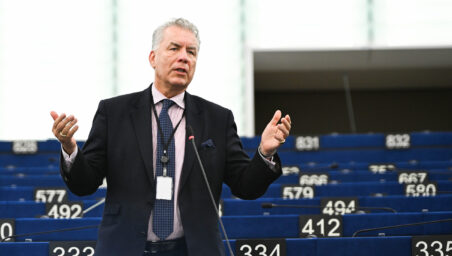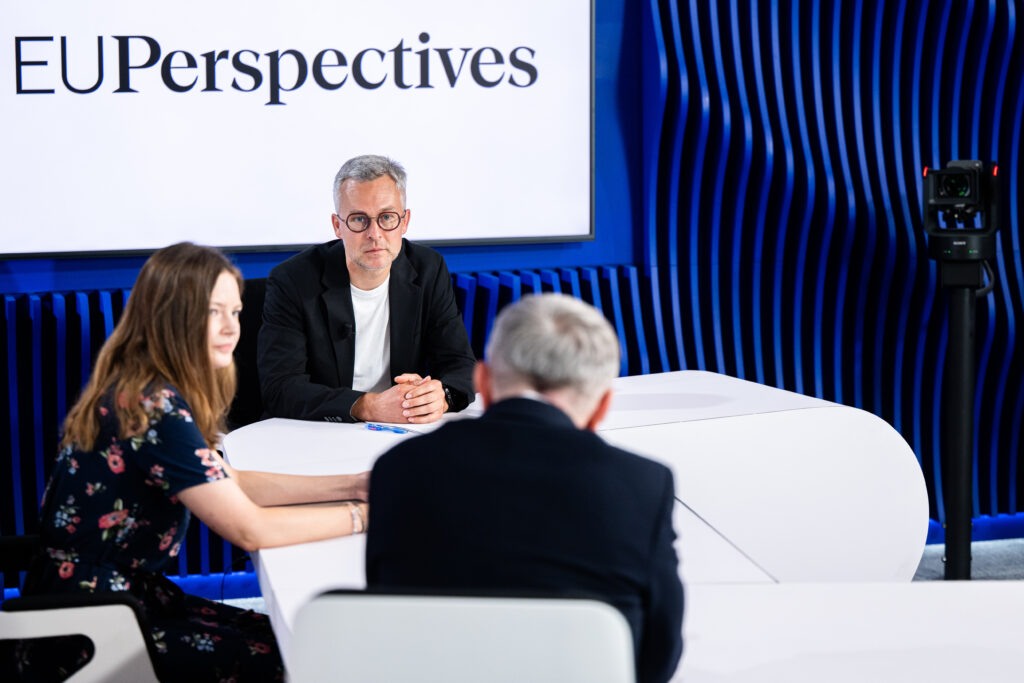
European policymakers have spent years debating how to regulate social media. Their first instinct has often been to equal protection with restrictions. MEP Ondřej Krutílek (ECR/CZE) and addiction specialist Jindřich Vobořil argue in an EU Perspectives podcast that the instinct is wrong and may actually aggravate the problem.
Mr Krutílek is direct about the scale of the challenge. “The impact of social media on minors and children, and not only on them, but also on other people, is huge,” he told the EU Perspectives podcast. The Covid-19 lockdowns accelerated the problem. Deprived of other outlets, people turned to screens. Social media use surged. The mental-health consequences, particularly among young people, are still unfolding.
Mr Vobořil frames the issue more broadly. Digital addiction, he argues, is not simply about social media. Gaming, gambling, and pornography are part of the same phenomenon. Then he held up his mobile phone: “We must not forget that this thing is not only social media. It’s also gaming, gambling, porn. It’s the whole thing together,” he says. Treating them separately, as EU policy currently does, misses the point.
The limits of bans
Both men converge on a central argument: banning does not work. Mr Vobořil draws on his clinical experience and his work on gambling regulation to make the case. More than half of the gambling industry has migrated online. Regulators switch off hundreds of illicit operators each year, only to find clones the following day. “You need the industries to be involved because they have instruments to help,” he says.
His model is partnership rather than prohibition. He recalls a debate from thirty years ago, when the idea of engaging industries as allies in addiction policy first surfaced. “I remember this debate 30 years ago when Margaret Thatcher came with this idea—let’s speak to the industries, let’s make them allies in these addictive areas and work with those industries who are willing to go with us,” he says. “I think that that’s the only option.”
If there is a product which goes against public health, against mental health of European society, then this type of product could not be put into the internal market.
— MEP Ondřej Krutílek (ECR/CZE)
Mr Krutílek agrees, and adds a practical dimension. The EU’s internal market is large enough to give Brussels genuine leverage over big technology companies. But that leverage works better as a negotiating tool than as a blunt instrument. “If we’ll not only restrict them, but if we’ll talk to them and find some middle ground, then I think that we can be partners,” he says. “What the European Commission does at the moment is just restricting them.”
One area where both guests see genuine promise is the Parliament’s focus on algorithms, the automated systems that determine which content users see and how often. Mr Vobořil argues this is the right target.
Algorithms, not access
It is not access to platforms that drives addictive behaviour; it is the design of the systems themselves. “The major thing is the algorithms, not the access,” he says. Regulating algorithmic design is technically complex, but he points to Australia as a country that has attempted it in the context of gambling. The strategy was partly successful.
Mr Krutílek points to existing EU legislation as an underused resource. The Digital Services Act—the EU’s main framework for regulating online platforms—already contains relevant provisions. Articles 34 and 35, he notes, require large platforms to assess and mitigate systemic risks, including those to mental health. “These are the main instruments which we do have in hand,” he says. The problem, in his view, is not a lack of rules but a failure to enforce them.

He is also sceptical of the social-media ban for minors that several EU member states have debated. Keeping children off platforms does not prepare them for the world they will eventually inhabit. “When they are adults, they will be blind as kittens on the internet and they will not be able to understand what is going on,” he says. “That will be the result of any restrictions which we are debating here.”
Prevention matters
The conversation then turned to prevention. Mr Krutílek described his own approach with his three children: limited screen time through parental controls, but open conversations about how social media works, why certain videos are designed to hold attention, and what lies behind online advertising. “They need someone like a mentor who shows them the way,” he says.
Mr Vobořil makes the same point at a policy level. Restricting access without investing in education and awareness is not a strategy. “We can ban anything, but if we don’t put money in preventative measures—not only in terms of raising taxation or restricting something, but in the soft type of prevention—it’s not going to work,” he says.
Thirty years ago, Margaret Thatcher came with this idea—let’s speak to the industries, let’s make them allies in these addictive areas and work with those who are willing to go with us.
— Jindřich Vobořil, ex-Czech national drug coordinator
Mr Krutílek sees a path forward that combines market leverage with industry partnership. If a product demonstrably harms public health, EU treaty provisions already allow member states to restrict its access to the internal market. “If there is a product which goes against public health, against mental health of European society, then this type of product could not be put into the internal market,” he says. “It’s as simple as that.” Starting there, then bringing willing industry partners into the conversation, is, in his view, the only realistic route.
The carrot and the stick
Both men acknowledge the political difficulty. Persuading the European Parliament to embrace industry partnership over restriction runs against the dominant instinct in the chamber. Mr Krutílek is candid. “It will be very difficult to get a green light for that here, especially in the European Parliament,” he says. He also notes that the current climate of anti-American sentiment in Europe complicates engagement with the large US-based technology companies that dominate the platforms in question.

Yet both guests argue that the alternative—a proliferation of bans that drive behaviour underground, fragment the market, and leave young people unprepared—is worse. The pattern they describe is consistent across tobacco, drugs, gambling, and now digital platforms: prohibition without prevention creates shadow markets, unintended consequences, and a false sense of political progress.
The EU’s digital agenda is vast and ambitious. But if Brussels cannot move beyond the reflex to restrict—and begin treating prevention, education, and industry partnership as serious policy instruments—it risks repeating, in the digital sphere, the same mistakes it has made everywhere else.