Coalition of the willing delivered on Monday. Kyiv signed contract for 16 Rafale fighter-jets, as well as French manufacturing licences. London made a landmark decision to join the EU’s €90bn loan for the war-torn country.
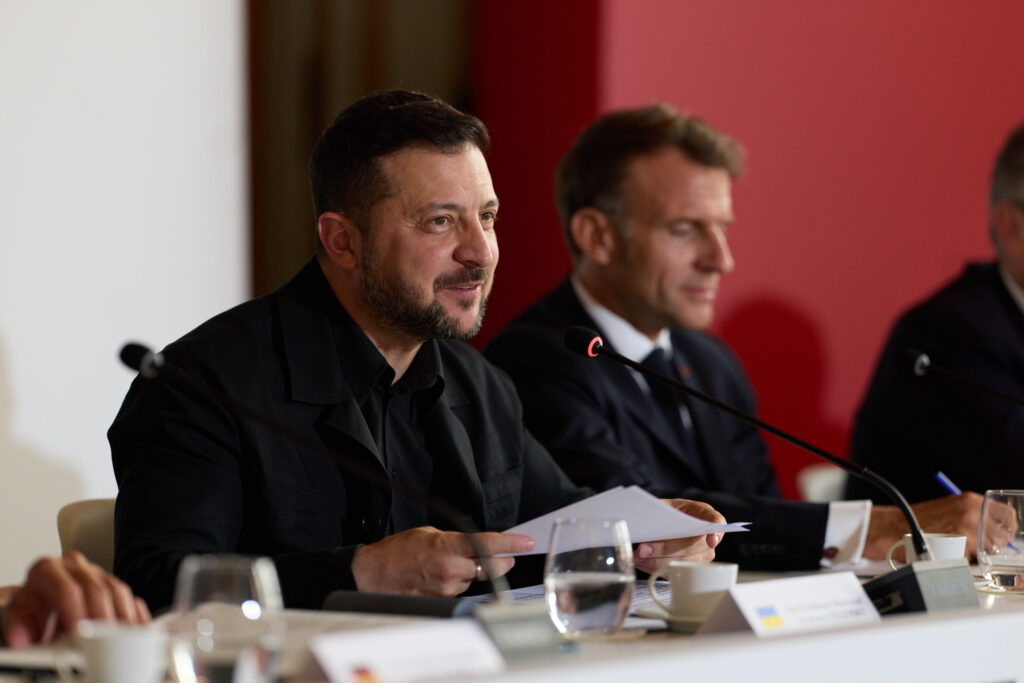
For once, Paris was kind to Volodymyr Zelenskyy. On the eve of Bastille Day, French President Emmanuel Macron welcomed 40 heads of state and government to Les Invalides in Paris. It was the 16th meeting of the coalition of the willing, an informal group of countries assisting Ukraine in its war effort. What emerged from the 13 July event was more than solidarity.
The timing was deliberate. Ukraine has, in Mr Macron’s own words, “largely regained the initiative” on the battlefield. Russia is accumulating failures. The Paris summit was designed to press that advantage: militarily, financially, and diplomatically. “The support for Ukraine is an investment in our own security, and those who think this war will stop at Ukraine’s borders if we yield or seek ways to accommodate the aggressor are wrong,” Mr Macron told reporters.
A new shield for Europe
Ukrainian President Volodymyr Zelenskyy arrived having already decorated Mr Macron with the Order of Freedom. He was direct. “Ballistic strikes have become Russia’s last bet — Putin’s real final means of dragging out this bloody war,” he told reporters. He added: “This year, Ukraine’s positions on the front are stronger than in any other year of the war.”
The centrepiece of the day was the launch of the Anti-Ballistic Coalition (ABC). The ten-nation initiative brings together Denmark, France, Germany, Italy, the Netherlands, Norway, Spain, Sweden, Ukraine, and the United Kingdom. According to the founding Joint Declaration, the members “initiate the establishment of a purely defensive integrated anti-ballistic missile architecture for Europe”. Moldova and North Macedonia have already signalled interest.
The declaration keeps the ABC “open to other nations that share its principles and objectives“. Members will create “common operational requirements, joint technical working groups, clear governance mechanisms and a roadmap toward the Coalition’s first operational capabilities.” The architecture is purely defensive. It complements, rather than replaces, existing national systems.
At the heart of the coalition is FREYJA, Ukraine’s indigenous interceptor missile. Its projected unit cost is roughly $0.7m, compared with $3.8m for a Patriot PAC-3 round. Allied industrial, radar, and command-and-control inputs are expected to allow initial mass-production as early as August 2026. First intercepts are expected by end-2027.
Twelve months
Mr Zelenskyy described the ambition plainly. “We all together can, within the next 12 months, make this missile, this system, make FREYJA mass-produced, which will close the deficit, will be affordable, and will allow all of Europe to provide itself with new anti-ballistic capability,” he said. The ABC will also ease pressure on limited American interceptor stocks.
France and Italy already produce the SAMP/T system and its Aster 30 interceptor. Mr Macron confirmed that France would licence Aster 30 production to Ukraine. Licences for SCALP cruise missiles and AASM precision-guided bombs are also part of the deal.
Several other coalition members made similar commitments. European Commission President Ursula von der Leyen set the tone. “Ukraine has built strong military momentum,” she said. “The tide is turning. We can and will do more.”
A licence to build
Mr Macron and Mr Zelenskyy also signed the first firm procurement contract for 16 Rafale F4-standard fighter jets. The package includes weapons, ground support equipment, and a multi-year training programme. A broader framework, agreed in November 2025, allows Ukraine to expand the order to up to 100 Rafales by 2035 if funding is secured.
We cannot put economic interests above security interests. That is a very dangerous trend.
— Lithuanian Foreign Minister Kestutis Budrys
“The first must take to the skies in Ukrainian airspace as early as 2028-2029, with the training that will take place in the coming months,” Mr Macron said. Pilot and technician schooling for roughly 30 pilots and 200 ground crew starts at French bases within months. Kyiv’s Myrhorod and Ozerne air bases are being upgraded to NATO standards. A joint Rafale Support Cell, headquartered in Lyon, will coordinate software updates and maintenance.
The Rafale F4 is a genuine 4.5-generation aircraft. Its AESA radar, SPECTRA electronic-warfare suite, and Meteor beyond-visual-range missiles give Ukraine a 200km-class engagement envelope. That is far beyond anything its MiG-29s or incoming F-16s can match. The jets can also act as airborne sensor nodes, cueing ground-based air-defence systems and providing over-the-horizon missile warnings.
Merci beaucoup!
France will finance roughly €3bn of the €5–6bn first-batch cost from its existing Ukraine military-aid envelope. Additional tranches will be serviced through the EU’s €90bn Ukraine Support Loan and, eventually, revenues from frozen Russian sovereign assets. The wider package also includes eight next-generation SAMP/T batteries with six launchers each, advanced radars, air-to-air missiles, and precision-guided bombs.
Mr Macron confirmed domestic production licences for SCALP cruise missiles, AASM bombs, and Aster 30 interceptors. Joint drone production forms part of the broader cooperation as well. Mr Zelenskyy was effusive. “Thank you, France, thank you, Emmanuel,” he said. “Licences for Asters and SCALPs are important decisions. They will help greatly.”
Outgoing UK Prime Minister Sir Keir Starmer confirmed that Britain would join the EU’s €90bn Ukraine Support Loan. It was one of his final acts before leaving office. “This agreement will help ensure Ukraine gets the support it needs to defend itself against Russian aggression, while backing British defence companies, supporting skilled jobs and strengthening our national security,” he said.
Britain joins the loan
The loan allocates two-thirds of its total to military spending. British firms will now bid for contracts funded by the scheme, including ammunition, air-defence systems, and long-range missiles. Mr Starmer’s participation carried an elegiac quality. Mr Macron paid tribute warmly, noting that the coalition “owes him a great deal.”
Mr Zelenskyy thanked Mr Starmer for his “consistent position.” He recalled that the memorandum on deploying a multinational contingent was signed during his premiership. Mr Starmer reflected on the progress made since the coalition’s first gathering in early 2025. “We now have clear plans in place for a multinational force for Ukraine, consisting of over 25 nations, ready to deploy within days to help secure the peace when a ceasefire is in place,” he said.
The support for Ukraine is an investment in our own security, and those who think this war will stop at Ukraine’s borders if we yield or seek ways to accommodate the aggressor are wrong.
— Emmanuel Macron, France’s president
He was equally clear about what comes next. “We must double down,” he said. “We have to do everything we can to ensure Ukraine has the air defences they need to prevent further senseless loss of life.” German Chancellor Friedrich Merz struck a similarly firm tone. He addressed Moscow directly. “It is time to come to the negotiating table; time to agree on a ceasefire, and to end the unnecessary bloodshed in Ukraine,” he said.
Sanctions and the shadow fleet
Mr Merz confirmed that Germany would press allies to do more on air defence immediately. He highlighted the NATO Ankara summit’s agreement to provide €70bn in military assistance for 2026 and 2027. He drew the strategic conclusion plainly. “Russia will not achieve its war aims,” he said. “And we are not doing this to continue the war, but to end the war as quickly as possible.”
The Paris meeting produced a coordinated sanctions push. EU foreign policy chief Kaja Kallas said she hoped ministers in Brussels would agree on as many as 250 new listings. “This is the biggest number of listings we have done so far,” she said. “It is also a reaction to the attacks that Russia has had on the civilians recently.” The 21st sanctions package targets Russia’s banking sector, its military-industrial complex, and sanctions-evaders.
Ms Kallas added that some questions remained open. “When it comes to the 21st package, there are still some open questions, but we are working towards agreement,” she said. The UK sanctioned 24 individuals and entities behind what it called “destructive cyber and hybrid operations” across Europe. Those sanctioned include GRU senior leadership figures Vyacheslav Stafeyev, Ivan Senin, and Ivan Kasyanenko.
Cybercriminals lambasted
The UK statement was explicit about the method. “GRU Unit 29155 cyber division worked with cybercriminals, including the company IMPULS, to recruit hackers and cyber specialists from universities and academies across Russia,” it said.
Britain and EU member states jointly attributed last year’s attempted attack on Poland’s electricity grid to Russia’s FSB Centre 16. “This reckless attack failed but could have caused 500,000 citizens to lose electricity in the depths of winter,” the UK statement said.
Ballistic strikes have become Russia’s last bet, Putin’s real final means of dragging out this bloody war.
— Volodymyr Zelenskyy, Ukraine’s president
NATO added its voice. It called on Russia to “stop these destabilising activities, which disregard agreed international norms of responsible state behaviour in cyberspace.” On the shadow fleet, Mr Macron noted that France had boarded five vessels since late 2025.
A ministerial meeting to expand the interdiction effort will take place in Paris in September. Lithuanian Foreign Minister Kestutis Budrys pressed for more ambition. “We cannot put economic interests above security interests,” he told reporters. “That is a very dangerous trend.”
Strategic awakening
Mr Macron closed with a message aimed squarely at European publics. “What we are building here is not only for Ukraine,” he said. “It is the demonstration that Europe can assume its own security, defend its interests and act with unity, with strength, without naivety about the intentions of Moscow. This coalition is the most concrete proof of that.”
The next Coalition of the Willing meeting will take place in Ukraine itself. On 14 July, Ukrainian troops marched down the Champs-Élysées alongside their allies. It was a visible symbol of what Mr Macron called Europe’s “strategic awakening”.
Mr Starmer, who has less than a week to go in Downing Street, left Paris with a verdict on the moment. “History will record that we rose to this moment,” he said. “And I have no doubt that ultimately we will help secure the peace that Volodymyr and his people so justly deserve.”
The shield is being built. Whether it rises fast enough is the question that will define the years ahead.