Not a day too soon, twelve European governments respond to Washington’s “force adjustments” by investing in long-range precision bombing.
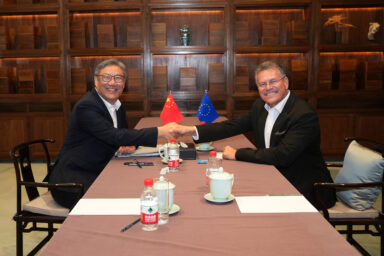
Leaders of nine EU member states plus Norway, the UK, and Türkiye gathered in Ankara with a single, pointed purpose. In the wake of the NATO summit on 8 July, they pledged €44bn over the next decade to develop new long-range strike weapons.
They also made clear why they felt compelled to do so. “In particular, we recognise the need to increase our deep precision strike capabilities, including in response to recent US force adjustments,” the coalition said in its joint statement. The message to Washington was as polite as it was unmistakable.
The initiative, formally named the Deep Precision Strike Capability Investment Initiative, launched on the sidelines of the NATO summit as outgoing British Prime Minister Sir Keir Starmer met fellow coalition leaders. The British ministry of defence described it as “further evidence” of allies “stepping up to ensure a stronger, more European” alliance. The weapons it aims to deliver, the ministry added, will be “the most advanced NATO will have at its disposal in the future. It will feature the ability to strike targets no less than 300 km away and in some cases beyond 2,000 km, with pinpoint accuracy.”
Shadows over Ankara
The timing was not accidental. Washington has withdrawn one brigade combat team from Europe, cancelled a long-range fires battalion earmarked for Germany. It has also halved the number of strategic bombers assigned to the NATO Force Model. Europeans, watching those cuts, concluded they needed to fill the gap themselves, and fast.
The war in Ukraine shaped every conversation at the summit. European governments watched Ukrainian long-range systems disrupt Russian logistics, degrade command infrastructure, and strike targets deep inside Russian territory. Britain’s statement acknowledged that Ukrainian strikes had demonstrated “game-changing impacts on the battlefield”. That lesson—that the ability to reach far behind enemy lines matters enormously—now drives European procurement thinking directly.
NATO itself drew the same conclusion. A separate alliance release, accompanying the launch of a parallel Ground-Based Precision Strike Capabilities High-Visibility Project, noted that the Ukraine conflict had shown the threat of long-range strikes is growing and demands “a more agile approach” to developing and fielding such capabilities. The alliance also acknowledged that “a lack of compatibility and interoperability” across allied deep strike systems “has been a recurring issue that affects production capacity”. The new initiative aims to fix both problems simultaneously.
The coalition’s governance structure reflects that ambition. A memorandum of understanding signed in Ankara establishes a common fund, an R&D steering board chaired by the UK Ministry of Defence, and a work-share formula tied to national industrial contributions. The first €22bn tranche covers 2026 to 2030. A second €17.5bn tranche runs from 2031 to 2035. A further €4.4bn contingency pot funds shared intelligence, surveillance, reconnaissance, and command-and-control systems.
What the money buys
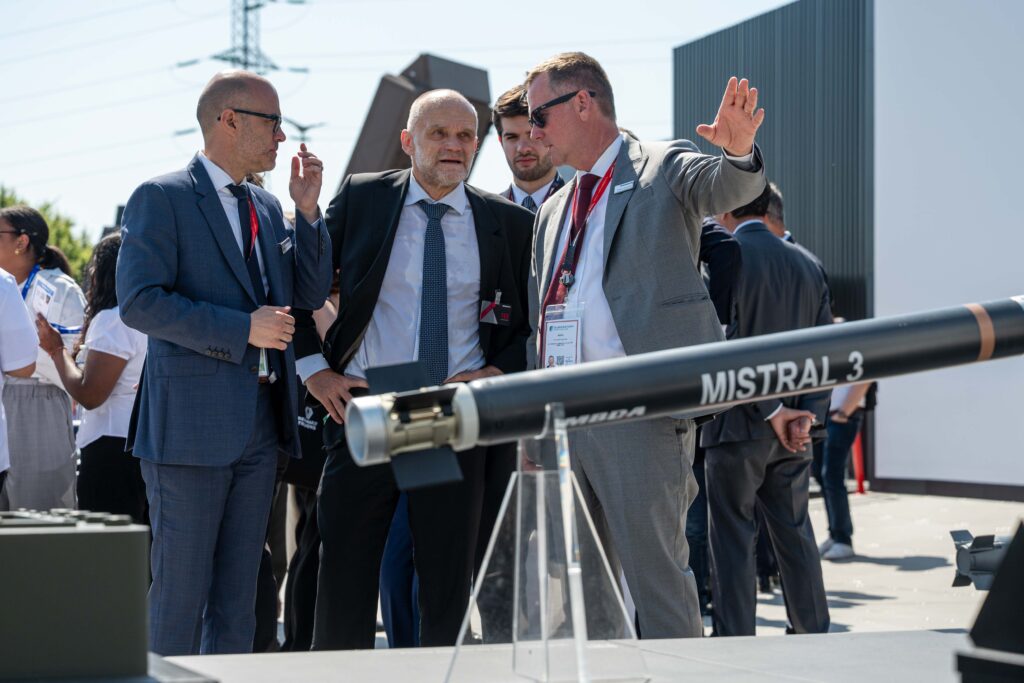
The initiative rests on three technological pillars. The first is a family of hypersonic and high-supersonic cruise missiles in the 1,000–2,000km class, built around the Franco-Italian-British Stratus programme, the planned successor to the MBDA-made Storm Shadow. Two variants are in development: one stealth-based, the other high-speed. Both aim to destroy enemy ships and air defences. France will integrate naval launch capability on future FREMM-EVO frigates. The UK opens MBDA facilities in Stevenage and Bolton for Stratus prototypes.
Europe needs to start producing missiles, not headlines. — Fabian Hoffman, Center for European Policy Analysis
The second pillar covers ballistic and quasi-ballistic missiles in the 500–750km band. The UK and Germany co-lead a hypersonic glide vehicle demonstrator, with entry to service slated for the 2030s. Germany also funds the JFS-M, a 500km-class land-attack cruise missile, as an interim solution. The UK separately joins the US and Australia on the Precision Strike Missile programme, fielding a supersonic ballistic round for land forces with a 500km reach.
The third pillar is a “low-cost salvo” family of sub-400km effectors. Denmark leads this work strand, using Terma’s production line for seeker heads. Norway contributes Kongsberg missile datalink technology and integrates naval strike variants on future Type 212CD submarines. Sweden’s Saab leads integration of a hypersonic air-launched round on the Gripen E/F and supports common targeting software.
Who pays what
The country-by-country breakdown of commitments within the €44bn envelope is as follows:
- United Kingdom: €9.7bn. Programme lead and steering board chair. Opens MBDA facilities for Stratus prototypes; joins US-Australian PrSM programme.
- France: €6.2bn. Leads Stratus stealth and hypersonic cruise development; naval launch integration on future frigates.
- Germany: €6.2bn. Co-leads hypersonic glide vehicle demonstrator with the UK; funds JFS-M as interim land-attack solution.
- Türkiye: €4.4bn. Contributes Tayfun short-range ballistic missile technology and Gezgin submarine-launched cruise missile; hosts joint test range near Sinop.
- Denmark: €1.8bn. Leads low-cost salvo work strand; co-chairs NATO High-Visibility Project on ground-based precision fires.
- Norway: €1.8bn. Kongsberg datalink technology; naval strike integration on Type 212CD submarines.
- Finland: €1.8bn. Contributes test data and tactics from AGM-158 JASSM employment at ranges exceeding 370km.
- Sweden: €1.8bn. Saab-led hypersonic air-launched integration on Gripen E/F; common targeting software.
- Estonia: €880m, plus HIMARS and ATACMS launcher access. Serves as Baltic forward-stocking site; contributes live-fire range data.
- The Netherlands: €880m. Deployable command-and-control and NATO datalink gateways; links the initiative to its space-based surveillance constellation.
- Romania: €880m, largely in-kind. Hosts Black Sea flight-test corridor; upgrades the Deveselu site for conventional missile telemetry.
- Spain: €880m. Navantia leads development of marinised launch cells compatible with both cruise and ballistic effectors.
Promises and sceptics
Not everyone greeted the announcement with unqualified enthusiasm. Fabian Hoffman, a European missile analyst, called the investment level “serious money”. But he immediately added a warning. “Europe needs to start producing missiles, not headlines,” the Center for European Policy Analysis expert said. “I’ll wait until orders are placed and timelines are known before getting enthusiastic.”
His caution is well-founded. If timelines hold, the first baseline missile family could reach initial operational capability around 2031. (It would be in time for NATO’s 2035 force-planning cycle.) That is a significant if. European defence programmes have a long history of slipping. The initiative’s pooled structure lowers unit costs and tightens industrial interdependence, which should accelerate delivery. It also creates new dependencies and coordination burdens that could slow it down.
What is beyond dispute is the strategic logic. Europe is moving, deliberately and at speed, from broad spending pledges to specific, high-end capability commitments. The €44bn initiative underwrites precisely the long-range fires capacity the US is cutting first. That is not a coincidence. It is a policy; and one that seems to make sense. The nagging question is, what are the remaining 18 EU member states doing?