Platforms should protect children by design, not as an afterthought. That is the message of a new Committee on Culture and Education report, which follows a recent proposal by a special panel to ban social media for children under 13. MEPs are now pushing for a dedicated mode for minors and stricter rules for influencers.
The European Parliament’s Culture and Education Committee approved a fresh set of proposals this Tuesday. The move comes a day after the Special Panel on online child safety issued its own recommendations to make the online environment safer for minors.
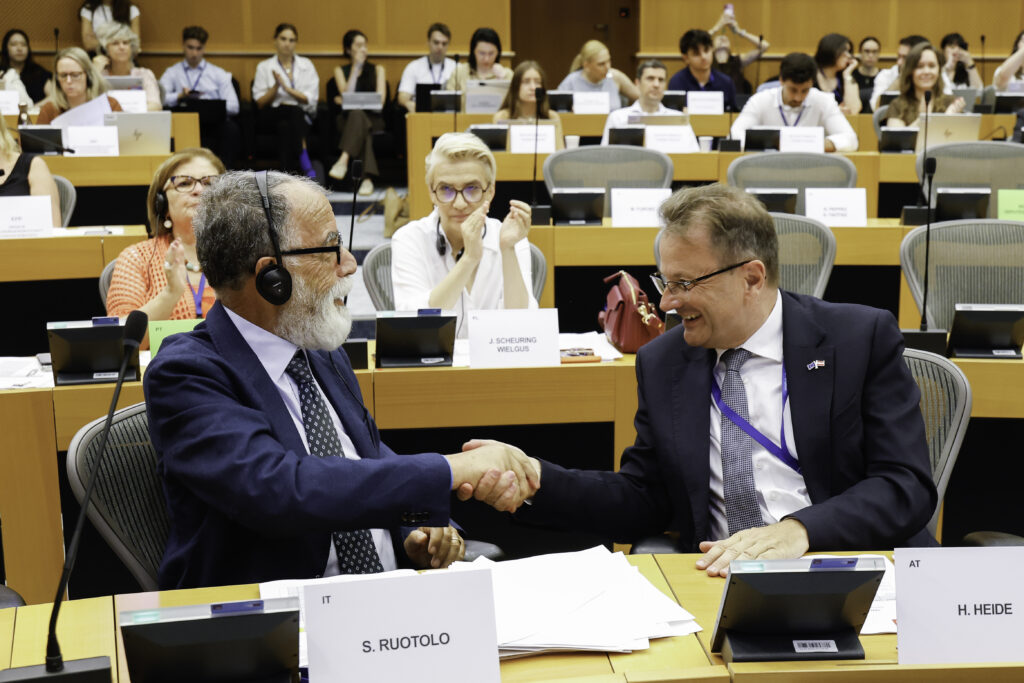
Echoing the Special Panel’s argument that platforms should be ‘safe by design’, the report from the Culture and Education Committee (CULT) also seeks to shift responsibility to the companies building and managing digital services. “The responsibility for the safety of children and adolescents must first and foremost lie with those who design and manage digital platforms,” rapporteur Sandro Ruotolo (S&D/ITA) said. “As rapporteur for the European Parliament, I fully agree with this approach. Platforms must eliminate features that encourage addiction, manipulation, and exposure to harmful content or contacts. Safety shall be incorporated into services by design”.
Youth mode and addictive design
The committee wants the online environment to follow the principles of privacy by design, safety by default and age-appropriate design. One of its main proposals is a dedicated ‘youth mode’ for minors. This would disable targeted advertising and restrict design features intended to keep users continuously engaged.
Platforms would also have to introduce safeguards based on the risks created by their recommender systems. The committee argues that the Digital Services Act (DSA) already provides important protections, but that implementation and enforcement remain uneven. It is asking the Commission to consider personal liability in cases of serious and persistent non-compliance with provisions intended to protect minors.
In 2024, 97 per cent of young people in the EU used the internet daily. More than 80 per cent use social media every day, while children aged between nine and 16 spend an average of three hours per day online.
More transparent algorithms
MEPs also want more transparency around the algorithms determining what children see online. The report argues that young users often have little understanding of why particular content is recommended, restricted, or removed. Opaque recommendation and content-moderation systems can limit their ability to navigate the online environment critically.
Platforms should provide greater transparency and ensure that their recommender and moderation systems give more visibility to reliable, age-appropriate material, including content produced by professional media organisations.
Influencer code of conduct
Influencers are another focus of the report. The committee is calling for an EU code of conduct for influencers and a harmonised definition of ‘influencer marketing’. It also wants children protected from practices such as ‘kidfluencing’, where minors themselves become commercial content creators.
The demands come as the EU prepares to review the Audiovisual Media Services Directive. That revision could reopen the question of whether influencers and online content creators should face stronger obligations.
The age question remains open
Ruotolo stopped short of endorsing 13 as an EU-wide minimum age. He said Parliament would wait for the Commission to present its approach in September before taking a position on individual measures. “On issues affecting children and adolescents, policy choices must be guided by scientific evidence and input from experts, educators, families and young people,” he said.
On issues affecting children and adolescents, policy choices must be guided by scientific evidence and input from experts, educators, families and young people.
— Sandro Ruotolo, rapporteur, European Parliament (S&D/ITA)
“The European Commission will present a proposal after the summer. We look forward to hearing in detail about the intervention in September 2026 before expressing our views on individual measures, in particular on sensitive issues such as the age of access to social media,” Ruotolo added. His report is expected to be voted on by the European Parliament during the September plenary session.