After seven years of silence, Brussels and Beijing finally sat down together. The result is a new forum for dialogue, but also an admission that the EU’s goods trade deficit with China rose to €359.9bn last year. Both sides now have until October to prove they mean it.
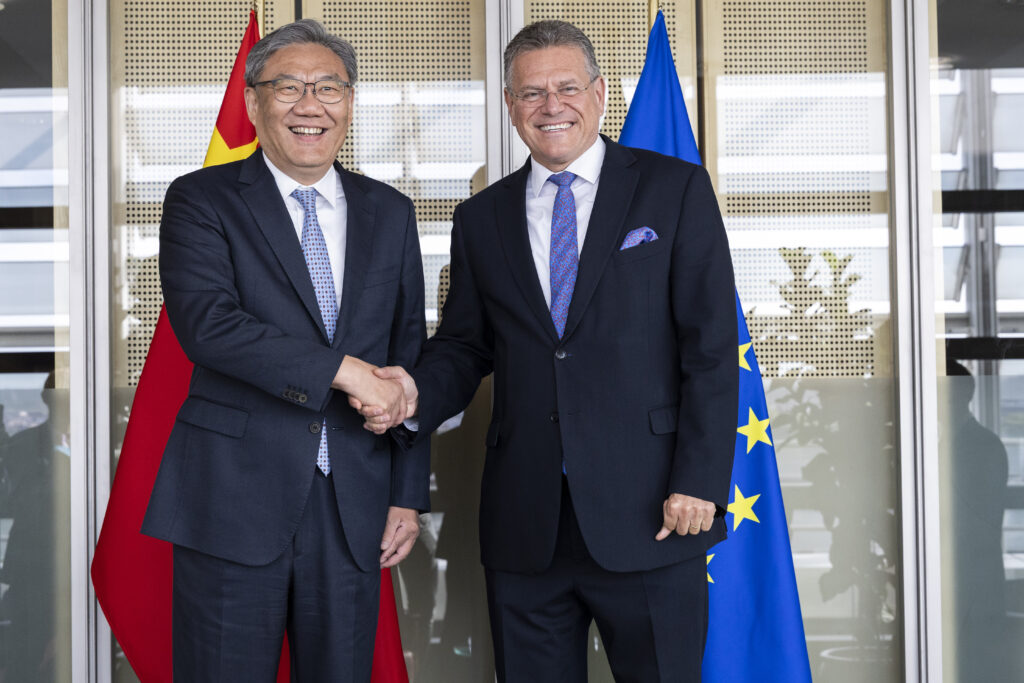
European Commissioner for Trade and Economic Security Maroš Šefčovič met Chinese Commerce Minister Wang Wentao in Brussels on Monday for the first session of the EU–China Trade and Investment Consultations (TIC). It was the first joint statement the two sides have issued since 2019, ending a seven-year gap in formal dialogue. For the first time, all 27 member states recorded a trade deficit with Beijing in 2025.
The figures behind the meeting are stark. The EU’s goods trade deficit with China reached €359.9bn in 2025, up 2.7 per cent on the previous year, according to the Commission’s own figures, though still below the record €397.3bn deficit recorded in 2022.
Four workstreams and an October deadline
The two sides agreed to focus their work on four areas: rebalancing trade and investment, managing export controls, protecting intellectual property rights, and reforming the World Trade Organisation. They also agreed to establish a joint mechanism to monitor trade flows, with the stated aim of improving transparency, building mutual trust and managing trade frictions.
Mr Šefčovič set October as the deadline for tangible progress. He plans to travel to Beijing that month, shortly before EU leaders gather in Brussels for the next European Council summit on 15 October. Commission spokesperson Olof Gill said the goal was real reciprocal market access, so that European companies enjoy conditions in China similar to those Chinese companies enjoy in the EU.
China offered assurances on rare earth and permanent magnet export controls, pledging not to let them disrupt EU supply chains. Beijing briefly tightened those same controls last autumn, during a separate dispute with the United States.
China’s exports to the EU keep rising, while our market share in China keeps shrinking. This trend is not sustainable.
— Maroš Šefčovič, European Commissioner for Trade and Economic Security
Speaking to reporters after the talks, Mr Šefčovič did not mince his words. “China’s exports to the EU keep rising, while our market share in China keeps shrinking. This trend is not sustainable. The status quo is not an option,” he said.
A framework, not a fix
Mr Šefčovič was careful to manage expectations on substance. “Not everything will be solved, not everything will be fixed,” he said, even as he described the dialogue itself as worthwhile. “That is why today’s talks, and the ones to follow, matter. They help us avoid unnecessary tension.”
Commission spokeswoman Paula Pinho said two tracks were now running in parallel: deeper dialogue with Beijing, and continued efforts under the EU’s Critical Raw Materials Act to diversify trade relationships away from dependence on China, citing Africa’s expanding role in rare earth processing as one example.
For now, Brussels and Beijing have agreed to talk. By October, the world will know whether they also agreed to change.