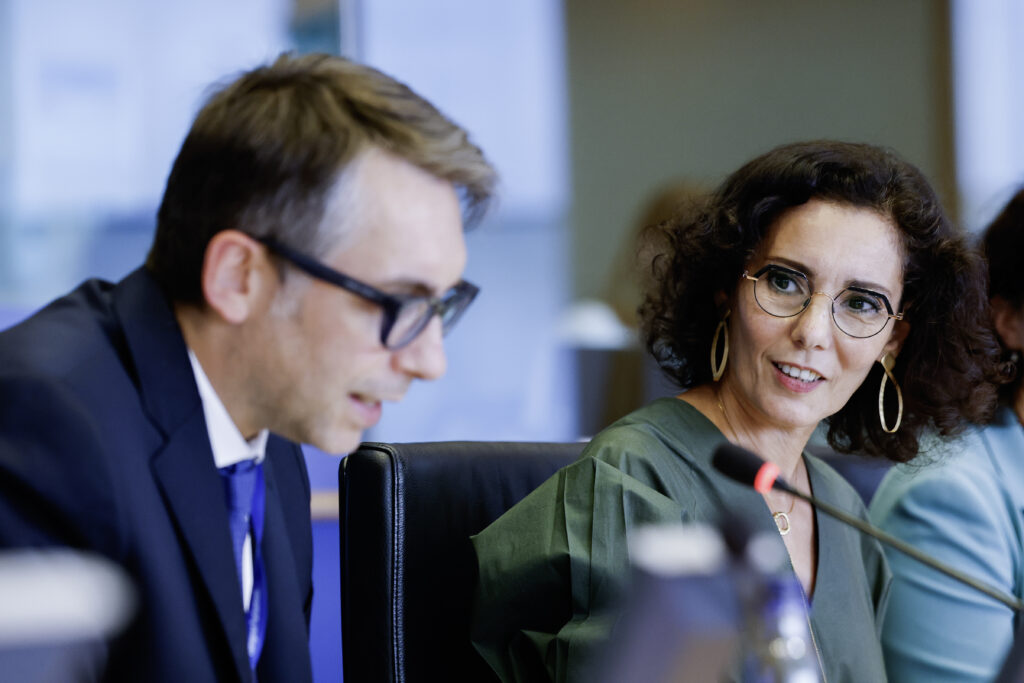
Europe’s wildfires are starting earlier, spreading further north and threatening more densely populated areas. Crisis Management Commissioner Hadja Lahbib warned that the continent is entering a new era of more dangerous fires, as European lawmakers clashed over the role of climate change, arson and forest management.
Almost 700,000 hectares have burned across the EU this year, more than the annual average of the previous two decades. Firefighters and pilots have died during emergency operations. More than 300,000 people had to evacuate their homes due to fires near Bordeaux and Madrid. Ms Lahbib said the evacuations in France were the largest since the Second World War.
“No country, no matter how rich or powerful, can fight nature alone,” Ms Lahbib told the European Parliament’s Environment Committee on Tuesday. “Climate change is no longer knocking on Europe’s door. It is already inside.” She added that this season was exceptional because fires appeared as early as April, spread to countries including Belgium, Germany and Czechia, and increasingly reached populated areas. “Nature has become a powder keg,” she said.
“There is no competition on a dead planet.”
— MEP Lena Schilling (AT/Greens)
She also highlighted the EU’s new framework for integrated wildfire management. The non-binding recommendation, proposed by the Commission in March and adopted by the Council in June, calls for measures covering prevention, preparedness, emergency response and recovery.
Far-right remarks provoke anger
The debate became more politically charged when far-right German lawmaker Marc Jongen (GE/ESN) took the floor. He argued that individual fires were being used to promote the Green Deal, instead emphasising the role of arson and inadequate vegetation management.
Christophe Clergeau (FR/S&D), said he was “outraged” by suggestions that forest fires were unrelated to climate change. “It is scandalous,” he said, arguing that their connection with heatwaves explained why Europe needed to prepare for more frequent and destructive fires.
Ana Vasconcelos (PT/RE) sought to separate criticism of EU policy from outright climate denial. “You don’t need to deny climate change to be critical of what the EU has done to prevent and adapt to it,” she said. She called for clearer public guidance on emergency kits, evacuations and how people should behave during disasters.
Other Green and left-wing members accused governments of delaying climate action despite the growing damage. “There is no competition on a dead planet,” Austrian Green Lena Schilling said.
Ms Lahbib acknowledged that most European fires were caused by human activity, whether deliberately or accidentally. However, she said four heatwaves and temperatures above 40°C had left vegetation dangerously dry. This then allowed fires to spread with an unprecedented intensity.
Lawmakers demand different forests
Much of the discussion ultimately focused on how European landscapes should be adapted to withstand hotter and drier conditions.
Tilly Metz (LU/Greens) argued that decisions made when rebuilding burned areas would determine how vulnerable those landscapes are to future fires. She pointed to highly flammable monoculture forests around Bordeaux and called for the restoration of more diverse forests capable of resisting fire and climate change.
Other lawmakers highlighted the importance of tree diversity, natural water cycles and research into which species could survive changing conditions. Several also called for farmers and foresters to be supported in clearing vegetation, maintaining firebreaks and restoring abandoned land.
Climate change is no longer knocking on Europe’s door. It is already inside.
— Hadja Lahbib, Crisis Management Commissioner
Centre-right members argued that some EU rules discouraged grazing, forestry and agricultural practices that previously kept vegetation under control. They called for relevant legislation to be reviewed and warned that some countries were fighting fires with fewer resources than a decade ago.
The emerging point of agreement was that emergency aircraft alone would not solve the problem. Lawmakers across the political spectrum supported better forest management, improved water retention and stronger cooperation with rural communities, even as they disagreed over the role of climate policy.
EU fleet will take years to arrive
Lawmakers also questioned whether Europe possessed sufficient aircraft and trained personnel to respond when national services become overwhelmed. Pascal Arimont (BE/EPP) called for a larger shared fleet, greater European production of firefighting aircraft and financial compensation for volunteers.
The wider EU emergency reserve available this summer comprised 22 planes and five helicopters. A permanent rescEU fleet will include 12 new firefighting planes. According to Ms Lahbib, however, the first delivery is now expected only in early 2028. Spanish lawmakers asked whether deliveries could be accelerated, warning that the aircraft would be needed increasingly often as fire seasons became more severe.
Ms Lahbib said the EU had answered every request for assistance this summer. However, Brussels could not intervene until a national government formally sought help. She suggested that the Commission could become more proactive. Member states meanwhile need to become “less proud” about requesting assistance.
The next EU budget will help determine whether Europe can build that capacity before the next severe fire season arrives. “Being prepared costs money, but not being prepared costs so much more. In lives, homes and so much more,” Lahbib said.