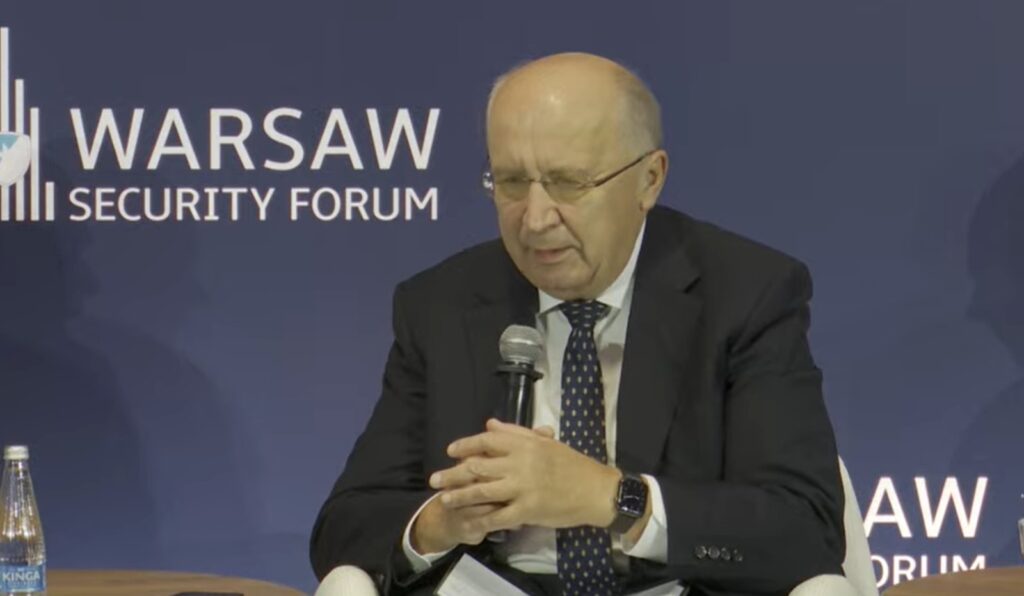
Europe is to take primary responsibility for conventional defence on the continent, Commissioner Andrius Kubilius said to kick off this year’s edition of the Warsaw Security Forum.
A panel at the Warsaw Security Forum on 12 October delivered one consistent message: Europe must do more for its own defence. Speakers, including prominent Americans (Victoria Coates of the Heritage Foundation, who moderated the debate; Matthew Whitaker, US NATO envoy), also debated the role of the European Union.
Andrius Kubilius, European Commissioner for Defence and Space, gave the clearest definition. NATO 3.0, he said, means Europe takes primary responsibility for conventional defence on the continent. The US keeps secondary responsibility and the nuclear umbrella. Mr Kubilius said Europe must become much stronger in defence capabilities. “That is what NATO 3.0 is about,” he said.
Mr Kubilius explained American thinking. Americans, he said, are not telling Europeans they no longer love them. Russia and China could threaten the West at the same time. The question is whether capabilities exist to deter both.
“Because if Americans really shift their resources into Indo-Pacific, we need to be ready to replace what we call strategic enablers, what Americans now are providing to Europe, including space capabilities,” said Mr Kubilius.
Washington’s logic
Matthew Whitaker, US permanent representative to NATO, said the approach already works. “NATO 3.0, a more European NATO, a factory reset, whatever we term it, is working,” he said. He cited Poland, which spends 4.7 per cent on core defence.
Mr Whitaker listed American priorities in order: the homeland, the Western Hemisphere, the Pacific, and Europe. He wants Europeans to step forward and match what America has invested over 77 years. “The United States isn’t stepping back,” he said.
Marcin Przydacz, Poland’s Secretary of State and head of the International Policy Office of the President, agreed. Keeping America in, he said, requires higher European spending. “I would say we really need to keep Americans in because the role of the US presence when it comes to the security of Europe is super important,” he said.
NATO 3.0, a more European NATO, a factory reset, whatever we term it, is working. — Matthew Whitaker, US permanent representative to NATO
Poland delivered the two per cent promised at Newport in 2014, Mr Przydacz said. It also delivered the five per cent promised at the Hague, though he called that painful. “We can have the best highways, but if we’ll be attacked by the foreign superpower, those highways won’t be serving us, but someone else,” he said.
Brussels, or the alliance?
Mr Przydacz called the EU a good project, but one about trade and economy. He said the EU has a role in hybrid operations below the Article 5 threshold. Above it, NATO leads. He acknowledged that the Commissioner may disagree. He said Poland belongs to both organisations. “There shouldn’t be any competition,” he added.
Mr Kubilius described what the EU is building. He listed projects of common interest for drone defence, the eastern flank, anti-ballistic and anti-missile and air defence, maritime security, and a space shield. Fragmentation, he said, has made such pan-European projects hard to build. Vladimir Putin, in Mr Przydacz’s account, wants to reshape the entire global security architecture. Poland, he argued, helps keep it intact. He urged tougher sanctions on Moscow.
“So I’m rather in favour of strengthening the policy of sanctions on Russia because that is what can bring finally hopefully one day Russia to the negotiation table if they will run out of money,” he said.
Mr Whitaker said not every ally keeps pace. He delivered a strong message to the Czech Republic, which he said is not committed to the Hague trajectory of year-over-year growth in defence spending.
What industry brings
Micael Johansson, president and chairman of the board of ASD and CEO of Saab Group, spoke for industry. Joining NATO made Swedish firms selectable, he said, and opened NATO acquisitions to them. NATO chose Saab for airborne early warning. Poland bought three Saab A26 submarines. “And that would never have happened unless we had been NATO,” said Mr Johansson. “I don’t think Poland would have selected the submarines either if we hadn’t been NATO.”
The Baltic is shallow, full of archipelagos, and busy with shipping, he said. He wants more than submarines. “I think we need to take it further to autonomous systems as well and create some sort of a hybrid navy because of all the things that’s happening in the Baltic Sea,” he said.
If Americans really shift their resources into Indo-Pacific, we need to be ready to replace what we call strategic enablers (…) including space capabilities. — Andrius Kubilius, EU defence and space commissioner
Mr Kubilius said Europe must replace the strategic enablers America supplies, including space. He hopes a European secure satellite communication system, which he calls Iris Square, starts its first operations in 2029. He also wants geo intelligence data with a high repeat rate.
Space and hard lessons
Launch is the gap. “Our big challenge really is also to have capabilities to build those systems using our launching systems, because that is where we are quite heavily behind, and that is what will be our priority,” the commissioner said.
Mr Whitaker warned against complacency. He said many Europeans believed the Soviet Union’s collapse ended old conflicts. “We have not overcome our human nature. We have not overcome history,” he said. “And Europe was not prepared for war.”
He said Europe still lacks lift for space and for moving troops, as well as submarines. He also urged Europeans to learn the right lessons from Ukraine. “It is about doing the basic stuff well, and the basic stuff is increasing capacity of our defence industrial base so that we can supply the huge demand,” the American said.