No TikTok rabbit holes, no 3AM notifications and no AI friends. The European Commission wants to make the internet a very different place for children.
Children under 13 might soon be barred from social media across the EU, while those aged 13 and 14 could use only parent-controlled accounts for up to one hour a day On Thursday, the European Commission proposed the EU KIDS Act. The legislation covers social media, video-sharing services, online games, AI companions and chatbots offered to users under 18.
Parents cannot compete or keep up against algorithms, and they should not have to.
— Ursula von der Leyen
“Platforms have been playing fast and loose with our children’s mental health,” Commission President Ursula von der Leyen said. She highlighted one of the biggest features of the draft law — it will force technology companies to prove that their platforms are safe before allowing minors to use them.
“Now we are reversing the burden of proof. Now they have to prove to us that they are safe.”
The Commission cited a Eurobarometer survey showing that 92% of Europeans wanted stronger online protection for children. Young Europeans spend an average of four to six hours a day looking at screens. For those who started using social media before turning ten, the number is even higher, between seven and eight hours. “Parents cannot compete or keep up against algorithms, and they should not have to,” Ms von der Leyen said.
Accounts and screen time would depend on age
If adopted, the new rules would ban social media for kids under 13. Personal accounts would only be allowed from the age of 15. Children between three and 12 could still access specially designed video-sharing services through a guardian’s account. Their use would be limited to one hour a day, and the Commission’s factsheet also envisages no personal devices for this age group.
Children aged 13 and 14 could use “mini accounts” created through their parent or guardian’s account. Parents would decide whether to enable access, approve new contacts and restrict how many users their child could interact with. Screen time would again be limited to one hour a day.
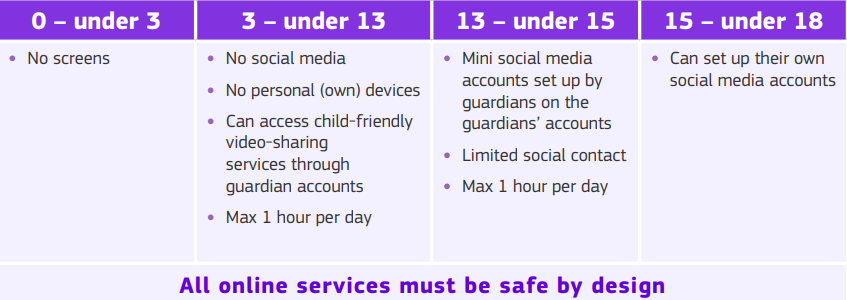
From 15, teenagers could open independent social-media accounts. However, every service offered to users under 18 would still have to comply with the Act’s safety requirements. The Commission describes this as a gradual introduction to social media rather than a single age threshold.
The approach differs from Australia, where platforms are required to prevent children under 16 from holding accounts on designated services, including when parents consent. The EU proposal would instead allow supervised access from 13 and independent accounts from 15, while retaining safety-by-design protections until 18. Von der Leyen said the approach avoided a “cliff edge” between no access and full access.
Infinite scroll and AI companions face restrictions
The proposal would also target the features that keep children glued to their screens. Platforms would have to remove addictive features including infinite scroll, points and reward mechanisms. Push notifications would be banned during sleeping hours. Platforms could not use profiling-based feeds to draw minors into “rabbit holes” of harmful content or allow unsolicited contact from strangers.
Parents cannot compete or keep up against algorithms, and they should not have to.
— Ursula von der Leyen
Children’s profiles would have to remain private by default, with geolocation, cameras and microphones switched off. Minors would receive tools to block users and control, reset or adjust recommendation systems. Platforms could not allow them to livestream or target them with personalised advertising based on previous activity.
AI companions and chatbots would have to remain switched off by default. They could not imitate human relationships in ways that create emotional dependency or automatically carry a child’s previous conversations into later interactions. Companies would need to test these systems before launch and monitor possible harm afterwards.
Privacy-friendly age checks?
Platforms and app stores would verify age through privacy-preserving tools, including the EU age-verification app. It uses a “zero-knowledge proof”, meaning that the service learns only whether someone meets the required age. It would not retain identity documents or biometric information.
So-called very large platforms would have to submit compliance plans to the Commission and an independent auditor. The rules would use enforcement structures established under the Digital Services Act and AI Act, but investigations into possible breaches should conclude within 90 days.
Platforms that retained addictive features could not offer their services to minors until they removed them. “We want to give parenting back to parents and childhood back to children,” Executive Vice-President for Tech Sovereignty Henna Virkkunen said.
The proposal now goes to the European Parliament and EU governments, which will have to negotiate and approve the legislation before it can become law.