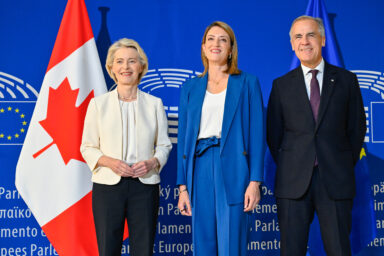
Canada’s prime minister urged the European Parliament on Thursday to build a sweeping Canada-EU alliance. In this three-part series, EU Perspectives breaks down Carney’s vision, examining what his proposed alliance could mean in practice — and what stands in the way. This first instalment looks at trade, strategic minerals and finance.
Imagine a European electric-car factory in 2030 that sources its battery-grade lithium from northern Ontario, finances its expansion through a jointly regulated transatlantic bond market, and sells its vehicles under trade rules that make the Canada-EU corridor as frictionless as a domestic market.
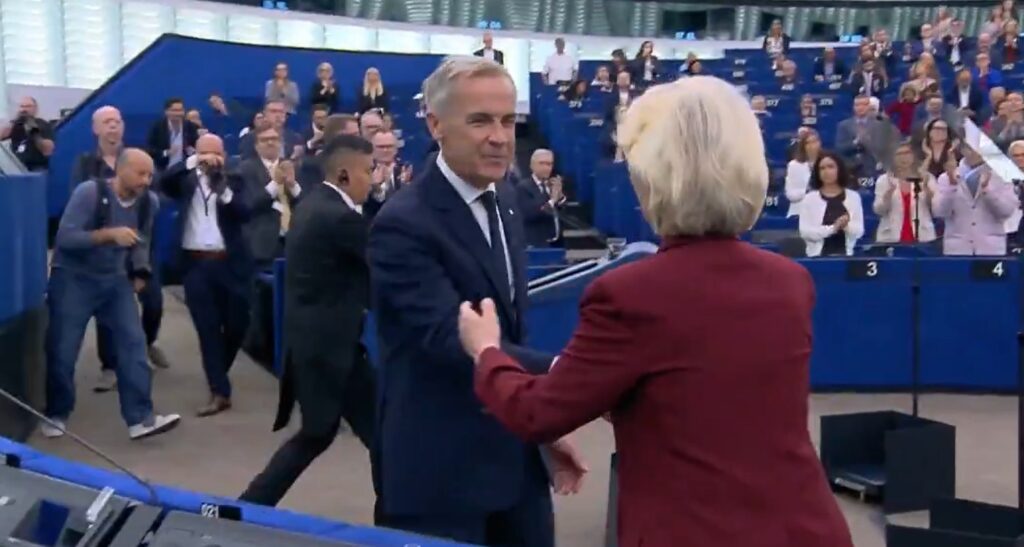
A Canadian pension fund holds a stake. A Quebec engineer spent two years at a German university on an Erasmus exchange. The supply chain is clean, documented, and immune to the whims of any single hegemon. This is the vision that Canadian Prime Minister Mark Carney laid before the European Parliament in Strasbourg on 17 September.
Mr Carney was quite precise about what he proposed. “Canada and Europe should secure our strategic autonomy through deep cooperation in the full range of strategic capabilities including critical minerals, defense, industrial capacity, AI and compute, energy security, space and payments,” he told lawmakers. He called for seamless digital trade, an integrated financial-services market, and Canadian membership of the Erasmus Plus and Horizon research programmes. This article deals with trade, raw minerals, and financial services.
From acorns to supply chains
Mr Carney framed his move not as a reaction to external pressure but as a positive construction. “It’s not a reaction to something else. It’s moving to the future,” he said at the subsequent press conference, trying to avoid the dreaded T-word.
The foundation already exists. CETA, in force since 2017, has lifted trade in goods between the two partners by 75 per cent, according to European Parliament President Roberta Metsola. A strategic partnership agreement followed in June 2025. Canada became the first non-European member of SAFE, the EU’s defence procurement framework. But Mr Carney was candid: “The ecosystem we’ve built is not yet equal to the ferocity of the changing climate and nor is it moving fast enough to match the speed of the upheaval.”
It’s not a reaction to something else. It’s moving to the future.
— Mark Carney, Canada’s prime minister
The most concrete near-term opportunity lies in critical minerals. Canada holds deposits of over 34 types of critical minerals and ranks among the top producers of the ten most essential for the energy transition, including lithium, cobalt, and nickel. The EU, for its part, has advanced processing capabilities that Canada lacks at scale. The fit is almost architectural. “Our alliance can help fill Europe’s need for reliable supply, Canada’s desire for advanced processing capabilities and our common objective to complete value chains in the transition and our defense,” Mr Carney said.
The framework and the gaps
Under current EU legislation, the framework for acting on this already exists, if imperfectly. The EU Raw Materials Initiative sets out principles for securing sustainable mineral supplies. Canada could align its mining and export practices with EU responsible-sourcing standards under that framework. Canada’s partnership with the European Raw Materials Alliance (ERMA) already points in this direction, with joint exploration and extraction projects under discussion.
The legislative gaps, however, are real. The EU’s Customs Code imposes documentation and procedural requirements that slow the import of raw materials. Amending it to create a fast-track channel for Canadian critical minerals (verified as responsibly sourced) would reduce friction significantly.
A hypothetical bilateral critical-minerals framework, modelled on the EU’s existing strategic partnerships with like-minded suppliers, could go further still, setting guaranteed offtake volumes, joint investment in processing infrastructure, and shared environmental standards. The Ring of Fire region in northern Ontario, home to large deposits of chromite, nickel, and cobalt, illustrates both the prize and the problem: indigenous land rights and environmental assessments have delayed development for years, and no EU trade framework can resolve those domestic Canadian tensions.
Rules, data, and the digital frontier
The upsides are substantial. Securing Canadian supply would reduce Europe’s dependence on Chinese processing—currently dominant for many transition minerals—and give Canadian producers access to a large, stable, high-value market. The downside risk is market volatility: a hypothetical surge in Canadian lithium output, if poorly timed, could depress global prices and damage the very industry the partnership seeks to build.
Trade integration beyond minerals runs into a thicket of regulatory divergence. Mr Carney called for movement “towards seamless digital trade and non agricultural goods and a wide range of services.” Under CETA, tariffs on most industrial goods already stand at zero. The next frontier is services (professional services, telecommunications, and transportation) and digital trade.
The ecosystem we’ve built is not yet equal to the ferocity of the changing climate and nor is it moving fast enough to match the speed of the upheaval.
— Mark Carney
Here the EU’s own rulebook creates friction. The General Data Protection Regulation (GDPR) restricts cross-border data flows to countries that the European Commission has deemed to offer adequate protection. Canada’s private-sector privacy law, PIPEDA, has received a partial adequacy finding, but gaps remain, particularly for public-sector data.
The controversies
A hypothetical amendment to the GDPR’s adequacy framework could create a bespoke, sector-specific carve-out for Canada covering anonymised research data and business-to-business transactions. This could unlock significant value without compromising individual rights. The EU’s Services Directive, meanwhile, does not currently provide for mutual recognition of Canadian professional qualifications. Updating it to do so would allow Canadian engineers, lawyers, and architects to practise in Europe without re-qualifying from scratch, and vice versa.
The controversy here is predictable. The Transatlantic Trade and Investment Partnership (TTIP), the aborted EU-US deal, collapsed in part because of public alarm about corporate power over regulation. CETA itself faced street protests and a near-veto by the Belgian region of Wallonia over its Investor-State Dispute Settlement mechanism.
Any expansion of investor protections through CETA’s Investment Court System will revive those arguments. Data sovereignty is the newer battleground: a hypothetical scenario in which a Canadian cloud provider stores EU citizen data on servers subject to Canadian security-agency access laws would test the limits of any adequacy agreement and hand critics a powerful argument.
The integration question
The most ambitious element of Mr Carney’s proposal (and the one most likely to move slowly) concerns financial services. “Canada and Europe should consider exploring an integrated market for financial services to broaden choice and reduce costs for our citizens, to improve access to capital for our companies while maintaining our world leading financial resilience,” he said.
Both Canada and the EU apply Basel III capital standards, which provides a common regulatory floor. CETA already permits some cross-border financial-service provision. Canadian pension funds—among the world’s largest and most sophisticated—already invest heavily in European infrastructure. The technical starting point for deeper integration is mutual recognition: an agreement under which Canadian banks and investment firms could passport into EU markets under a simplified regime, and EU firms could do likewise in Canada.
Canada and Europe should consider exploring an integrated market for financial services to broaden choice and reduce costs for our citizens.
— Mark Carney
Getting there requires legislative surgery on two major EU texts. The Markets in Financial Instruments Directive II (MiFID II) governs investment services across the EU. It currently requires third-country firms to establish EU subsidiaries or rely on equivalence decisions that the Commission can withdraw at short notice — as it did with the United Kingdom after Brexit.
Resilience over dominance
A hypothetical revision of MiFID II that created a durable, treaty-anchored equivalence mechanism for Canada would give firms the regulatory certainty they need to invest in cross-border infrastructure. The Capital Requirements Directive (CRD) sets capital buffers for banks. Amendments allowing mutual recognition of Canadian capital standards would reduce the cost of operating across the Atlantic. It would probably do a better job than requiring Canadian banks to hold EU-prescribed buffers on top of their domestic requirements.
The downside risks are not trivial. A hypothetical scenario in which a large Canadian bank, newly active in EU retail markets, faces a regulatory fine for mis-selling (or simply outcompetes smaller European lenders on price) would generate political pressure to reverse the opening.
The TTIP precedent looms here too. “The objective is not self sufficiency, it’s collective respect, resilience,” Mr Carney said. The framing of resilience taking precedence over dominance is designed precisely to pre-empt the backlash. Whether it succeeds depends on how the benefits are distributed and how visibly.
The road to Montreal
None of this happens automatically. Mr Carney confirmed that a Canada-EU summit in Montreal on 29 and 30 October would be the next substantive milestone. “It will all roll out transparently,” he said. The Canadian Parliament will debate and ultimately vote on whatever framework emerges. The European Parliament, which ratified CETA and controls the budgets for Horizon and Erasmus, will do the same.
“Diversity confers advantage,” Mr Carney told Strasbourg plenary. The economics, he argued, is clear; the politics is harder. Sovereignty concerns, environmental objections, data-privacy disputes, and the ghost of failed trade deals past will all need managing. The forest Mr Carney described, with roots intertwined, canopy shared, takes time to grow. But the acorns, at least, are in the ground.