Canada and the EU want to share satellites, weapons factories and Arctic waters, but their lawmakers must agree first. This is the second instalment of a three-piece EU Perspectives series on Mark Carney’s vision of a closer EU-Canada Alliance.
Picture a Canadian satellite, part of the RADARSAT Constellation, feeding real-time ice-melt data to an EU Arctic monitoring station in Tromsø. Meanwhile, a joint EU–Canada frigate patrols the Northwest Passage under a shared command framework. In Brussels, a Canadian defence firm bids on a radar-development contract funded by a reformed European Defence Fund. It does so directly, without an EU subsidiary.
In Toulouse, engineers from a Canadian space company work alongside their Airbus counterparts on the next generation of IRIS² secure-communications satellites. The North Americans have full Programme Board voting rights.
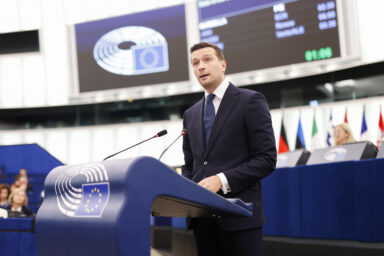
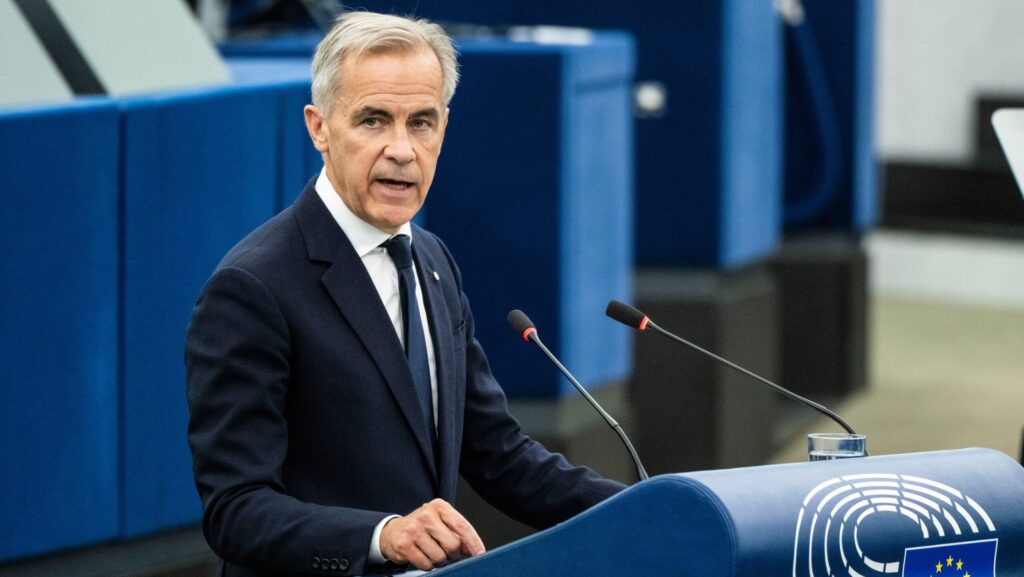
This is hypothetical. It is, however, the direction of travel that Canadian Prime Minister Mark Carney pointed to when he addressed the European Parliament in Strasbourg on 17 September. His argument was structural: “Where our strengths differ, they complement. Where they overlap, they create scale.” The three areas where that logic bites hardest are defence and its industrial base, space, and the Arctic.
What is already standing
The legal and political architecture is more developed than the ambition of the rhetoric might suggest. The 2017 Strategic Partnership Agreement (SPA) provides the political umbrella. At the June 2025 EU–Canada summit, the two sides signed a dedicated Security and Defence Partnership (SDP), institutionalising senior-level dialogues and opening the door to Canadian participation in Permanent Structured Cooperation (PESCO) projects (notably Military Mobility) under Council Decision (CFSP) 2017/2315 and its companion Decision 2020/1639 on third-state participation.
On defence industry specifically, Regulation (EU) 2021/697 establishing the European Defence Fund (EDF), budgeted at €8bn for the current period to 2027, already allows EU-located subsidiaries of Canadian firms to bid for grants. Several Canadian prime contractors are exploiting that route.
Canada can contribute LNG and hydrogen at large scale to support Europe’s energy security. — Mark Carney, Canada’s prime minister
More significantly, Canada became the first non-EU participant in the Security Action for Europe instrument (SAFE). This received a green light through a bilateral arrangement in December 2025.
The Connecting Europe Facility Regulation (EU) 2021/1153 funds the military-mobility budget line. It already benefits Canadian brigades deployed for NATO reassurance exercises, who test the rail-to-port corridors it finances.
Where the gaps bite
In space, Regulation (EU) 2021/696 establishing the Union Space Programme—covering Galileo, Copernicus, GOVSATCOM, IRIS², and Space Surveillance and Tracking (SST)—is the legal backbone. The EU–Canada Copernicus Cooperation Arrangement of May 2022 guarantees reciprocal, free Sentinel data access and created a joint Copernicus Cooperation Group. Canada’s €665m ESA association agreement of 2025 deepens industrial eligibility and aligns Canadian projects with the IRIS² work programme.
Under Article 58 of Regulation (EU) 2021/696, shared SST services already improve debris-collision warnings for Canadian operators. Canada’s RADARSAT-Constellation imagery, in turn, supports EU Arctic monitoring.
In the high north, the Joint Communication ‘A stronger EU engagement for a peaceful, sustainable and prosperous Arctic’ of 13 October 2021 names Canada as a key partner across all three pillars: peace and security, climate resilience, and sustainable development. The European Territorial Cooperation (Interreg) Regulation (EU) 2021/1059 funds the Northern Periphery and Arctic programme, in which several Canadian provinces already participate as adjacent areas. The EU Critical Raw Materials Act, Regulation (EU) 2024/1252, lists Arctic rare-earth deposits and triggers EU–Canada strategic raw-materials work plans under the SPA.
The existing framework has hard limits. EDF and SAFE grants still require EU-controlled entities for most funding streams; purely Canadian R&D teams are shut out. The EU Dual-Use Regulation 2021/821 diverges from Canada’s Export and Import Permits Act, complicating co-development of ITAR-free systems.
Three sets of changes
In space, Canada holds only observer status on the EU Space Programme Board, limiting its influence over security-sensitive constellations such as IRIS². In the Arctic, the EU’s competence remains largely civilian. No hard-security instrument matches Canada’s NORAD obligations (North American Aerospace Defense Command, a joint military organization of the United States and Canada defends North American skies and waterways).
We’ve also begun to take advantage of Canada’s role as the first non-European member of SAFE. — Mark Carney
Mr Carney named the problem plainly. “We’ve also begun to take advantage of Canada’s role as the first non-European member of SAFE,” he told MEPs. “But we should recognise that the ecosystem we’ve built is not yet equal to the ferocity of the changing climate and nor is it moving fast enough to match the speed of the upheaval.”
His diagnosis of the deeper issue was equally direct: “Sovereignty today goes beyond being able to feed, fuel and defend ourselves. It now requires secure access to AI, semiconductors, critical minerals, payment systems, clean energy technologies, vaccines, space-based communications.”
On defence and its industrial base, three sets of changes are necessary. First, Regulation (EU) 2021/697 would need its ownership-cap provisions removed, so that Canadian-based consortia, not merely their EU subsidiaries, can receive EDF grants directly; Canada would also need a voting seat on the EDF Programme Committee. Second, Decision 2020/1639 would need updating to add Canada as a systemic PESCO partner, eliminating the current requirement for per-project Council approval.
A new category
Third, Defence Procurement Directive 2009/81/EC would need its scope extended to Canada in exchange for reciprocal Canadian market access. This comes with equivalent offset, security-of-supply, and review-body provisions transposed into Canadian federal law.
In space, Regulation (EU) 2021/696 would require a new ‘Associated Third State’ category. This would feature budget contributions, Programme Board representation, and access to the Public Regulated Service encrypted signals of Galileo. A dedicated Canada–EU Secure Connectivity Agreement would give Canadian operators guaranteed IRIS² bandwidth in exchange for hosting Arctic ground segments. Mr Carney pointed to the strategic logic: “We can pool new sovereign compute capacity and build more secure broadband connections between Europe and Asia via our common geography.”
In the Arctic, the 2021 Joint Communication would need upgrading to a full Council Decision on an EU–Canada Arctic Partnership, making its three pillars legally binding and opening Interreg, Horizon, and LIFE funding lines to Canadian northern territories. Canadian environmental-impact rules would need alignment with the EU Maritime Spatial Planning Directive 2014/89/EU and the Offshore Safety Directive 2013/30/EU for joint High-North energy projects.
Mr Carney noted the scale of Canada’s contribution. “Canada can contribute LNG and hydrogen at large scale to support Europe’s energy security, including by developing and leveraging new port infrastructure in our high north and on our east coast,” the PM said.
Where the arguments start
Underpinning all three areas, export-control regimes would need mutual recognition between Regulation 2021/821 and Canada’s Export and Import Permits Act schedules. Without these, co-developed defence and space technologies cannot move freely across the Atlantic.
The fault lines are speculative but visible. The first dispute will likely concern defence-industrial sovereignty. Several EU member states, most prominently France and Italy, have built national champions partly on EDF grants. Opening those grants to Canadian-based firms, even under a reformed regulation, will face resistance. The SAFE instrument is a partial precedent, but SAFE funds procurement, not research and development; the political economy of R&D grants is more fraught.
Where our strengths differ, they complement. Where they overlap, they create scale. – Mark Carney
A second controversy will centre on Arctic governance. The EU’s civilian competence sits uneasily alongside Canada’s hard-security role through NORAD. Any Council Decision on an Arctic partnership will force a debate about where EU foreign and security policy ends and NATO begins. This is a boundary that several member states guard jealously.
Some will also note that the EU has candidate countries in its formal enlargement queue. Granting a non-European state shared governance rights inside EU programme boards, even in exchange for budget contributions, sets a precedent those countries will invoke.
What’s in a name?
A third friction point is the nomenclature itself. Mr Carney was relaxed about it. “The nomenclature, the precise nomenclature, is for Europe — it’s a question for Europe,” he said. “What matters is the substance.” That pragmatism may not survive contact with EU treaty lawyers. For them, whom the label attached to a relationship determines which legal base applies, and which institutions have a say. And, of course, whether the European Parliament gets a ratification vote.
Mr Carney confirmed that Canada’s own Parliament will vote on the final structure. “There will be a vote in the Canadian Parliament for the final structure of the alliance that we’re working on,” he said. The Montreal summit on 29–30 October is the next substantive moment. The process, he insisted, is positive, not reactive. “This is for a better future for our citizens. It’s not a reaction to something else. It’s moving to the future.”
The architecture he sketched feature shared defence-industrial capacity, co-owned space infrastructure, and a legally binding Arctic partnership. It would, if built, amount to the most significant reconfiguration of transatlantic relations since NATO’s founding. Can the legislative machinery on both sides of the Atlantic can move at the speed the geopolitical moment demands? It is a question the Montreal summit will not answer; but it may well start the journey.