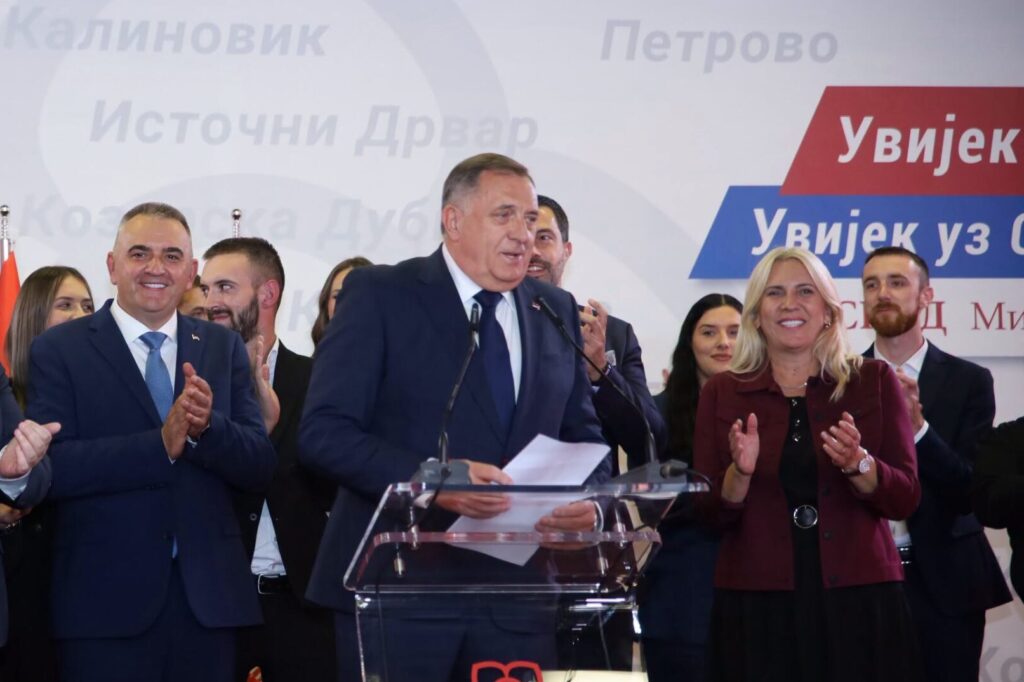
Bosnia and Herzegovina’s EU ambitions face another test after allies of separatist leader Milorad Dodik won key posts in Sunday’s election. Brussels warned that failure to push through reforms could freeze accession progress and put hundreds of millions of euros in EU funding at risk.
Milorad Dodik, the separatist Bosnian Serb leader, did not stand in Sunday’s election in Bosnia and Herzegovina. His allies won anyway in Sarajevo; another, Savo Minić, took the presidency of Republika Srpska, the Serb-majority entity, according to preliminary results.
Mr Dodik’s party keeps substantial influence despite his removal from the same office last year. The vote also fills the three-member state presidency. Denis Bećirović keeps the Bosniak seat. Željka Cvijanović, of Mr Dodik’s party, holds the Serb seat. Darijana Filipović, a newcomer, takes the Croat seat.
Brussels responded on Tuesday. It urged the winners to form governments quickly. It warned that further delays could cost the country more European funding. “The EU calls on all leaders to foster trust between people and communities,” said a statement by Kaja Kallas, the bloc’s top diplomat, and Marta Kos, the enlargement commissioner.
The man who cannot stand
A Sarajevo court sentenced Mr Dodik for failing to comply with rulings by the international envoy overseeing Bosnia’s 1995 peace accords. An appeals court upheld the verdict. It imposed one year in jail and a six-year ban from all political activity. In August 2025, Bosnia’s Central Electoral Commission stripped him of the Republika Srpska presidency. Mr Dodik’s appeal to the Constitutional Court went nowhere.
Mr Dodik has been a key political figure since the 1990s. He is known for nationalist rhetoric and calls for secession, which he says protects Serbs. He casts himself as their defender against Bosniak and Croat leaders. Critics say he undermines state institutions.
Moscow is his strongest foreign ally. Russian officials have given him political support. His administration aligned itself with Russian interests in the Balkans. He criticises NATO and EU influence in the region. Shared Slavic and Orthodox Christian identities underpin the bond, and his rhetoric often mirrors Russian nationalist narratives.
Belgrade is the other patron. Mr Dodik has strong ties with Serbian President Aleksandar Vučić and the ruling Serbian Progressive Party. He often visits Belgrade and has expressed admiration for Mr Vučić’s governance model. The link ties Bosnian Serb interests to Serbia’s and strengthens his political capital.
Russia’s quiet win
The result plays into Russian hands. Mr Dodik’s allies stay at the centre of Bosnian politics — and they are de facto partners of Moscow and critics of Brussels. Their success fits a wider Balkan struggle in which Russian interests counter Western influence. Mr Dodik is a key player in it.
His administration has long resisted the reforms the EU demands. It sees them as a threat to Republika Srpska’s autonomy. His allies’ win suggests the same hostility to Brussels will continue. That hinders Bosnia’s progress towards the EU.
His camp may also put Belgrade and Moscow ahead of Western powers. That could isolate Bosnia further. It could also inflame ethnic tension, because pushes for greater autonomy risk a backlash from Bosniaks and Croats.
An opening without reforms
Winning offices does not settle who governs. The presidency represents Bosniaks, Croats, and Serbs. State, entity, and cantonal legislatures sit beside it. The Dayton constitution gives each people veto rights, which often produces deadlock. Progress needs agreement across all of these bodies.
Mr Bećirović’s Social Democratic Party keeps the Bosniak seat. Ms Filipović brings the Croatian Democratic Union of Bosnia and Herzegovina into the Croat seat. Their priorities must now meet the parliamentary majorities emerging from the vote. “No bloc can win a clean majority, so expect a long coalition fight after the vote,” Amanda Thorpe, Jasmin Mujanović, and Olivia Olson wrote in an Atlantic Council assessment before the election. They warned that the vote was unlikely to resolve longstanding divisions.
To avoid the further loss of funds, the country urgently needs to finalise the legal and institutional framework.
— Kaja Kallas, EU foreign policy head; Marta Kos, EU enlargement commissioner
The EU has already opened the door. Bosnia won candidate status in December 2022. Brussels decided to open accession negotiations in March 2024. The country still awaits its first formal accession conference.
Legislation on the courts and the High Judicial and Prosecutorial Council remains a central requirement. So does agreement on a chief negotiator and the machinery for conducting talks. The presidency helps set direction, but parliament must pass the judicial laws.
The price of delay
EPC analyst Berta López Domènech argued in an April policy brief that recent advances resulted mainly from EU political impetus, not sustained domestic reform. She blamed inconsistent EU conditions, elites’ use of accession for their own interests, and the exclusion of citizens from reforms.
The costs are tangible. EU ambassador Luigi Soreca warned in May that €373.9m from Bosnia’s Growth Plan allocation was at risk. Bosnia had already forfeited €108m. The package combines grants and favourable loans, but reforms must come first.
The figures—which predate the election—are not a new penalty on its winners. Ms Kallas and Ms Kos renewed the warning on Tuesday. “To avoid the further loss of funds, the country urgently needs to finalise the legal and institutional framework,” their joint statement said.
They also called for governments to be formed without delay once results are certified. The test is concrete. Do coalition agreements include the laws and administrative decisions needed to unlock negotiations and payments?
Cleaner voting, same deadlock
The election introduced biometric voter identification and electronic ballot scanners nationwide. International observers found genuine competition and an orderly election day. They also found technical difficulties and problems protecting ballot secrecy.
Observers noted procedural shortcomings during counting. They said discriminatory restrictions based on ethnicity and residence remained unresolved. Better voting technology cannot make parties agree on judicial independence or on how to share authority between institutions.
Europe’s own response adds difficulty. Milan Nič and Nikola Xaviereff of the German Council on Foreign Relations warned on 29 September of weak, disjointed international oversight. They urged a stronger European role.
The result leaves Brussels needing both cooperation and evidence of change. It must work with the leaders voters chose and judge them by what they deliver. The next breakthrough will come when a governing majority passes the required laws, appoints a negotiating team, and makes EU funding available.