Attacks on undersea cables in Europe’s north largely stopped after NATO launched the Baltic operation. But other questions remain unresolved.
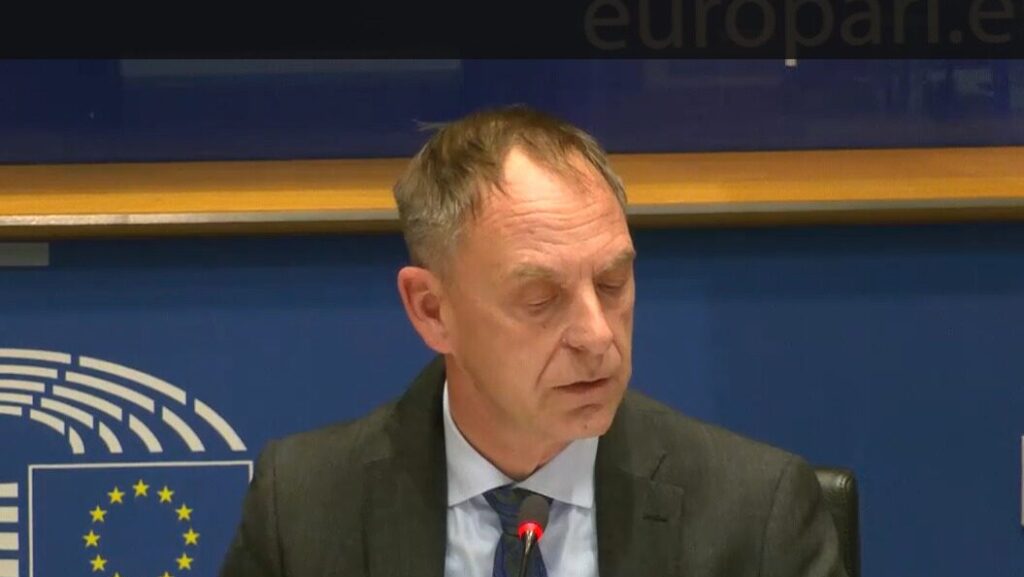
Allied deterrence works, Mr Christian Buck, NATO Assistant Secretary General for Operations in the context of Russia’s ongoing war of aggression against Ukraine, told the European Parliament’s SEDE Committee on 3 November. The last incident came in January, he said.
“It is simply too costly, in terms of reputation and possibly also economically,” the German diplomat added. Russia has since moved to other domains. “So whatever it is, it proves that our measure has had impact.” His message was clear — a modest, flexible activity works.
MEP Ret Gen Christophe Gomart (EPP/FRA), who chaired the session, set the scene. The Baltic Sea, he said, has become a key feature of Russian hybrid war, with airspace violations, sabotage of undersea infrastructure, and GPS jamming. The EU is responding with sanctions on the shadow fleet and a cable-security action plan.
Mr Buck opened with unity. “Our strength lies in our unity,” he said. “We need all allies on board, EU and non-EU alike,” he added. NATO remains the cornerstone of collective defence, he stressed, but it welcomes the EU’s new defence initiatives.
Ukraine shows the point, the NATO official argued. The EU’s support loan is being used to buy American equipment. That is currently the only way to procure critical Patriot interceptors, he said.
A faster alliance
Baltic Sentry rests on changes inside NATO, Mr Buck explained. The alliance’s military commander now holds standing authorities to manage its posture daily. Political decisions at headquarters have been streamlined, with the aim of deciding in hours. “We take decision-making readiness seriously, both at military and political level,” he said.
Planning has changed too. Forces are built against concrete defence plans, not fictitious scenarios. “We now have more troops in high readiness than we ever had before,” Mr Buck asserted. Allies have pledged to spend at least five per cent of GDP on defence, including 3.5 per cent on core requirements.
There’s a difference between what we can do in peacetime and what we would do in defence. — Christian Buck, NATO Assistant Secretary General
Alignment is the third shift. National and NATO plans are being matched, and peacetime activities are synchronised to sharpen situational awareness. Together, Mr Buck said, these changes form the foundation of NATO 3.0, a stronger Europe in a stronger alliance.
Out of this system came the enhanced vigilance activity, or eVA. The commander can stand one up when a specific threat emerges that falls short of triggering defence plans. “EVAs are not the same as operations and missions,” stressed the German. They can be scaled up or down at any point.
Watching the seabed
Some eVAs last days, while others run for months or years. All sit within peacetime authorities. “They are thus not offensive nor aggressive by any stretch of imagination,” Mr Buck said. Even so, he added, they help protect every inch of allied territory.
Baltic Sentry has a clear origin. Incidents, notably towards the end of 2024, damaged critical undersea infrastructure. The activity—set up in January 2025—combines frigates, maritime patrol aircraft, and a small fleet of naval drones. It lets allies plug in their national surveillance assets.
A tool called Mainsail underpins it. The Alliance representative described it as a maritime situational awareness tool covering everything from seabed to space. It fuses public, space-based, commercial, and International Maritime Organisation data. In his words, it shows where the Russian shadow fleet is at any point in time.
The results, he highlighted, are plain to see. “Since its launch, there has been a drastic reduction in incidents related to critical undersea infrastructure in the Baltic Sea,” said Mr Buck. “In fact, the last event we observed took place in January this year and was limited in scope and impact.”
Beyond deterrence
Deterrence is only part of the story. The activity is a testing ground for uncrewed systems. It also trains command relationships, with two headquarters and Combined Task Force Baltic working together. Coast guards and other civilian authorities contribute too, which Mr Buck called a whole-of-government approach.
That approach, he said, will be critical in any conflict. NATO has also built a network on undersea infrastructure linking governments, the military, industry, and partners, including the EU. He welcomed the EU’s cable-security plan. NATO brings military presence, while Brussels brings regulatory and financial tools.
We now have more troops in high readiness than we ever had before. — Christian Buck
MEPs then probed the limits. MEP Riho Terras (EPP/EST) asked about capability gaps, why no similar activity exists in the Black Sea, and why Article 4 is not invoked. Mr Buck replied that Baltic Sentry shows Europeans can do a lot with what they have.
The real shortfalls, he said, lie elsewhere. They include mass uncrewed systems, a digital command and control architecture, and space assets owned largely by one ally. Allies agree this must change urgently. (MEP Pierre-Romain Thionnet (PfE/FRA) was particularly vocal about it.)
The American share and the Black Sea
MEP Nathalie Loiseau (Renew/FRA) asked how much the Americans contribute. “The US does not have currently assets, maritime assets or air assets in this enhanced vigilance activity,” Mr Buck answered. The patrol aircraft are European, though an American four-star general leads the command.
Ms Loiseau then turned to the Black Sea. “What is NATO going to do when Bulgaria, Romania, Türkiye are asking themselves questions and facing the consequences of the attacks led by Russia?” she asked the most pointed question of the afternoon.
The reply was careful. Those three states, Mr Buck noted, have not asked NATO to operate there. “The problem in the Black Sea is quite different in the moment,” he said. NATO has awareness and holds exercises, but does not operate there.
On Article 4, he was firm. Weekly consultations would risk devaluing a powerful instrument. “So Article 4 is used judiciously and, if necessary, if member states so request,” he said. Russia, he argued, tries to challenge the alliance just below any threshold.
Attribution and the bill
MEP Sven Mikser (S&D/EST) asked about the political side of deterrence. Perpetrators are often non-state actors, he noted, so how well is NATO attributing attacks and acting against the states behind them? Mr Buck’s answer was unambiguous. “Attribution is a deterrence,” he said, promising that “NATO’s attribution will be more frequent, as we’ve seen in several cases recently, and that will raise the cost”.
Attacks in the Baltic have largely ceased, he argued, because prosecution would cost too much in reputation and money. NATO runs a network that collects data and compares forensics. Attribution remains a national task. The aims behind such attacks, he said, are to destroy unity and resolve to support Ukraine.
Since (the Baltic Sentry) launch, there has been a drastic reduction in incidents related to critical undersea infrastructure in the Baltic Sea. — Christian Buck
MEP Mārtiņš Staķis (Greens-EFA/LAT) called Baltic Sentry a success but found its costs unfair. “Is there any way we could make those who were responsible actually pay this bill?” he asked. Mr Buck was candid. “This is of course a question of jurisdictions which NATO as an alliance does not possess,” he said.
Courts might one day award damages, he added, and EU sanctions can raise costs for state-backed perpetrators. He drew a lesson from Ukraine, where cheap attack systems face costly defences. Whoever tilts that balance gains an advantage, he stressed, and the commander’s strategy aims to deny it.
Proof and jurisdiction
Mr Gomart asked the last hard question. “How do you evaluate the deterrent effect if an adversary changes terrain?” he asked. Mr Buck conceded that proof is difficult. Russia has moved to other domains, he said, but that is itself telling. “So whatever it is, it proves that our measure has had impact,” he said.
Who should act against shadow-fleet vessels passing Denmark? It is a matter of jurisdiction, said Mr Buck. NATO can show presence but cannot block in peacetime. “I think there’s a difference between what we can do in peacetime and what we would do in defence,” he said. Member states, and possibly the EU, hold the tools against sanctions evasion.