From testing spare parts for circularity to recycling titanium shavings, sustainability policies may help arms industry contractors cut strategic dependencies.
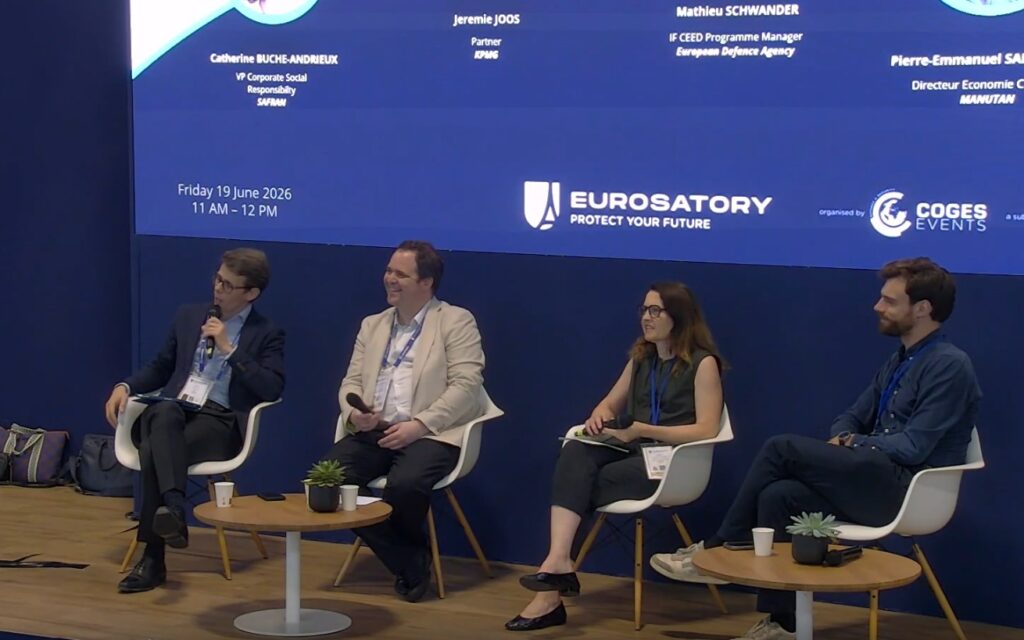
The think-tank Ideas posed a blunt question at a KPMG-led autumn defence debate: are sustainability and competitiveness adversaries or allies for defence players? The panellists, all of them heavily invested in all things ESG, put on a brave face. Their answer was that the seemingly disparate influences do not have to be contradictory. The speakers backed the idea with examples ranging from engines to warehouses to European armed forces.
KPMG partner Jeremie Joos, who leads the firm’s ESG activities in France said the defence sector bundles problems that sustainability can solve. They include energy intensity, the availability of metals and materials, and possible supply-chain disruption. “In short, every time we look at the issue of sustainability in the defence sector, this very quickly leads to questions of competitiveness and sovereignty,” said Mr Joos.
A cost that pays back
Mr Joos set out the opposing view first. A common line says that when Europe invests in sustainability, China and the US invest in their competitiveness. Another says all of it is cost, not profitability. He said the same debate runs through consumer goods and agribusiness. “Because ultimately, when I decarbonise well, I’m much better at energy efficiency and therefore at my costs. When I develop circularity, I regain control over my value chain,” he said.
Mr Joos introduced three other panellists: Catherine Buche-Andrieu, vice-president for corporate responsibility at aircraft equipment manufacturer Safran; Pierre Emmanuel Saint-Esprit, director for circular economy at workplace equipment supplier Manutan; and Mathieu Schwander, a programme manager at the European Defence Agency (EDA). He opened with a definition of the circular economy. He said it preserves the highest value of equipment, components and materials for as long as possible. “To simplify it means doing the most with what you have,” he said.
With titanium (…) until 2022, 50 per cent of the material came from Russia. So we went from one dependency to another.
— Catherine Buche-Andrieu, Safran
He called that the daily life of soldiers, from cannibalisation to sharing spare parts. He said EDA guidance, including the Capability Development Priorities and the White Paper on Defence, sets the direction. Circular economy is one pillar for readying European armies by 2030.
Operational need still comes first. “We cannot afford to have a spare part which does not meet performance,” said Mr Schwander. His projects test titanium and nickel recycling, a digital passport for bulletproof vests, and a mobile laboratory to qualify additively manufactured spare parts.
A swapped dependency
Ms Buche-Andrieu said Safran treats sustainability as strategy. “It’s part of our reason for being, because in fact, our raison d’être is to sustainably change the airline industry, aviation and contribute to a safer world,” she said.
Titanium shows the stakes. “With titanium, we realised that we were completely dependent on a number of countries. Until 2022, 50 per cent of the material came from Russia,” she said. Safran then turned to the US. “So we went from one dependency to another,” she said.
Safran produces the Rafale engine. “We cannot afford to be dependent on major foreign powers on the subject of this matter, this critical matter,” she said. Safran committed to acquiring French player Aubert et Duval, with Airbus. It aims to return at least 60 per cent of titanium shavings to the supplier for reuse.
Sovereignty as a selling point
Mr Saint-Esprit described the buyer’s lot. “I will begin by saying that the job of direct or indirect buyer has become almost impossible,” he said. He said resilience and decarbonisation now join cost cutting.
Customers including EDF and La Poste, and defence firms such as MBDA and Thales, demand a geostrategic and climate continuity plan, he said. Manutan has 14 warehouses in seven countries. “Manutan is a family business, 100 per cent owned by a French family, European, and therefore, consequently there is no influence,” he said. He warned that a foreign government could cut supply overnight. “So you need to make sure that we are not held hostage by this issue,” he said. “80 per cent of the products we sell are made in Europe,” said Mr Saint-Esprit. “We did it once for an environmental issue and now it is obviously an issue of sovereignty.”
The job of direct or indirect buyer has become almost impossible. — Pierre Emmanuel Saint-Esprit, Manutan
On governance, Ms Buche-Andrieu said: “I think there are different levers involved.” Top management support is essential, she said, but not enough. Safran handles sustainability at executive committee level and builds it into its roadmap, risk management and performance targets. It also trains employees.
“And so, since it’s a complex and transformative subject that takes a great deal of time, it needs constant forceful pushes to prevent it from falling into oblivion,” said Mr Saint-Esprit. He urged firms to price avoided risk, as many already price carbon.
One sovereignty or many?
Mr Schwander said EDA created the effort in 2021 to mobilise defence ministries, industry, technical centres, universities, Commission representatives and financial institutions. “Of course, we are the intergovernmental agency, the agency of the 27 defence ministries of the European Union,” he said.
Recyclers told the agency that the digital passport would work for them. “It makes life easier and we see value in our work,” said Mr Schwander. “This is a twofold issue, that is to say both energy supply and cost control,” said Mr Joos. He said power purchase agreements now work as hedging instruments. They cover energy costs over the medium and long term.
Another questioner asked whether one sovereignty could conceal another. Ms Buche-Andrieu said the Aubert et Duval deal serves defence and civil activities. “In fact, this acquisition was really made to reduce our dependence,” she said.
She said the circularity models serve both sectors and could help nuclear and naval industries. Mr Joos then made a point about the debate itself. “And as you saw, reporting wasn’t mentioned even once,” he said.
What Brussels has written
The EU rulebook gives the panel’s argument a legal frame. The Sustainable Finance Disclosure Regulation does not exclude defence as a sector. Only prohibited weapons trigger mandatory negative indicators. A benchmark regulation narrows automatic exclusions from mid-2026.
The Taxonomy Regulation lets defence firms claim alignment for horizontal activities, such as energy, buildings and transport, if they meet screening criteria. The reporting directive requires ESG disclosure from the 2025 financial year. Firms may withhold classified information.
To simplify means doing the most with what you have.
— Mathieu Schwander, European Defence Agency
The due-diligence directive treats defence like any other industry. Its first application comes in 2027. A Commission notice recognises a social objective, and the InvestEU Defence Equity Facility received a €50m in March 2026.
Money and exemptions
The 2025 EDIP Regulation offers €1.2bn to €1.5bn to reinforce the industrial base. It may trigger priority contract execution obligations and a buy-European preference. Articles 12 to 15 permit mandatory prioritisation of defence orders across supply chains in a crisis.
A Defence Readiness Omnibus package proposes broader exemptions in REACH, CLP, POPs and environmental directives. It treats defence readiness as an overriding public-interest ground. It would also allow derogations in Habitats, Water and Waste Shipment rules.
Brussels announced expanded REACH Article 2(3) defence derogations in June 2025. The 2026 Parliament compromise kept the proportionality test. Member states can still invoke Article 346 TFEU for essential defence interests, and often do.
The rules and the cases
Brussels now writes rules—some still under negotiation—for the sector. The Commission also clarified that ESG frameworks should not become de facto capital-market barriers. It urges investors to avoid blanket exclusions.
Every time we look at the issue of sustainability in the defence sector, this very quickly leads to questions of competitiveness and sovereignty
— Jeremie Joos, KPMG
Mr Joos ended on the debate’s core. “Being at the heart of the business, it is to be at the heart of what is being delivered, it is to be at the heart of what also makes the model of our armies so robust,” he said. Time will tell whether his optimism was justified.