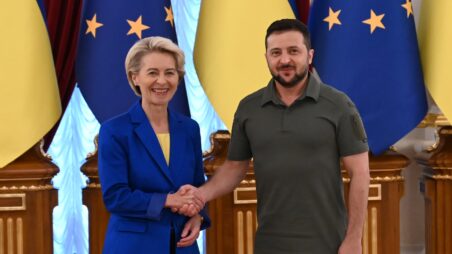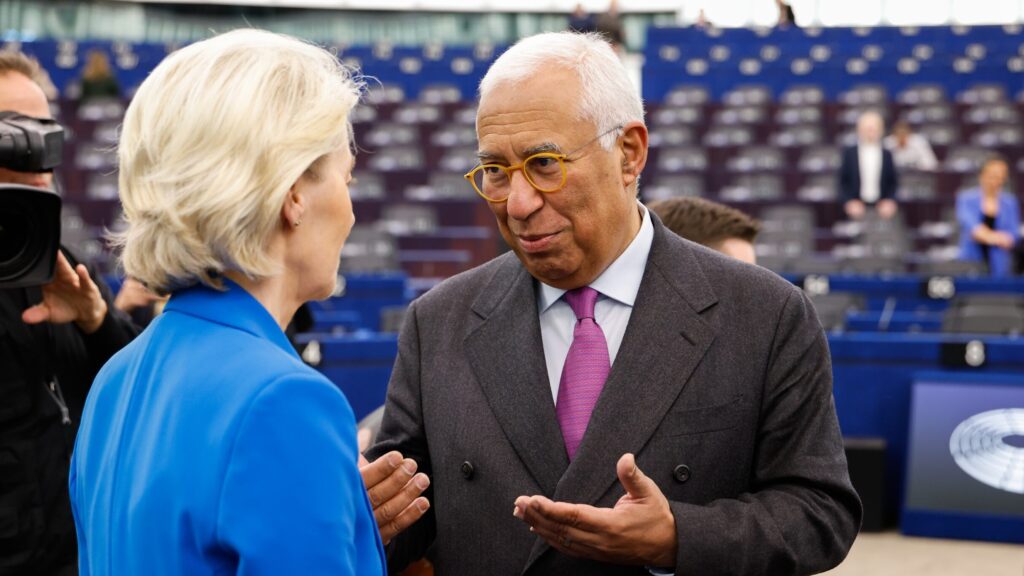
European Council President António Costa and European Commission President Ursula von der Leyen put Russia at the centre of the Union’s defence efforts. They briefed the European Parliament in Strasbourg on Wednesday on last week’s European Council summit.
“By protecting Ukraine, we’re protecting ourselves,” MEP Valérie Hayer (Renew/FRA) declared, delivering one of the strongest lines of the debate. She spoke after two leaders told Parliament that Russia threatens Europe directly. “If Ukraine falls, it is our security which is directly threatened,” the French member added. Her warning set the tone for a debate that, when it came to defence, ran from Ukraine’s battlefield to sanctions to border threats.
Mr Costa spoke first and tied Ukraine’s fate to Europe’s own. He opened his defence argument with a warning about Russia. Then he informed the chamber that Ukraine’s security and Europe’s security are unbreakably connected. He also proceeded to explain why. “Russia’s hybrid war campaign and its acts of sabotage attacks on European airspace and territorial waters remind us that the security of Ukraine is the security of Europe,” the Council president remarked.
Sanctions, gas and doubts
Ms von der Leyen turned to energy sanctions on Russia. The EU imposed them because of Russia’s war of aggression against Ukraine. She left no room for doubt about their future — and she then set the condition. “I want to be crystal clear: these sanctions will stay until Russia stops the war,” she said.
The Commission president drew on Europe’s own experience. She said Russia is not a trusted supplier of energy. Russia, she said, would weaponise energy dependencies to blackmail others. “It was Russia that cut Europe’s supply of gas. That is a lesson that Europe certainly will not forget,” she added.
The war will be decided in our political will, whether we stand up for freedom and democracy. — MEP Manfred Weber (EPP/DEU)
MEP Iratxe García Pérez (S&D/ESP) wants Europe to spend on defence. She named the aim. “We want a Europe that invests in defence, so that we can fight against Putin,” the newly re-elected Socialist leader said. She also stressed farmers, because security depends on food sovereignty. She opposed budget cuts that make Europe choose between priorities.
João Oliveira (The Left/PRT) criticised the summit’s handling of Ukraine. He spoke of 40 hours of debate without decent conclusions. “There’s not a single political initiative or diplomatic initiative to put an end to the war in Ukraine, to create peace and security that every people in Europe needs,” he pointed out.
Money and peace
Mr Costa said he would summon a second meeting of leaders at Alden Biesen in February. They will assess progress on competitiveness and defence there, he said, and renew their political commitments. “So we will implement our defence strategy and we will be bolstering our capacity to protect our citizens and our critical infrastructure,” he said.
The Council president also promised steady support for Ukraine. Europe and its member states provide 80 per cent of Ukraine’s external aid, he said. He wants other countries to share the load. “Our international partners also need to step up and intensify their efforts,” he said. “Our determination to support Ukraine and its people is stronger than ever.”
By protecting Ukraine, we’re protecting ourselves. — MEP Valérie Hayer (Renew/FRA).
The EU has paid out €16bn this year as part of the defence component of the loan to Ukraine, Mr Costa said. It will pay out €17bn in budgetary assistance—conditional on reforms—this year. “We will honour our commitments. We will respond to the financing needs of Ukraine as required for 2027,” he said.
Mr Costa set out the EU’s approach to peace. “Our commitment to peace thus has to keep step with sustained pressure on the aggressor,” he insisted. He also named his goal. “Our objective remains a fair and lasting peace on conditions that respect the sovereignty and security of Ukraine,” the Portuguese repeated a well-worn phrase.
Threats at the border
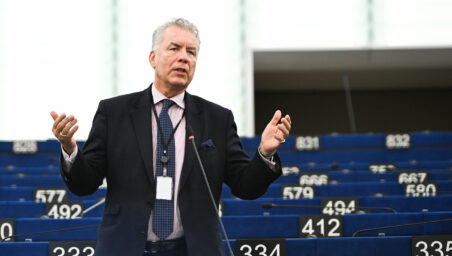
MEP Manfred Weber (EPP/DEU), leader of the most numerous parliamentary faction, said the winter ahead will test Europeans again. He tied the war’s outcome to politics, not the battlefield alone. “The war will not be decided on the front line,” he said. “The war will be decided in our political will, whether we stand up for freedom and democracy.”
Mr Costa said the EU must prepare for state and non-state actors that deliberately exploit migration. Ms von der Leyen named two of them. She said Russia and Belarus have weaponised migration. This summer, she said, showed how quickly new threats can emerge at the borders. “State and non-state actors are deliberately engineering mass movements of people,” she said.
We will not allow anyone to exploit our values, to put pressure on our Union. — Ursula von der Leyen, European Commission president
The Commission chief spelled out the goals of those behind it. “They want to overwhelm authorities,” she said. They also want to spread fear and divide the Union, she added. Her answer was short. “They will not succeed. We will not allow anyone to exploit our values, to put pressure on our Union,” she said defiantly.
The Commission will respond with a new proposal. Ms von der Leyen called it a European Emergency Response Framework. It would give member states a tool to respond quickly to extraordinary threats at the external borders. She set a deadline. “We will present this proposal on the European Emergency Response Framework by the end of this year,” she said.
Calls for “more firepower”
MEP João Cotrim de Figueiredo (Renew/PRT) criticised last week’s Council for inaction, saying it brought “sounds of joy in Moscow” because Ukraine did not get the €70bn it asked for. His party colleague MEP Laurence Farreng (Renew/FRA) voiced a similar sentiment, saying Mr Trump is again betraying Ukraine through deals with Mr Putin. She wants Europe to protect Ukraine’s sky, use frozen Russian assets and stand up to Mr Trump. She also wants a budget with new resources that gives more “firepower”.
MEP Alice Kuhnke (Greens-EFA/SWE) said that freedom and defence are preconditions for dealing with the challenges Europe faces. She wants the EU to fight disinformation and support independent media and civil society. These, she said, are the societies Putin wants to destroy.
I want to be crystal clear: these sanctions will stay until Russia stops the war. — Ursula von der Leyen
“We will propose to reinforce Frontex so it can support member states whenever and wherever needed, including on returns,” Ms von der Leyen said. That means giving it the mandate and the capabilities that this new reality demands, she added. In a related section of his speech, Mr Costa said the Commission will work with member states on a European emergency reaction capacity.
The anticlimax
Extreme voices, however, dominated parts of the debate. MEP Catarina Martins (The Left/PRT) accused Ms von der Leyen of wanting more money for the arms industry, “taken from schools”. At the other fringe, MEP Mary Khan (ESN/DEU) called mass migration at Ceuta “a weapon against our continent”. She said there has been no will to defend Europe.
Most of the Wednesday’s debate, ranging way beyond defence matters, felt like a bit of an anticlimax. The MEPs aired their numerous grievances with gusto (too many migrants, too many rules, Turks bad to Cyprus, too high living expenses). Ms von der Leyen, however, left the premises shortly after her opening remarks due to other arrangements. As a result, the members‘ valuable ideas about various aspects of Brussels policies rang through the chamber without ever reaching her ears.