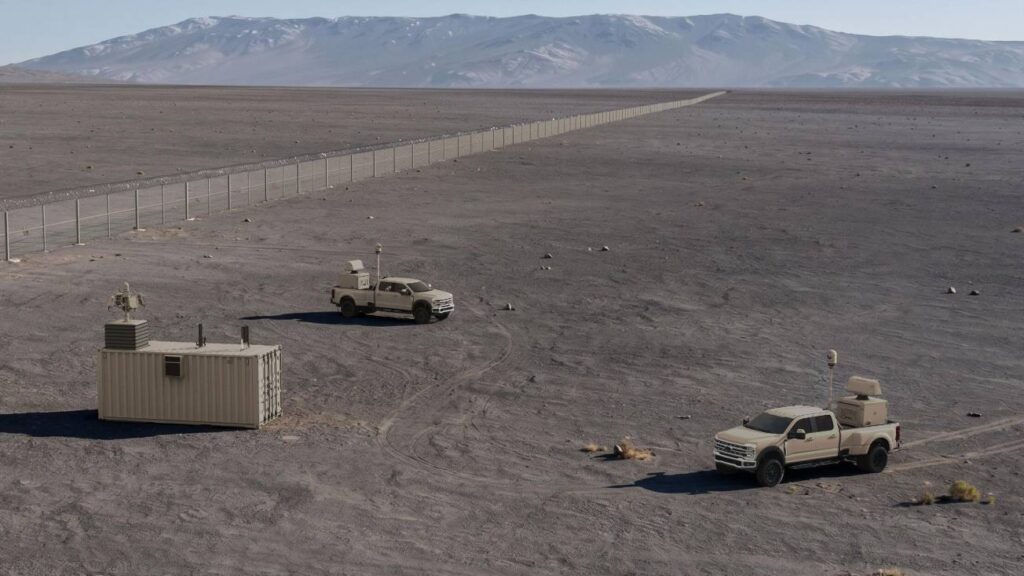
A British firm has won a £370m deal to shield the tiny Arab country from cheap drones. The same AI-driven system may find buyers in Europe as well.
A British company has won a £370m contract to defend the whole of Kuwait against drones. MARSS, a subsidiary of Electro Optic Systems (EOS), will build the system over 24 months. It is to detect threats that approach from the air and from the sea, the company has announced.
Drones have been all the rage for the past couple of years. Recent conflicts in the Middle East have shown the damage they can inflict. They have also exposed the limits of air defences that rely on expensive interceptor missiles, which are to destroy incoming targets.
The cost mismatch is the heart of the problem — a costly missile aiming at a cheap drone is a poor trade. Andreas Schwer, chief executive of EOS, makes the point: “Air defence is being redefined by the drone. Nations can no longer afford to answer low-cost threats with high-cost interceptors, and they need integrated systems that can respond faster than the threat.”
MARSS will act as prime contractor and systems integrator. In plain terms, it will be responsible for the whole project and for making the different parts work together. The contract calls for rapid deployment of what the company describes as a cellular system, built from a network of sites.
Eyes, brains, and weapons
The system starts with sensors. The company will install electro-optical sensors, which are cameras that pick up light, along with radar and sonar. Radar uses radio waves to find objects in the air. Sonar uses sound to find them in water. All of them will feed central command centres.
The brains of the operation are NiDAR, a piece of software. It is an AI-enabled command and control system, meaning a programme that gathers information and helps people decide what to do. It will fuse the sensor data into threat assessments. MARSS says this gives hemispherical coverage, in effect a dome of protection, against drones in the air and along the coast.
Countering drones and aerial threats is not about any single system. It is about an intelligent, layered architecture that detects, decides and defeats within seconds. — Johannes Pinl, MARSS
NiDAR uses artificial intelligence to classify threats automatically and to recommend how to respond. This, the company says, reduces the mental burden on human operators. It also claims the software dramatically shortens the time between spotting a threat and dealing with it.
The contract also covers the initial supply of two kinds of weapon. Hard-kill interceptors destroy a target physically. Soft-kill jammers stop a drone without destroying it, by interfering with its control. Through NiDAR, operators can pick the most appropriate response for each situation.
Layers and speed
Johannes Pinl, chief executive of MARSS, argues that no single device can do the job. “Countering drones and aerial threats is not about any single system. It is about an intelligent, layered architecture that detects, decides and defeats within seconds, and MARSS has built exactly that.”
A layered defence means several types of protection working together. A cheap jammer may suffice for one threat, while another may call for an interceptor. The aim is to avoid using the costliest weapon every time. That is the logic behind pairing the two kinds of weapons in one system.
MARSS says the contract builds on NiDAR systems it has already fielded in the Gulf region. According to the company, these have been in operational use throughout the recent crisis. The Kuwaiti deal extends that approach to nationwide scale. The firm adds that NiDAR has more than 60 deployments worldwide.
EOS sees the contract as a signal of wider demand. “Kuwait’s decision to deploy this capability nationwide shows where the market is heading, and it positions EOS as a leading provider of integrated counter-drone defence,” said Mr Schwer. EOS designs and exports defence and space systems, and has done so for more than 40 years.
Jobs at home
The deal matters in Britain, too. The contract is likely to create around 100 new jobs in the UK, across MARSS and its supply chain. These are high-end engineering and manufacturing roles. Some production is to be based in Bristol, and MARSS will expand its wider UK offices to support delivery.
Mr Pinl stressed the domestic benefit. “Over the coming 24 months, MARSS will integrate the sensors and effectors that protect Kuwait’s people, critical infrastructure and national assets, backed by British engineering and new skilled jobs here in the UK.” A team will also deploy to Kuwait to deliver the work. Recruitment is already under way.
The contract forms part of the UK government’s Taskforce Sabre. The initiative brings together government and industry to help Gulf states rapidly secure the systems they need. MARSS is thus selling not only a product, but also a policy aim.
Delivery will be phased over 24 months. MARSS will also run a training package lasting several months, with personnel on the ground to teach operators to use the sensors, the effectors, and NiDAR. A multi-year Integrated Logistic Support programme will follow. That is the long-term support needed to keep equipment working.
On show
MARSS is exhibiting at SOFEX 2026 on stand H101 from 27 to 29 October. Visitors can see a live demonstration of NiDAR and meet the team. The software will also be shown integrated onto vehicle platforms around the exhibition.
Those vehicles will appear alongside EOS remote weapon stations, which are guns that operators control from a distance. The display gives potential buyers a look at how the pieces fit together. It also shows how EOS wants to present counter-drone defence: as a single package, not a set of separate products.
Nations can no longer afford to answer low-cost threats with high-cost interceptors, and they need integrated systems that can respond faster than the threat. — Andreas Schwer, EOS
MARSS says it has about 20 years of experience. It cites research collaboration with the EU, NATO, defence agencies, academia, and industry. Whether Kuwait’s nationwide system performs as promised will become clear only once it is built and tested.
Europe may offer another market, though nothing is confirmed. NiDAR has not been shown to have received funding from the European Defence Industry Programme (EDIP) or to have been picked for one of its projects. EDIP allocates €1.5bn for 2026–2027 to expand defence production, common procurement, and strategic defence projects.
A European opening
Within that sum, €240m is earmarked for joint procurement by EU member states and Norway, including counter-drone systems. Grants may reach €20m per project. The counter-drone call covers integrated systems and components, such as sensors, kinetic and non-kinetic effectors, directed-energy weapons, and command-and-control tools. It also aims to replenish depleted stocks.
A separate €80m topic concerns unmanned and counter-unmanned systems. A proposed European Defence Projects of Common Interest initiative, called DECODER, would coordinate the development, scaling, and deployment of such systems. It includes joint procurement, expanded production capacity, and a European network of drone-technology hubs.
As to MARSS, the future’s not ours to see. It could join a consortium of contracting authorities, partner with European firms, or offer NiDAR as the command-and-control and sensor-fusion layer in a larger package. It could also seek a place in a future DECODER consortium.
A caveat applies. EDIP is meant to raise production capacity, reduce fragmented national procurement, and rebuild stocks. It is not an automatic subsidy for commercially available products. Proposals must meet consortium, European industrial-control, procurement, and capability requirements.