Floods, storms, and droughts have cost the EU more in the past five years than in any other five-year stretch since 1980. Most of that bill never reaches an insurer. Households, businesses, and governments pay it themselves, while Europe’s efforts to adapt fail to keep pace.
Extreme weather events caused approximately €920bn in direct economic losses across EU member states between 1980 and 2025, the European Environment Agency (EEA) reports in its updated data. More than €270bn came in the last five years alone, nearly a third of the total.
The figures make 2021–2025 the costliest five-year period on record, highlighting the growing economic burden of extreme weather across Europe. The estimates cover only direct economic damage, excluding indirect costs such as lost productivity, impacts on GDP, environmental impacts, and consequences for human health.
With extreme weather events expected to intensify further, the agency warns that Europe’s adaptation efforts are not keeping pace. The European Climate Risk Assessment estimates annual losses of at least €175bn across the EU and the UK at 3°C of global warming.
You might be interested
Floods as the biggest bill
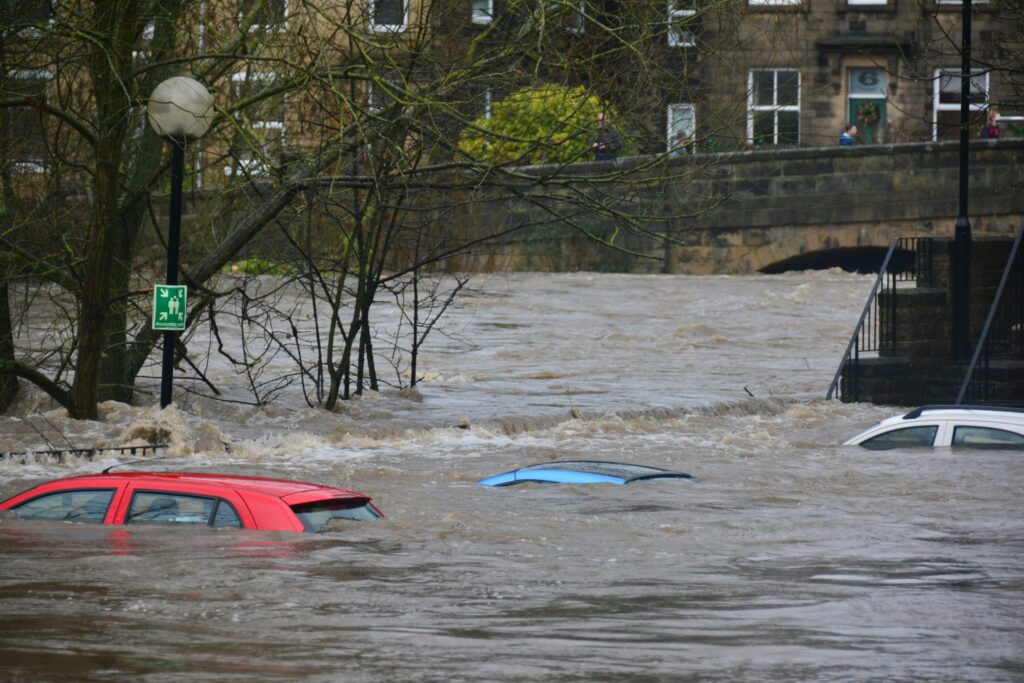
Flooding has been the most economically damaging type of extreme weather event in the EU, accounting for 44 per cent of total losses between 1980 and 2025. Climatological events, including droughts, cold spells, and frost, accounted for roughly a quarter of the losses, as did meteorological events such as storms and lightning. Wildfires, hail, and heatwaves together represented around five per cent of the total.
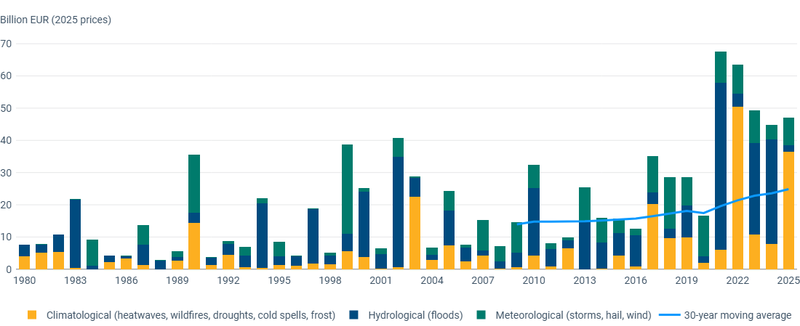
The EEA data also reveal that a relatively small number of extreme events caused most of the economic damage. Just five per cent of these events accounted for 63 per cent of total losses, while the top one per cent alone caused 31 per cent.
Uneven damage, uneven insurance
The economic impact of extreme weather differs significantly between EU member states. In absolute terms, Germany, Italy, and France recorded the highest economic losses between 1980 and 2025. However, when adjusted for population size, Slovenia, Spain, and Luxembourg were the hardest hit. Slovenia also topped the ranking for losses relative to land area, followed by Belgium and Luxembourg.
According to the EEA, less than 20 per cent of the total economic losses recorded across the EU during the period were insured. In Bulgaria, Cyprus, and Romania, insurance covered less than two per cent of losses, compared with more than 60 per cent in Denmark and Luxembourg. This means that insurance did not cover the vast majority of the economic damage caused by extreme weather across the EU, leaving households, businesses, and governments to bear the costs.
From disaster response to prevention
As extreme weather intensifies, the EU is seeking to strengthen its ability to anticipate and withstand climate-related risks. On 27 October, the European Commission presented its new EU Framework for Climate Resilience. It includes a proposal for a European Climate Resilience Law and a set of practical tools to help member states better prepare for climate risks and reduce potential damage.
2026 is already a year of heavy losses due to weather and climate-related extremes. — European Environment Agency, press release
The initiative also aims to shift the EU’s approach from responding to disasters towards preventing avoidable losses. The pressure is not easing. “2026 is already a year of heavy losses due to weather and climate-related extremes,” the EEA warns, pointing to storms, heatwaves, and droughts. “And the year is not over yet.”