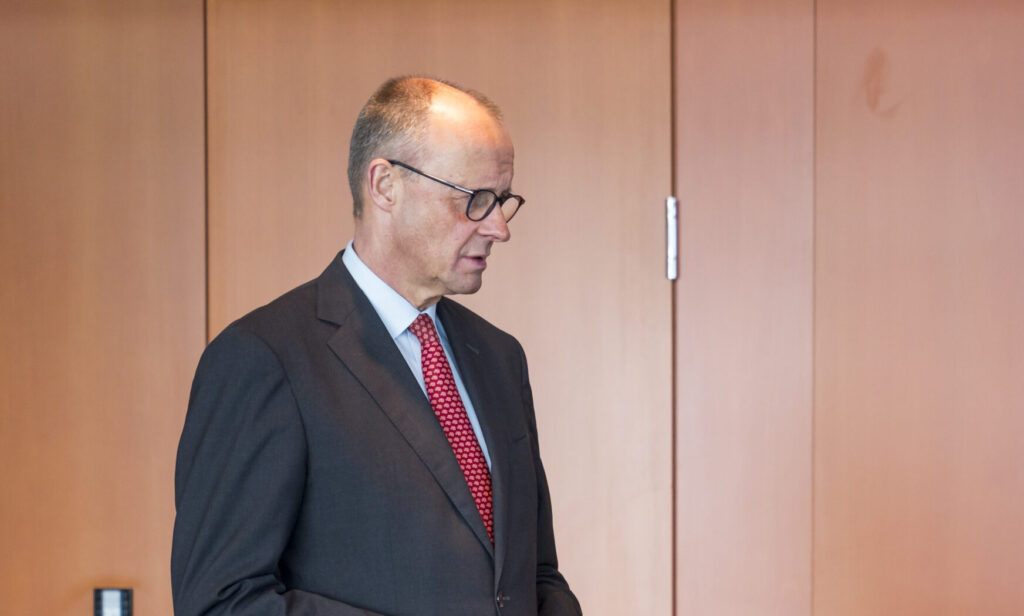
German Chancellor Friedrich Merz has urged Ukraine to press on with reforms of the rule of law and to intensify its fight against corruption.
The demands carry weight — they are central to Kyiv’s economic future. Mr Merz’s message came at the 9th German-Ukrainian Economic Forum in Berlin, where more than 500 guests were expected on Friday. The demands, reported first by German media, are a condition for investment and for Ukraine’s path to the European Union.
The timing of the Bundeskanzler’s remarks was significant. At home, he is facing a multi-pronged government crisis. The opposition AfD party, with its infamous far-right and pro-Russia leanings, has been gaining ground while street protests rattle the country’s cities. And even as the majority of Germans support Ukraine in theory, Mr Merz’s pro-Kyiv stances are not universally popular.
Reform as a condition
At the same time, Ukraine is facing an intense aerial campaign from the east, as Vladimir Putin’s Russia is trying to bomb the country’s leadership into submission ahead of planned peace talks. No official response from Kyiv to Mr Merz’s remarks was available at the time of writing.
You might be interested
Senior officials from both governments were due to attend the forum. Germany’s delegation included Economics Minister Katherina Reiche and State Secretary for Development Cooperation Niels Annen. Ukraine’s delegation was led by Prime Minister Serhii Koretskiy, alongside Economics Minister Oleksandr Kravchenko.
Peter Adrian, president of the German Chamber of Commerce and Industry (DIHK), acknowledged the strain on Ukraine. “Even in the fifth year of the war, Ukraine must overcome enormous challenges every single day. However, the determination with which people and businesses there shape their economic future is remarkable.”
The German economy’s commitment to Ukraine is (…) assisting a country that has been fighting for its freedom—and for Europe’s freedom—for years. — Christian Bruch, chief executive of Siemens Energy
The event is hosted by the DIHK, the Committee on Eastern European Economic Relations (OA), and the German-Ukrainian Chamber of Industry and Commerce (AHK Ukraine). Its programme spans business, politics, and institutions. Mr Adrian set out what German firms need. “Nevertheless, promises of support must translate into economic opportunities. Companies need conditions that allow them to take on projects, invest, and create jobs despite significant risks.”
Christian Bruch, deputy chairman of the OA and chief executive of Siemens Energy, framed the relationship in wider terms. “The German economy’s commitment to Ukraine is much more than an economic issue. It is about assisting a country that has been fighting for its freedom—and for Europe’s freedom—for years.”
Trade, finance, and defence
Mr Bruch also pointed to trade figures. “The expected bilateral trade growth to €13bn in 2026 is a strong and encouraging signal. Our goal must, therefore, be to facilitate investments and further integrate Ukraine into European supply and innovation chains.”
Oliver Gierlichs, president of AHK Ukraine and managing director of Bayer in Ukraine, linked investor confidence directly to governance. “Ukraine has proven its resilience in recent years while also aligning itself with European standards. For international companies, reliability, progress on reforms, and planning security are decisive factors.”
Several agreements are expected to be signed at the forum. A declaration of intent on advanced training for Ukrainian specialists involves the Federal Ministry for Development Cooperation, the Ukrainian Ministries of Economy and Environment, KfW, Siemens Energy, and other German energy companies. The aim is to embed the training in Ukraine’s vocational system.
The Green for Growth Fund and ProCredit Bank Ukraine plan a five-year synthetic credit facility in Ukrainian hryvnia, equivalent to €10m. It will support renewable energy, energy efficiency, and resource efficiency projects. Targeted cash grants for final borrowers will supplement the facility. Selected Ukrainian companies, including Auterion and Tencore, also display security and defence technology at the Haus der Deutschen Wirtschaft.