The European Commission wants to give member states more leeway in tackling the energy crisis, from price interventions to targeted support for industry and households. At the same time, it is pushing to speed up electrification and the rollout of clean energy — betting that faster action can ease short-term pressure while cutting long-term reliance on fossil fuels.
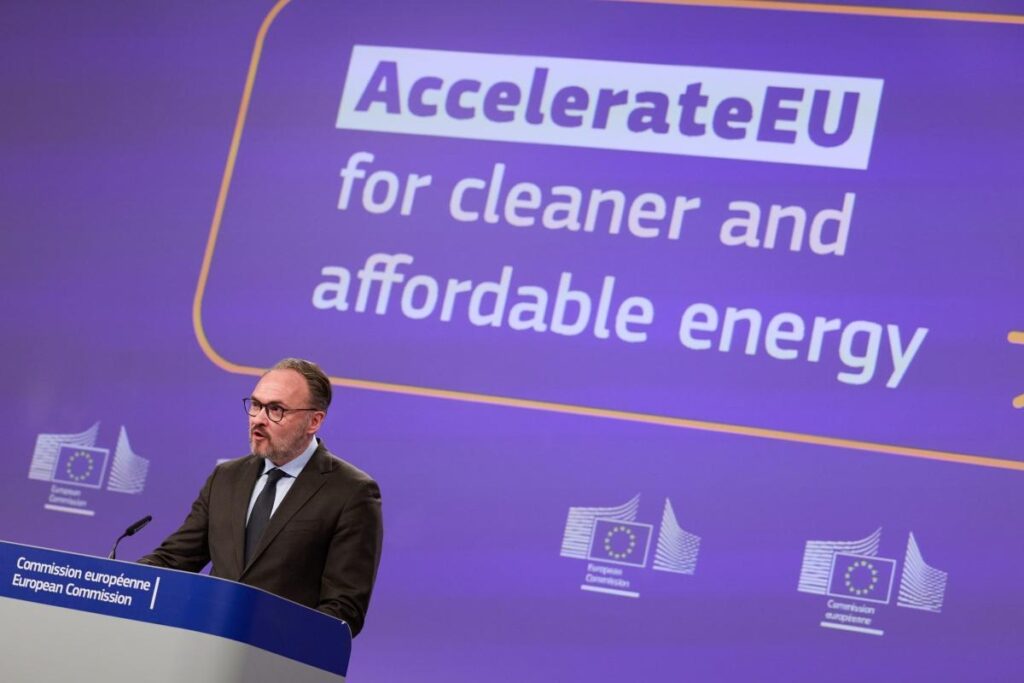
The Commission on Wednesday unveiled a broad package of recommendations under the name AccelerateEU in response to the ongoing fossil fuel energy crisis. The plan focuses on adapting existing energy rules to better reflect current market pressures and on strengthening coordination among member states. It also includes an annex listing a set of measures that governments could employ at the national level.
Since the outbreak of conflict in the Middle East in late February 2026 and the closure of the Strait of Hormuz, the EU has incurred an additional €24 billion in fossil fuel import costs. Although Iran and the United States have agreed to a temporary ceasefire, conditions in the Strait of Hormuz remain unstable. Reports of container ships coming under fire continue, sustaining pressure on fossil fuel markets.
“Our AccelerateEU strategy will bring both immediate and more structural relief measures to European citizens and businesses,” Commission President Ursula von der Leyen said in a statement. “We must accelerate the shift to homegrown, clean energies. This will give us energy independence and security, and mean we are better able to weather geopolitical storms.”
Jet fuel shortages
One of the most pressing issues that Europe is currently facing is a looming shortage of jet fuels. Fatih Birol, the head of the International Energy Agency (IEA) said last week that Europe has “maybe six weeks or so of jet fuel left”.
To combat jet fuel shortages, the Commission said it will set up a fuel observatory to monitor jet fuel supplies. “Coordination is key,” the Commission wrote in the AccelerateEU press release Wednesday, stating that it will work with member states, fuel suppliers and the aviation sector to ensure fuel availability. The EU could also review its rules on strategic stocks to include specific jet fuel requirements.
We must accelerate the shift to homegrown, clean energies. This will give us energy independence and security, and mean we are better able to weather geopolitical storms. — Ursula von der Leyen, European Commission president
How dire the shortages currently are remains unclear. On Tuesday, EU Transport Commissioner Apostolos Tzitzikostas stated there are no indications of jet fuel shortages yet. On Wednesday Energy Commissioner Dan Jørgensen did say that “we can indeed end up in a situation that can cause real problems” if the outlook changes.
Electrification bottleneck
Another key element of the AccelerateEU plan is urging member states to accelerate negotiations on the European Grids Package, aiming for swift adoption before summer 2026. The proposal is currently under discussion in the European Parliament and the Council of the EU.
“We need to speed up the expansion of our grids and the deployment of new infrastructure,” Mr Jørgensen said. He identified insufficient grid capacity as “the biggest bottleneck in Europe’s green transition”, stressing the urgency of both upgrading existing networks and building new ones.
Ahead of the summer, the Commission is expected to present an Electrification Action Plan. This plan will set electrification targets and outline measures to support the transition of industry, transport, and buildings toward electricity. The objective is to reduce the EU’s overall dependence on fossil fuels.
Temporary emergency measures
The European Commission also announced it will introduce a temporary State Aid framework. This will allow member states to implement temporary emergency measures to support some of the economic sectors most exposed to price spikes.
As we cannot predict anything, we need to be prepared for everything. — Dan Jørgensen, European Commissioner for Energy and Housing
According to a draft Commission proposal, new state aid rules might include allowing the state to cover 70 per cent of wholesale power bills for heavy industry until the end of the year, up from 50 per cent today. The state aid framework is expected to be announced “in the upcoming days”.
Demand-side measures
Notably absent from the AccelerateEU plan are concrete measures targeting energy demand, such as those the IEA published in March. The IEA recommended that people work from home and use public transport. Mr Jørgensen said the Commission continues to encourage member states to do everything they can to reduce demand, but “the specific measures they choose are for them to decide”.
Belgium and Germany for example are offering reduced VAT and lower electricity prices to boost the installation of heat pumps. France, meanwhile, is relaunching its social leasing programme for electric vehicles, which allows modest-income households to lease them at affordable rates.
Despite the lack of binding measures in AccelerateEU, the European Commission did take the opportunity to reiterate its climate and energy goals. “Green energy means security, affordability and independence. Now is the time to push fossil fuels out of production,” Mr Jørgensen said. “As we cannot predict anything, we need to be prepared for everything.”