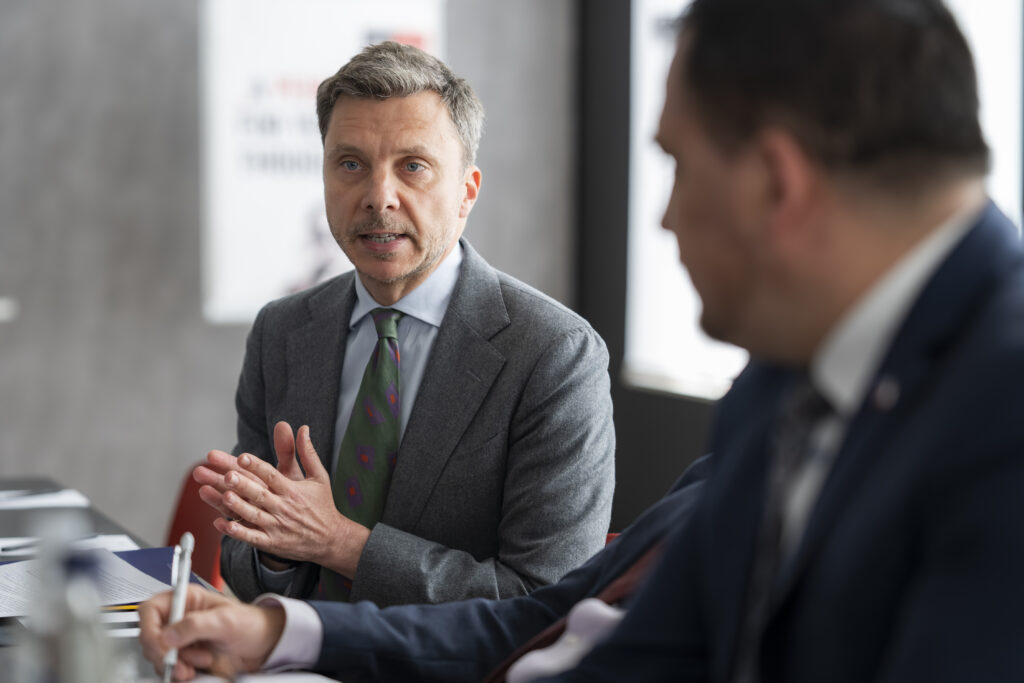
Europe’s defence ambitions are outrunning its willingness to pay for them, says analyst Melchior Szczepanik. The head of the Brussels office of the Polish Institute of International Affairs delivered the message at an EU Perspectives roundtable last week, featuring MEP Tomáš Zdechovský (EPP/CZE) and Burkard Schmitt of AeroSpace, Security and Defence Industries in Europe.
Mr Szczepanik’s argument rested on three interlocking claims: that the strategic case for greater European defence spending is solid; that the institutional architecture to support it is taking shape; and that the political will to sustain both remains fragile.
The strategic logic begins with two converging pressures. Russia’s full-scale invasion of Ukraine has persuaded most member states that Moscow represents a long-term threat—not merely to Ukraine, but to the EU itself. Intelligence assessments, Mr Szczepanik noted, no longer exclude a direct territorial attack on a member state.
No certainties
At the same time, Washington’s reliability as a security guarantor has become uncertain. “There are growing doubts if in case of an attack on a European NATO member US support would be fast and commensurate with the threat,” he said. Together, these two pressures have produced a conclusion that Mr Szczepanik regards as durable: Europe must be able to defend itself, and that means spending considerably more—and more wisely—on its own capabilities.
The spending record to date is not encouraging. Between 2020 and 2024, member states directed over 50 per cent of their defence procurement towards American equipment, up from around 40 per cent in the preceding five years. Mr Szczepanik sees reversing that trend as an important objective of EU defence policy.
The underlying conviction is straightforward: a bloc that cannot produce its own critical equipment, or at minimum secure stable supply chains for what it cannot manufacture at home, cannot credibly claim to defend itself. “The EU has to have a larger capacity to produce equipment,” he said. “And if it cannot produce everything on its territory, then it has to have stable, secure supply chains.”
None of this is new in principle. The problem is that European governments have made comparable commitments before and failed to honour them. NATO’s two per cent of GDP spending target was met by only a handful of allies for years after it was agreed.
A history of hollow promises
The European Defence Agency set a benchmark in 2007 requiring member states to procure at least 35 per cent of equipment jointly. Common procurement has never exceeded around 20 per cent. “We have to take the pledges by the member states with a pinch of salt,” Mr Szczepanik said. “Because there is a history of unmet pledges.”
That scepticism applies to the current round of commitments too. Defence firms need contracts, not announcements. Banks and investors require hard evidence of long-term demand before financing the industrial expansion Europe says it wants. The Franco-German collaboration on a next-generation fighter jet and a new tank—two of the most high-profile cooperative programmes on the continent—has been slow and contentious.
Mr Szczepanik did not dispute the theoretical advantages of joint procurement. He simply offered a dry observation that “It is quite difficult to convince member states to develop and procure equipment jointly,” and that the EDA’s 2007 benchmark stands as a monument to that difficulty.
Building the architecture
The pandemic offers a pointed comparison. When COVID-19 struck, member states agreed to take on joint debt at a scale previously unthinkable to facilitate economic recovery. They have so far declined to replicate that approach for defence. Mr Szczepanik called that “to a certain extent disappointing”. The Commission has tried to compensate through other means—loosening the rules of the Stability and Growth Pact and offering member states attractive loans—but these are partial remedies, not substitutes for a larger common effort.
We have to take the pledges by the member states with a pinch of salt. There is a history of unmet pledges.
— Melchior Szczepanik, Polish Institute of International Affairs
The EU has nonetheless assembled a nascent set of instruments. The European Defence Fund (EDF) allocates €7.95bn over the current multiannual financial framework to co-finance research, prototyping and pre-deployment testing of joint projects — the first time defence R&D has been financed directly from the EU budget. The Act in Support of Ammunition Production (ASAP), enacted in July 2023, fast-tracked industrial output of 155mm ammunition and missiles to replenish stocks depleted by transfers to Ukraine.
The European Defence Industry Reinforcement through Common Procurement Act (EDIRPA) added a €500m incentive for joint off-the-shelf purchases among three or more member states. Its long-term successor, the European Defence Investment Programme (EDIP), flagged in the Commission’s 2024 Defence Industrial Strategy, would embed joint procurement permanently into the post-2027 budget framework.
Flexibility versus predictability
Within the draft multiannual financial framework, the Competitiveness Fund’s policy window for resilience, defence industry and space is to receive more funds, than the allocations for the digital and green transitions combined, Mr Szczepanik noted. That, he argued, shows that “This ambition to put more into defence is genuine and it’s important.” But the precise balance between ring-fenced allocations and discretionary spending remains unresolved. The tension is visible not only in the defence budget line but across the entire framework, from cohesion policy to agricultural support.
The question of flexibility versus predictability has no easy answer. The Commission wants more freedom to move some funds, for example in reaction to international crises. Some member states and the European Parliament want guarantees. Mr Szczepanik declined to adjudicate, acknowledging that striking the right balance “will be relatively challenging”.
What he was clear about is that the architecture being built—EDF feeding into EDIRPA, EDIRPA giving way to EDIP—represents a coherent if incomplete progression towards a genuine EU procurement framework. Without pooled demand, it will be more difficult for European defence manufacturers to achieve the scale needed to compete or to sustain investment. Industrial competitiveness and strategic autonomy, in this reading, are two sides of the same coin.
Finding the money
The budget debate is where Mr Szczepanik’s argument became most pointed. The Commission’s draft multiannual financial framework is, he said, “really the minimum” — its overall envelope, measured against gross national income, barely exceeds the current budget. That does not reflect the scale of ambition member states profess. “When I hear the net payers saying that still the Commission proposal is too much, I’m really surprised and I think there is a problem,” he said.
Without more money, we cannot fulfil the wide variety of ambitions that the EU declares.
— Melchior Szczepanik
His prescription has three components. Member states should contribute more to the EU budget. New revenue sources must be found — he acknowledged the difficulty, noting Poland’s firm opposition to channelling proceeds from the Emissions Trading System to Brussels. And the EU should consider a degree of joint debt, not on the scale of NextGenerationEU, but targeted at a well-defined purpose such as common procurement.
Cuts to cohesion policy and the common agricultural policy, already introduced in the Commission’s draft, have gone as far as politically feasible. Countries such as Poland, where cohesion funding has visibly transformed infrastructure, will not accept further reductions. “Without more money, we cannot fulfil the wide variety of ambitions that the EU declares,” Mr Szczepanik said, explicitly endorsing the European Parliament’s position. The answer, he argued, lies on the revenue side.
From Tallinn to Lisbon
One underexplored avenue is the opening of cohesion funds to expenditure that would contribute to achieving the defence-related objectives, for example related to transport infrastructure. That is a development Mr Szczepanik welcomed as capable of mobilising considerable additional resources. It also illustrates a broader point: the boundary between traditional EU spending priorities and the new defence agenda is becoming porous, and that porosity can be an asset if managed well.
Underlying the entire debate is a question of political sustainability. Mr Szczepanik is not certain the current consensus will hold. Threat perceptions still vary: Estonia and Poland experience the danger differently from Spain and Portugal. Political parties in several member states continue to advocate a return to normal relations with Moscow.
Yet he argued that the gap in threat perception has narrowed considerably. Even for a country such as Spain, where a Russian invasion is implausible, the consequences of war at the EU’s eastern border would be severe. “If the EU allows itself to be pushed around by Russia,” he said, “it means that its ambitions of being a geopolitical power are simply not serious.”
Not peacetime, not war
The most arresting formulation came at the close. Europe is not formally at war. But it is not at peace either. Hybrid attacks from Russia are ongoing. Intelligence services assess a direct territorial attack on a member state as a real possibility. “It’s not perfect peacetime anymore,” Mr Szczepanik said.
It’s not perfect peacetime anymore.
— Melchior Szczepanik
Politicians can and should use that reality to make the case to citizens for higher spending. They may do so not only by invoking Ukraine, but by pointing to the broader assault on European values and political systems that Russia is conducting. The threat, he stressed, is not confined to the front line. It is aimed at the foundations of European democracy itself.
Whether European governments prove willing to match that diagnosis with the resources it demands remains the question on which everything else depends.