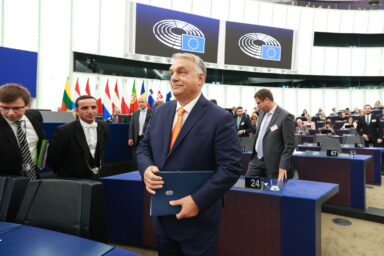
The European Parliament has approved a budget exceeding €2 trillion for 2028–2034, ruling out higher contributions from member states. To fill the gap, Brussels is pushing new EU-level taxes, including a corporate levy that businesses say will drive investment away. As negotiations with member states get under way, industry’s message to negotiators is blunt: you cannot tax your way to competitiveness.
When the European Commission unveiled its plan to fund the EU’s next long-term budget last summer, businesses were quick to raise concerns. At the heart of the proposal were “own resources” — EU-level revenues designed to reduce reliance on national contributions.
But those measures, from a corporate levy to redirected taxes, struck industry as adding costs. Europe is already struggling to stay competitive, and competitiveness sits at the core of both the Commission’s and Parliament’s ambitions. To cover Parliament’s expanded spending plans, even further own resources would likely be needed, and businesses are wary.
A difficult starting point
From the outset, business groups took issue not with the Commission’s ambitions, but with how it planned to pay for them. The proposal sought to refocus spending on priorities such as defence, clean technology and innovation, areas broadly supported by industry. Part of that is a €410 billion competitiveness fund meant to unlock private investment and strengthen Europe’s economic base, echoing warnings from the Draghi report about declining productivity.
But the financing side has raised concerns. The proposal included a “basket” of revenues: the CORE corporate levy, ETS revenues, and contributions linked to tobacco and electronic waste. The shift towards new or repurposed taxes has drawn the sharpest criticism from business.
Corporate tax
The CORE (Contribution on Revenue of Enterprises) levy would apply to companies operating in the EU with net annual turnover above €100 million, including foreign firms. It would subject them to a fixed annual charge scaled in brackets. The Commission estimates it would raise €6.8 billion per year.
The corporate levy immediately sparked strong opposition from some member states. “There is no question of the EU taxing companies, as the European Union has no legal basis for this,” said German Chancellor Friedrich Merz. Similar statements came from the Netherlands, where officials said such a levy is not up for discussion.
The proposed levy would apply to turnover rather than profits, making no distinction between high- and low-margin sectors. It would be calculated at company or permanent establishment level, not at group level.
Room to grow, or to lose?
Several MEPs have echoed those concerns. Anouk van Brug (Renew/NLD) warned the levy could do more harm than good. “With the proposed corporate tax in the EU budget, we risk chasing businesses away. The EU must choose: invest in innovation, AI and defence, not in higher tax pressure.”
Meanwhile, the S&D group supports the levy, framing it as a matter of fairness: “We believe big corporations have to pay fair taxes and contribute to the European budget as part of a system of new and genuine own resources.”
More money needed
But Parliament is calling for roughly 10 per cent more spending on top of the Commission’s proposal. It has made new EU revenues a condition for approval. In practice, that means doubling down on already contentious measures or introducing new ones, including potential levies on tech companies or other sectors. For businesses, that sends a mixed message.
“We welcome the proposed 10 per cent increase in the programme’s budget, which reflects the European Parliament’s recognition of the importance of competitiveness priorities,” a spokesperson for BusinessEurope said. The group also backs efforts to strengthen investment tools. “We appreciate the proposals to strengthen and clarify the primacy of InvestEU… helping to de-risk and incentivise private investment.”
The levy is totally counterproductive.
— spokesperson, BusinessEurope
It is, however, concerned about the revenue side, and has previously dismissed measures such as the CORE levy. “The levy is totally counterproductive,” the spokesperson said, warning it would create additional barriers to growth and further weaken the EU’s attractiveness for investment.
Tense negotiations ahead
At the same time, negotiations with member states are shaping up to be tense. Countries such as Germany and the Netherlands are pushing for a smaller budget. They reject both higher spending and new EU-level taxes, setting up a direct clash with Parliament’s position.
For businesses, that creates a double layer of uncertainty: not just about what measures will be adopted, but whether a deal can be reached without prolonged political deadlock. Either way, the bill is likely to land on their desk.