The EU’s carbon market is either Europe’s green lifeline or a noose around its industry. A debate in Strasbourg has made that clash impossible to ignore. MEPs from the right blamed the emissions trading system for cascading bankruptcies in steel, chemicals, and construction, while the left insisted fossil fuel dependency is the real culprit driving up costs. Reforms are now on the table, but the fight over who pays for Europe’s decarbonisation has only just begun.
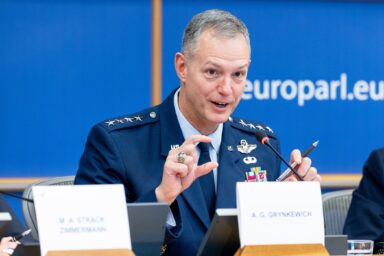
“The ideological approach of the Green Deal has chained us to unrealistic targets that damage our economy,” argued Nicola Procaccini (ECR/ITA), whose group called the debate. Climate Commissioner Wopke Hoekstra, however, reassured Parliament that ETS and competitiveness can and should go “hand in hand”.
The European emissions trading system (ETS) works by putting a price on carbon emissions. Companies operating in sectors covered by the system must buy allowances for the CO2 they emit, while the total number of allowances available decreases over time. The idea is simple: make pollution progressively more expensive so industries are incentivised to decarbonise.
The competitiveness concern
Over the past two decades, the mechanism has become a cornerstone of EU climate policy. Emissions from sectors covered by the ETS have fallen substantially since its launch, and Brussels increasingly presents the system as proof that market-based climate policy can work, while attempting to export the system outside the EU even to those countries that currently do not have their own emission pricing system in place via the Carbon Border Adjustment Machanism (CBAM).
But the political environment around the ETS has changed. Europe’s industries are facing persistently high energy prices, intensifying global competition, and mounting pressure to invest in decarbonisation technologies, all while carbon costs continue to rise. That combination is bringing competitiveness concerns back to the centre of the debate.
“The ETS credits system — that is, the tax on carbon dioxide emissions from anything produced in Europe — was conceived in a season of green and socialist utopias,” Mr Procaccini said during the debate. “While we chose the path of happy degrowth, the rest of the world started running fast, thanking Europe for deciding to take itself out of the game.”
His intervention echoed arguments increasingly heard among conservative and right-wing parties across Europe. Many of them argue that climate policy risks accelerating deindustrialisation rather than preventing climate change.
Hand in hand
The European Commission, however, is signalling no retreat from the ETS. If anything, Brussels is increasingly framing the system as essential not only for climate goals, but also for Europe’s strategic autonomy.
“We have and we continue to have a huge climate problem,” Mr Hoekstra told Parliament. “Europe is heating up much more quickly than the rest of the world.” But Mr Hoekstra also acknowledged the growing competitiveness concerns surrounding the system. “We have substantial issues with competitiveness that we do need to fix,” he said, while warning that Europe remains deeply vulnerable because of its dependence on imported fossil fuels.
“We are importing more than 80 per cent of the gas that we consume and more than 95 per cent of the oil,” Mr Hoekstra said. “As long as we continue to do that, we will be at the mercy of what others are doing across the globe.”
Who pays the price?
Much of the disagreement now centres on who ultimately bears the cost of decarbonisation. For critics of the system, ETS has become synonymous with rising energy prices and industrial decline. Jordan Bardella (PfE/FRA) described ETS as “three letters that strangle our industrial champions” and blamed the system for “cascading bankruptcies” in sectors such as steel, chemicals, and construction.
That is not competitiveness — that is desperation.
— Mohammed Chahim, MEP (S&D/NLD)
On the left side of the Parliament, MEPs warned that fossil fuel dependence, not ETS, is Europe’s real economic weakness. “Europe cannot be competitive if we depend on fossil fuels and continue to be exposed to gas and price shocks,” argued Mohammed Chahim (S&D/NLD). “That is not competitiveness — that is desperation.”
Emma Wiesner (Renew/SWE) went even further, accusing critics of defending fossil fuel interests rather than European consumers. “ETS is not the cause of the high energy prices,” she argued. “It is the way out of them.”
Michael Bloss (Greens/DEU) similarly accused the political right of blaming the ETS for problems caused by fossil energy dependency. “Do you know what is actually driving energy prices up?” he asked. “It is oil and it is gas costing every single citizen a fortune every single day.”
Reforms ahead
Despite the sharp rhetoric, there is also growing recognition across political groups that changes to the ETS are likely unavoidable. Lawmakers supportive of the system acknowledged that reforms may be necessary better to shield European industry from competitive disadvantages. In that light, Peter Liese (EPP/DEU) argued that “we need reforms” and called for more free allowances for companies investing in Europe.