Whatever happens to Iran’s nuclear programme now? Unlike Washington, Brussels has no active negotiating track with Tehran. Yet ‘diplomacy plus’ offers Europe the only plausible path forward.
The bombs did not finish the job. When American stealth bombers struck Fordow in June 2025, following Israel’s initial assault on Iran’s nuclear infrastructure, the world briefly assumed the Iranian nuclear question had been answered by force. It had not.
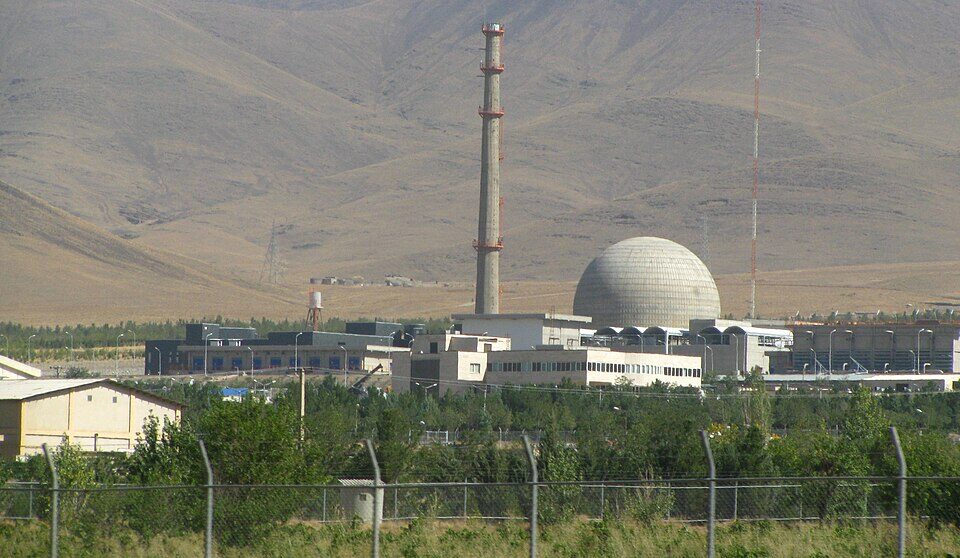
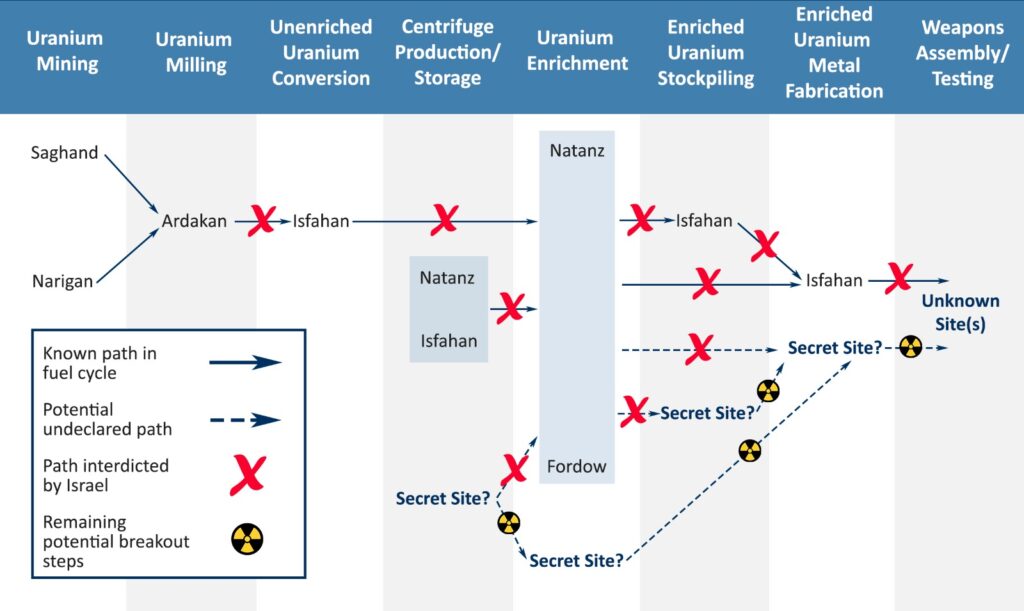
Satellite imagery as of May 2026 shows no major excavation or reconstruction at Natanz, Fordow or Isfahan. Yet workers were photographed in January 2026 covering bombed facilities with roofing at both Natanz and Isfahan. The purpose was unclear: possibly stabilisation, possibly concealment of recovery efforts.
The embers of ambiguity
Iran retains a substantial portion of its nuclear programme. It has not attempted to access its highly enriched uranium stockpiles, nor has it constructed replacement facilities for sites destroyed in the twelve-day war. At Isfahan, however, images from November 2025 and February 2026 show Iran actively fortifying the site against future strikes. How successful the potential effort was, we do not know. But it seems to keep Tehran’s options open.
Mohammad Eslami, the head of the Atomic Energy Organization of Iran (AEOI) captured the regime’s posture in January 2026 with studied ambiguity: “If sites are bombed, what remains to monitor?” That question now falls squarely on Europe’s desk.
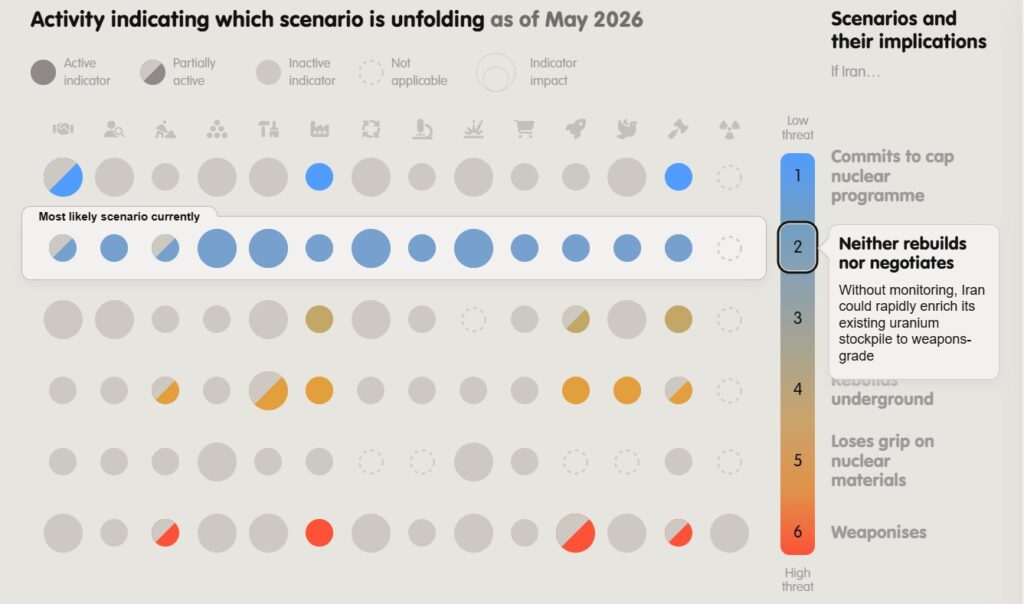
Iran’s current stance—neither rebuilding openly nor negotiating seriously—is, in the assessment of analysts familiar with the file, ultimately unsustainable. Domestic hardliners, emboldened after the February 2026 confrontation with the United States and Israel, are pressing new leadership to resume nuclear activities, both to recoup the costs of sustaining the programme and to gain leverage in any future talks. Tehran’s ruling elite may be buying time to forge an internal consensus on long-term nuclear goals, amid economic constraints, internal unrest and the persistent threat of renewed strikes.
Iran has also not entered genuine negotiations with America on a nuclear deal, despite several mediation attempts. Leaders in Tehran appear unwilling to offer major concessions after the war, yet equally unwilling to hand Washington a fresh pretext for military action by rebuilding openly. The regime may also be prioritising its missile capabilities and conventional arsenal. That would be consistent with the pattern of its post-war posture.
23 years of European effort
What Iran does next will shape Europe’s choices profoundly. Richard Nephew, Fellow at The Washington Institute, notes that Iran could probably develop crude nuclear weapons without rebuilding its programme to any significant degree, since it likely retains enough highly enriched uranium and the chemical processing equipment required to fashion this material into several crude bombs, even if they are not missile-deliverable.
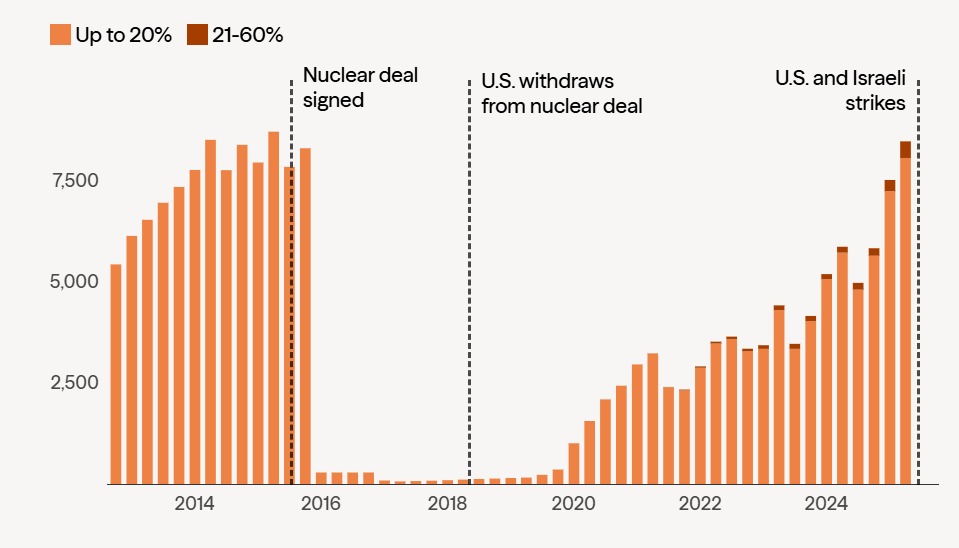
Europe did not arrive at this juncture unprepared. It has been involved in efforts to curb the programme from August 2002, when the Iranian exile group NCRI revealed the undeclared enrichment plant at Natanz and the heavy-water project at Arak. That triggered an IAEA investigation. The foreign ministers of France, Germany and the United Kingdom flew to Tehran in October 2003, forming the ‘EU-3’ and producing the Tehran Declaration — Iran pledged full IAEA co-operation, signed the Additional Protocol and voluntarily suspended enrichment.
That first diplomatic track collapsed in August 2005 when President Ahmadinejad ordered enrichment restarted. An EU diplomat later wrote that “Europe had no leverage without the U.S.” The lesson was partially absorbed: from 2006 onward, the EU aligned with and augmented UN sanctions, and the bloc’s High Representatives—first Javier Solana, then Catherine Ashton—became permanent coordinators of the ‘E3/EU+3’ format. “Europe’s added value is persistence and creativity in multilateral diplomacy,” Baroness Ashton said in 2014.
“Victory for the European way”
The Joint Comprehensive Plan of Action, agreed in Vienna on 14 July 2015 after more than 120 EU-chaired negotiating days, represented the high-water mark. The EU’s external action official Helga Schmid led the technical drafting. At the signing, Iranian Foreign Minister Mohammad Javad Zarif said: “We never sought nuclear weapons; Europe finally recognised our rights.” Federica Mogherini, EU High Representative at the time, called it “a victory for multilateral diplomacy and the European way”.
The architecture cracked in May 2018 when the US withdrew from the JCPOA. Europe updated its 1996 Blocking Statute (Regulation (EC) No 2271/96 to shield EU firms from American extraterritorial fines, and created INSTEX — a special-purpose vehicle for humanitarian trade hailed by the E3 as proof of “determination to save the deal”. INSTEX never scaled commercially. Iran accused Europe of “fine words, no economic delivery”.
If sites are bombed, what remains to monitor? — Mohammad Eslami, head of Atomic Energy Organization of Iran (AEOI)
By late 2023, EEAS then-chief Josep Borrell warned the deal was becoming an “empty shell”. In August 2025, France, Germany and the UK invoked the UN snap-back clause. The EU re-imposed all pre-2016 nuclear sanctions and additional autonomous measures under Council Regulations 2025/1500-1502. Iranian foreign ministry branded the move a “strategic mistake” and accused Europe of “following Washington’s maximalism”.
What Tehran might do next
Iran now faces four broad paths, none of them comfortable. The first—confining itself to foreign-supplied reactors and fuel, with Russia continuing to build at Bushehr—would mark a significant walk-back of decades of rhetoric and would enshrine Iranian dependency on foreign nuclear supply, an arrangement Tehran has come to view as unreliable. This option is, in Mr Nephew’s assessment, the regime’s least likely choice.
The second path—a full, declared rebuild, restoring uranium conversion and enrichment facilities and opening them to IAEA inspections—carries political and technological advantages but requires a longer-term political deal with security guarantees. That does not appear forthcoming. The third path—a full, undeclared rebuild—would carry the same high costs, plus a higher risk of war given the added justification of flagrant nuclear noncompliance.
The fourth and arguably most dangerous path involves Iran redefining the programme entirely: abandoning large civil facilities in favour of a smaller, weapons-dedicated enterprise, more deeply buried and far harder to detect. Such a revamped programme could be much easier to hide from international observation even if American and Israeli intelligence penetration persists. Iranian officials have said that retaining the right to enrich uranium inside Iran remains a red line, and that giving up enrichment entirely is unacceptable. The form that enrichment takes remains, however, undecided, as far as the West knows.
Europe’s uncomfortable options
Against this backdrop, Europe enters the next five years with three partly overlapping strategies: tightening economic pressure, re-energising diplomacy, or supporting military deterrence. Each carries distinct risks and costs.
The sanctions-first path builds on what the E3 already triggered. The EU sanctions regime under Council Regulation (EU) No 267/2012—extensively amended, most recently on 1 April 2026—keeps broad trade, finance, metals and software controls in place.
The 2026 IRGC terrorism listing (Council Decision (CFSP) 2020/1123) adds another layer. Multilateral sanctions cut Iran’s oil revenue and limit access to high-technology goods; previous rounds helped bring Tehran to the 2015 JCPOA table. But discounted crude continues to flow, mainly to China; revenue loss is real but not crippling.
Iran, Russia and Venezuela together supplied approximately 14 per cent of global crude in 2025, with Chinese refiners saving up to $28m per day on cheap Iranian barrels. EU goods trade with Iran is tiny—€3.7bn in 2025, with imports of just €0.8bn, of which only $12m was crude—so direct economic pain inside Europe remains limited.
Talks first, but…
The diplomacy track appears as the only realistic option that could roll back stockpiles, freeze enrichment and restore inspections. The EEAS holds a formal JCPOA coordinator role under its mandate. The EU could resume shuttle diplomacy with incentives including phased sanctions relief, a regional de-escalation forum, civil-nuclear cooperation and EU-backed escrow channels for limited oil sales.
Iran’s threats go beyond the nuclear programme. — Kaja Kallas, High Representative of the EU for Foreign Affairs and Security Policy
The objective of the JCPOA was to constrain Iran’s nuclear programme so there would be confidence it was not moving toward a nuclear weapon. Any successor agreement would need more stringent verification measures and the complete dismantlement and verification of existing nuclear facilities to satisfy critics.
Ms Mogherini’s September 2019 observation still applies: “Every step so far by Iran is reversible — our task is to keep the agreement alive.” Yet diplomacy requires American buy-in—uncertain beyond the 2028 US election—and at least tacit Israeli acceptance. Iran’s post-war domestic politics are harder still: 84 per cent of Iranians in late-2025 polls wanted to rebuild or expand the programme if attacked. YouGov data shows 50-60 per cent of Europeans doubt a deal can really stop weaponisation. Yet majorities in Germany, the UK and Spain still favour talks first.
No appetite for war
Enrique Mora, the EU’s then-chief nuclear negotiator, put it plainly in August 2022: “What can be negotiated has been negotiated; now political decisions are needed.” That observation is, if anything, more acute in May 2026.
The military deterrence path, such as intelligence sharing, logistical support for future strikes, and expanded EU naval presence in the Strait of Hormuz and Red Sea, offers the least attractive risk profile. The June 2025 Israeli-American strikes destroyed key sites and bought time but did not stop the programme. Iran withdrew IAEA access in response.
Repeated strikes might delay breakout but cannot monitor clandestine sites. Twenty-one per cent of global liquids (used to) pass through the Strait of Hormuz; any Iranian retaliation or harassment there would carry severe economic consequences. European public opinion strongly opposes another Middle Eastern war, with support for military action below 25 per cent in most EU polls.
The blended path forward
No single option suffices. The most credible European strategy—even as no formal EU position yet exists—would combine economic pressure as leverage, diplomacy as the primary instrument, and credible but proportionate deterrence to deter Iranian retaliation.
A ‘sanctions-for-talks’ sequence would keep the UN and EU snap-back measures in place under Common Position 2007/140/CFSP. It would simultaneously embed automatic relief benchmarks to lure Tehran back toward compliance.
The next 18 months (i.e., before American domestic politics harden ahead of the 2028 election cycle) represent the most plausible window for designing a ‘JCPOA Plus’ package backed by American guarantees and regional confidence-building steps. Tightening export-control co-ordination under the Dual-Use Regulation (EU) 2021/821 with the US, Japan and South Korea could close technology loopholes without alienating China entirely.
Non-starters and red lines
The gap between Washington and Brussels remains wide. US President Donald Trump has said, with his trademark combination of modesty, understatement, and factual accuracy: “The single most important achievement, I believe, is the agreement that Iran will never ever have nuclear material that will create a bomb,” adding: “Now we are talking about zero stockpiling.”
The single most important achievement, I believe, is the agreement that Iran will never ever have nuclear material that will create a bomb. — Donald Trump, US president
The current American framework would prohibit enrichment on Iranian soil and instead favour a regional consortium model. Iranian officials have said that giving up enrichment entirely is unacceptable. That is a red line that makes the current American position a non-starter for Tehran.
Europe’s leverage is limited but not negligible. The EU de facto controls access to its single market, insurance markets, SWIFT connectivity and dual-use export licences. These tools matter to Iran and to the third parties, including China, that trade with it. The EU sanctions framework under the Review of the EU Sanctions Framework gives Brussels room to calibrate pressure and relief in ways Washington cannot always replicate unilaterally.
Better than nothing
Whether Europe can translate its normative commitment to multilateralism into a revived agreement will depend on a combination of factors. These include its capacity to marshal those economic incentives, maintain transatlantic coherence, and address regional security concerns that have grown far beyond the nuclear file.
Iran’s then-Chief negotiator Ali Bagheri Kani set the Iranian condition in October 2021: “Talks must guarantee that no American administration can again abuse Europe’s goodwill.” Tehran has not budged since; it has little incentive to do so now, as the actual winner of this year’s hard-power showdown with the US.
None of this makes any future steps easy. As Kaja Kallas, the EU’s top diplomat puts it, Iran’s threats go beyond the nuclear programme, and talk alone is not enough. That said, Europe has not yet found an answer to satisfy both its interests and Tehran’s demands. It has, however, 23 years of practice in trying. It is not much by any means; but in the current stalemate, it is better than nothing.