Moscow continues to test the boundaries of NATO and the EU – and Western leaders are running out of patience. After a Russian drone hit a home in Romania and injured two people, the bloc is preparing to reinforce its eastern flank and roll out a 21st round of sanctions. According to the Kremlin, the EU needs to “shut up”.
“Russia’s war of aggression has crossed yet another line,” European Commission President Ursula von der Leyen stated after a Russian drone crashed in Romania. Brussels, she added, would continue strengthening security and deterrence along the EU’s eastern frontier. “We are preparing a 21st package of sanctions,” she announced.
The response from European institutions came after a Russian drone launched during an overnight attack on Ukraine crashed into a residential building in the city of Galați, close to the Ukrainian border. A 14-year-old boy and a 53-year-old woman were taken to hospital. Dozens of residents had to be evacuated and the building sustained significant damage.
According to Reuters, this is the first time since the start of Russia’s full-scale invasion of Ukraine in February 2022 that a drone in Romania has struck a densely populated area and injured civilians.
Bucharest subsequently decided to close the Russian consulate general in Constanța and declare Consul General Andrey Kosilin persona non grata. President Nicușor Dan called for a coordinated international response.
EU foreign policy chief Kaja Kallas described the incident as a “blatant and serious violation of Romania’s sovereignty and European airspace”. “Russia has long ago stopped respecting borders,” she wrote on X. Ms Kallas added that EU foreign ministers had already agreed on Thursday to step up pressure on Russia, increase support for Ukraine and boost investment in European defence.
Defending every inch
In recent days, the European Commission has repeatedly warned of a growing number of hybrid incidents and security breaches along the EU’s eastern flank. During a visit to Lithuania this week, von der Leyen said such attacks were not isolated incidents but part of a broader Russian strategy aimed at destabilising democratic societies.
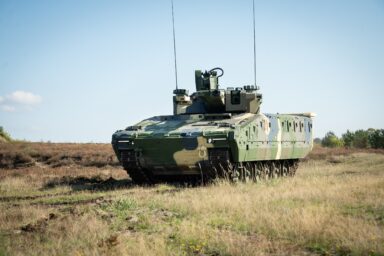
The Commission is also pushing for further investment in air defence systems, counter-drone technology and projects designed to reinforce the EU’s eastern frontier.
NATO Secretary General Mark Rutte assured the Romanian president of the alliance’s “absolute solidarity” with Romania. He claimed that NATO stood ready to defend “every inch” of allied territory. “Russia’s reckless behaviour is a danger to us all,” Mr Rutte added.
French Foreign Minister Jean-Noël Barrot described the strike on the residential building as an irresponsible act and summoned the Russian ambassador in Paris. Polish Foreign Minister Radosław Sikorski said that “regardless of whether it was on purpose or the result of ineptitude, Russia is still dangerous and we must defend ourselves against it”.
The incident was also condemned by German Chancellor Friedrich Merz and Britain’s Home Secretary Yvette Cooper, who said Russia’s violation of NATO airspace was an “extremely dangerous and reckless” act.
Backing from Kyiv
Kremlin initially claimed there was no evidence the drone was Russian, with President Vladimir Putin saying that its origin could not be determined without a full technical analysis. The Russian embassy in Romania suggested the incident may have been a Ukrainian provocation.
However, Romanian President Nicușor Dan later said the drone was Geran-2, a Russian-made version of the Iranian Shahed. According to him, a detailed technical investigation by experts confirmed matching materials, components, and Cyrillic markings found on the wreckage. Dan added that the findings pointed to “exclusive responsibility” on the Russian side, based on forensic and technical evidence.
Dmitry Medvedev, deputy chairman of Russia’s Security Council, dismissed European criticism, warning that similar incidents could continue as long as the bloc supports Ukraine. “In any case, all EU countries need to shut up on this matter. European states are direct participants in the war against Russia, and no one is arguing about that anymore,” he wrote on a Russian social media platform Max.
Ukrainian President Volodymyr Zelenskyy said Kyiv was ready to provide Romania with any support it might need. He also urged the EU to adopt tough new sanctions against Russia.
According to the Ukrainian Foreign Minister Andrii Sybiha, the incident once again demonstrated that Russian aggression threatens not only Ukraine, but the entire Black Sea region and Europe as a whole. Strengthening Ukraine’s air defences, he argued, was also vital for the security of neighbouring NATO and EU member states.
SAFE to keep Europe safe
Romania is also among the five countries to have already signed loan agreements under the EU’s new SAFE defence instrument. The scheme is designed to help member states finance joint defence projects, strengthen military capabilities and invest in Europe’s defence industry, particularly on the Union’s eastern flank.
Poland has already received the first payment from the SAFE programme, securing €6.6 billion — around 15 per cent of its total allocation of more than €43 billion. The country is also the largest beneficiary of the instrument. Alongside Poland, Lithuania, Croatia, Romania and Belgium have signed loan agreements under the scheme, while other countries are yet to finish negotiationing about the terms.
The Russian drone strike in Romania is not the first incident in which Moscow’s war has spilled onto the territory of NATO or EU member states. For Brussels, however, the episode serves as yet another reminder that the war in Ukraine and Europe’s security can no longer be treated as separate issues.