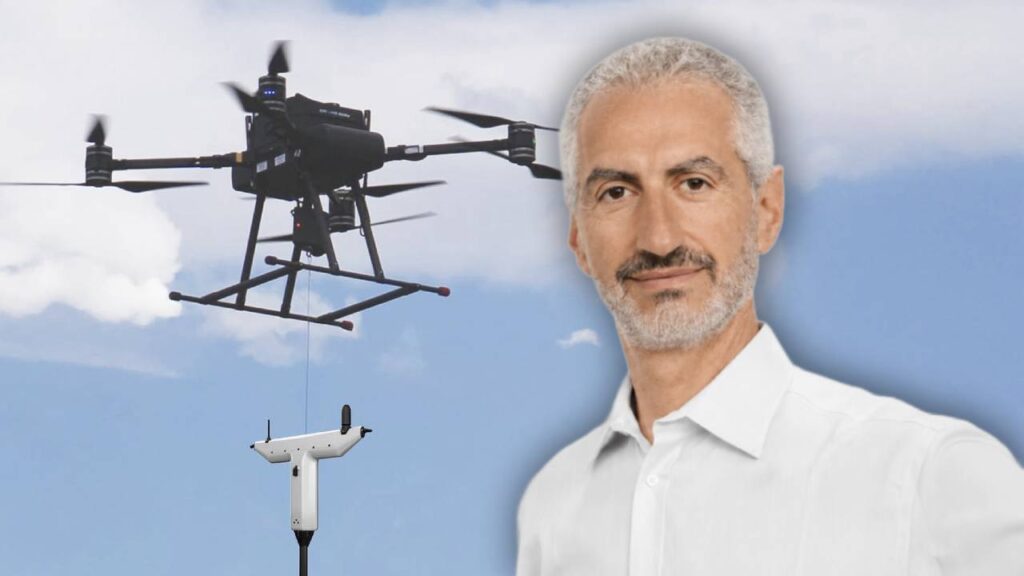
For Drone Volt, versatility is the name of the game. Emmanuel Nabet, the French company’s senior sales executive, sat down with EU Perspectives to discuss the thrills and pitfalls of navigating European defence markets.
The halls of Eurosatory, the biennial defence and security trade show held outside Paris, are never short of ambition. Among the exhibitors this June was Drone Volt, a French manufacturer of professional drones founded in 2011 in Villepinte, Île-de-France (which, by a fluke, is the location of le Parc des Expositions, the show’s venue). Listed on Euronext Growth Paris, the company employs around 60 people and operates subsidiaries in Denmark, Canada, Switzerland, the Benelux countries, and the US.
Fifteen years ago, the company started by serving French clients — but that has changed, Mr Nabet says. The company now counts users across Europe (including Ukraine), North America, Africa, the Middle East, and Asia. “We have that opportunity that our products manufactured in France are quite appreciated around the world,” he says.
A drone for every danger
“We are present at Eurosatory 2026 as a manufacturer of drones which are coming from the civilian market but are also very much appreciated by the defence and security users,” he explains. “Today we have a range of drones coming from the tactical up to the VTOL (vertical take-off and landing) long-range type of drones, including some heavy lifter drones. Those drones are very much used by defence users as well as the security forces in the world.”
The show floor reflects that breadth. Drone Volt displayed its full range of dual-use platforms, products designed for civilian purposes but adapted for defence and security applications. Among them: the Kobra tactical drone, the Heliplane long-range surveillance aircraft, and the Hercules 20, a heavy-lift drone capable of carrying up to 15 kilograms of payload.
The Kobra is the company’s most versatile platform. It can carry different sensors depending on the mission. It may be detecting gas leaks, monitoring borders, identifying radiological hazards, or locating landmines. Drone Volt does not develop all these sensors itself. “We are working with partners who are specialists in the payload, in their sensors,” Mr Nabet says. “They become a payload to our drones and they are sent to the field to do their job.”
One such payload is an IMSI catcher, a device that detects mobile-phone signals. “When somebody is lost, actually they still have a phone even if they cannot talk, they cannot move,” Mr Nabet explains. “We can detect the phone and then zoom in on the area where the person is. This is very, very efficient for civil security.” The Kobra also integrates with the AP4C+ detector made by Proengin, enabling real-time identification of chemical agents, including those found in CBRN—chemical, biological, radiological, and nuclear—environments.
Mines and the Hormuz question
The Heliplane, a long-range fixed-wing drone with a wingspan of up to 4.15 metres, is designed for what Mr Nabet calls “blue borders”, i.e., maritime surveillance and intelligence-gathering over open water. “This one is more for security and intelligence over the sea, the ocean,” he says. “Today we are working with certain EU institutions such as Frontex”—the European Border and Coast Guard Agency—”in order to monitor their working areas.” Several European navies contributing assets to Frontex operations already use the platform.
Of course, there might be a lot of floating mines at the Hormuz Strait, and we need this type of equipment to detect it today. — Emmanuel Nabet, Drone Volt
The Hercules 20 is already deployed in Ukraine for mine-clearance operations, where it helps secure post-conflict areas without exposing ground crews to risk. The machine drew particular attention at Eurosatory. In its standard configuration, it carries a magnetometer—a sensor that measures magnetic fields—to detect landmines on the ground or underwater, at depths of up to 12 metres.
“This one attracted a lot of attention from our users, specifically at Eurosatory,” Mr Nabet says. “Of course, there might be a lot of floating mines at the Hormuz Strait, and we need this type of equipment to detect it today.”
Fighting and training
The same drone has been used in firefighting trials. In a test conducted with the Oise Departmental Fire and Rescue Service, the Hercules 20 sprayed 250 litres of water at a pressure of 240 bar from a height of 96 metres—onto a burning wind turbine—for more than ten minutes, maintaining stability throughout.
Beyond manufacturing, Drone Volt also operates drones directly for clients. “We not only manufacture, we also operate,” Mr Nabet says. “In our business we have about more than 25–30 per cent of our job is operating drones for the end users.” The drone-as-a-service model includes counter-UAS—counter-unmanned aircraft system—training. Drone Volt brings multiple drone types to a site and tests how well an anti-drone system responds to them.
The conversation turns to Europe. Drone Volt operates across the EU, and Mr Nabet is candid about where the single market helps and where it does not. “I can answer this question in two ways,” he says. “The first one is we are very active in the civilian market such as the power lines and power transportation. The unified market is very useful for us in this domain.”
The single market’s unfinished business
In defence and security, the picture is different. “Each country keeps its own regulations in terms of exports. Even if I want to export to Germany, for instance to Denmark, I have to go through my domestic regulation for export control. The unified market is good on an economic point of view. But in defence, it is not fully unified at this time.”
The drones are very much used by defence users as well as the security forces of the world. — Emmanuel Nabet
The European Commission has tried to close that gap. It has launched programmes modelled on Horizon—the EU’s flagship civilian research-funding scheme—for the defence sector, most notably the European Defence Fund. Mr Nabet acknowledges the intent. “They launch a number of large programmes,” he says.
The results, however, fall short in his view. “It’s not actually successful because the programmes require maybe three or four countries, end users and industrial companies from various countries in Europe, to come together to propose a programme. That is very fine, but it still has some difficulties or some hurdles when it comes to working together with various countries.”
Paperwork as a barrier to entry
The problem, Mr Nabet argues, is not political will but administrative weight. “The way they regulate such a programme is financially,” he says. “This is where the difficulty comes for companies like small and middle-sized companies like mine. It’s a lot of paperwork quite difficult to get into. Sometimes you even have companies specialised in handling that. That, of course, comes with a fee.”
When pressed for a concrete example of what could change, he is direct. “I believe some of the rules of those programmes might be simplified to make it more efficient or more broadly used.” He understands why the rules exist. “I completely understand. This is needed to make sure that the funds are used in a proper way.” He even acknowledges the limits of that safeguard: “I heard that despite that there are still some funds which are misused.”
We can detect the mobile phone and then zoom in on the area where the person is. This is very, very efficient for civil security. — Emmanuel Nabet
The Commission has created a dedicated category for small and medium-sized enterprises (SMEs) within these programmes. Mr Nabet welcomes it, but considers it insufficient. “The complexity of it is still a hurdle for more companies to participate,” he says. “I think the objective at the end of the day would be to see more SMEs contribute. Today, if I look at the French market I know, what we call the base industrielle et technologique de défense, or France’s defence industrial and technological base, I still see a very small number of companies contributing, participating, or bidding for those Commission and EU funds. And I find it’s a pity. I would like to see more of them contributing.”
A revolving door
Drone Volt itself is a case in point. Founded fifteen years ago as a civilian-market company, it has built a defence portfolio that now spans mine detection, maritime surveillance, chemical-hazard identification, and counter-drone training. Its gross margin rate rose from 13 per cent in 2024 to 37 per cent in 2025, as the company shifted away from low-margin distribution towards higher-value manufacturing and services.
In June 2026, it signed an exclusive partnership with Latvian firm DK Unity to distribute NS-series interceptor drones—net-capture and ram-type anti-drone systems—in France and Francophone markets.
For a company of 60 people competing in a market dominated by far larger players, the EU’s defence funds could, in principle, be a lifeline. In practice, Mr Nabet suggests, the entry cost in time and consultancy fees makes the market accessible mainly to those already familiar with its mechanism. That makes it feel less like an open door than a revolving one.