Europe’s electricity grid faces more than just a shortage of infrastructure. Connection queues increasingly filled with speculative projects that have little chance of ever being built. Experts highlighted this less visible but potentially serious bottleneck during an EU Perspectives roundtable discussion on the European Commission’s proposed European Grids Package.
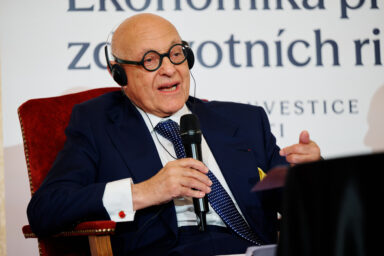
During the roundtable, Andrew Kasembe, head of the Transmission System Development Department at ČEPS and representative of ENTSO-E, argued that Europe’s infrastructure problem is no longer simply about building more cables and substations.
“The main structural issue is that storage, data centres and other large projects are growing faster than grid expansion.”
— Andrew Kasembe, head of the Transmission System Development Department at ČEPS and representative of ENTSO-E
Instead, he pointed out, grid operators are increasingly struggling with a flood of connection requests from projects that are either underdeveloped, financially uncertain or strategically filed simply to reserve future capacity.
“The main structural issue is that storage, data centres and other large projects are growing faster than grid expansion,” said Mr Kasembe. “They are outpacing realistic grid delivery.”
But according to Mr Kasembe, the issue goes further than speed alone. “Many connection requests contain speculative or immature projects, so they are unnecessarily blocking grid capacity,” he said.
Big gap between theory and practice
The warning reflects growing concerns across the European energy sector that connection queues are becoming increasingly detached from projects that are likely to materialise in practice. As renewable deployment accelerates and electricity demand from industry, artificial intelligence and data centres grows, grid access itself is becoming one of the most contested parts of Europe’s energy transition.
Industry representatives say the result is that transmission operators are often forced to plan around theoretical future demand rather than realistic deployment pipelines.

The scale of the mismatch is already becoming visible.
Daniel Vig, Senior Policy Officer at Energy Storage Europe, pointed to figures showing that more than 1,700 GW of projects are currently waiting for connection across the EU, despite the bloc’s total installed power capacity standing at around 1,200 GW. “What wants to connect to the grid is much more than what is actually necessary,” he said. “There are many speculative projects, many projects which really distort what is needed to connect to the grid.”
According to industry representatives, the current system creates incentives for developers to secure queue positions early, even before financing, permitting or technological readiness are fully in place.
That dynamic has already become a major challenge in several member states, particularly in markets experiencing rapid renewable expansion.
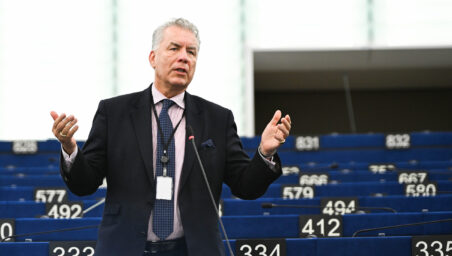
“Permitting is the key, of course, and it should primarily be the member states dealing with this.”
— MEP Ondřej Krutílek, shadow rapporteur for the Grids Package
While the Commission’s proposed Grids Package acknowledges growing connection delays, Brussels still underestimates the administrative complexity behind them. “We believe the package must focus more clearly on the real implementation barriers to timely grid delivery,” Mr Kasembe said.
Among those barriers, he listed permitting delays, spatial and land-use planning disputes, supply chain shortages and labour constraints. “The issue of staffing is also important,” he said. “You need adequate staffing and expertise — technical capacity — to deal with both grid infrastructure approvals and project permitting alike.”
Invest. But not too early
Another problem identified during the debate was the limited ability of transmission operators to invest ahead of demand.
Under current regulatory frameworks, grid operators often face restrictions on so-called anticipatory investments — infrastructure built before concrete connection requests are fully confirmed. “We cannot invest into the grid for the future,” Mr Kasembe said. “Enable anticipatory grid investment through regulatory cost recovery frameworks, so TSOs (editor’s note: transmission system operators), can invest ahead of confirmed agreements where credible demand signals exist.”

That creates a paradox for Europe’s energy transition: while policymakers push for faster electrification and industrial decarbonisation, operators are frequently prevented from building infrastructure until demand is already formally locked in.
The debate over connection queues is likely to become increasingly political as the Grids Package moves through negotiations in the European Parliament and Council.
No additional red tape
The broader question, however, remains how far the EU itself should intervene. Ondřej Krutílek (ECR/CZ), member of the European Parliament’s Committee on Industry, Research and Energy and the shadow rapporteur for the Grids Package, also stressed during the discussion that responsibility for permitting still largely rests with national governments. “Permitting is the key, of course, and it should primarily be the member states dealing with this,” he said.
The Commission has proposed a stronger role for itself in coordinating infrastructure planning scenarios across Europe, arguing that fragmented national planning is slowing the energy transition. But both industry representatives expressed concern about centralising too much authority at EU level.
“The European Commission wants to take the scenario into their own hands,” Mr Vig said. “But how do they know how to build these grids?”
Mr Kasembe similarly argued that transmission operators already possess the technical expertise needed to assess realistic infrastructure needs.
The concern among operators is that without tighter filtering mechanisms, Europe risks creating an infrastructure planning system increasingly shaped by hypothetical projects rather than real energy demand. At the same time, policymakers face a delicate balancing act: tightening access rules too aggressively could slow innovation and make it harder for emerging technologies to enter the market.