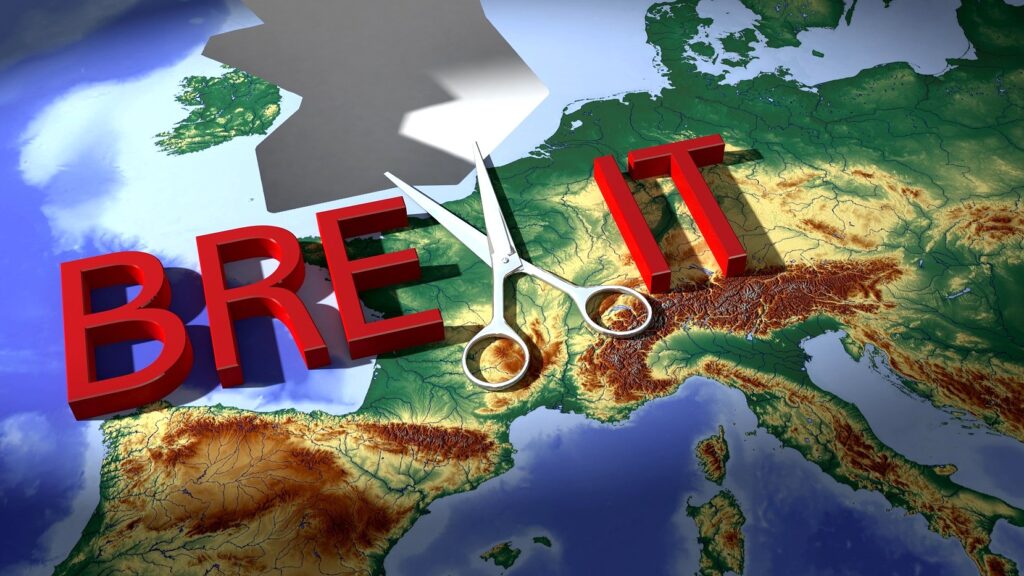
Tuesday marks the anniversary of one of the most consequential decisions in modern European history — the Brexit referendum. A decade on, its economic and political effects remain visible across Britain.
Just one day before the tenth anniversary of the referendum, UK Prime Minister Keir Starmer resigned. Years of economic drag have left Britain churning through prime ministers while the problem underneath went unfixed. And new data shows a country chasing a relationship with Europe it can’t get back, unwilling to pay the price that closer ties would cost at home.
Britons are living through a grinding cost-of-living squeeze, an economy that has barely grown, and public services visibly fraying at the edges. Dissatisfaction has become the norm: in polling for the European Council on Foreign Relations, 66 per cent of voters say Brexit has had a negative effect on the cost of living, and 65 per cent say the same of the economy.
“There may be a greater number of people in Britain who would support membership again, but that’s not a debate that will take place in the current political climate,” said Anton Spisak, senior research fellow at the Centre for European Reform.
The political climate is one where the centre cannot hold a prime ministership for long, and where Reform UK has begun to flourish. Nigel Farage’s party is harnessing the sensation Brexit has left behind, channelling it into a politics of grievance that points everywhere except at the rupture of 2016. That rupture, however, has been costly and central to Britain’s decade of political instability.
Counting the cost
The Centre for European Reform’s (CER) latest modelling puts the damage at roughly 12 per cent off total UK exports to the EU and around 16 per cent off imports — a contraction in the country’s most important trading relationship that shows no sign of reversing.
The losses span goods and services alike — goods exports down about 16 per cent, services imports down 19 per cent. The services effect is what distinguishes CER’s findings: the “doppelgänger” studies that dominate the debate find little impact on services, because CER is measuring the trade costs of leaving the single market and customs union, not the entire economic drag.
There may be a greater number of people in Britain who would support membership again, but that’s not a debate that will take place in the current political climate. — Anton Spisak, Centre for European Reform.
As Spisak puts it, the honest range is somewhere between four and six per cent of GDP, depending on the method. At the upper end, that is an economy roughly £180 billion a year smaller than it would otherwise have been. But that only begins to scratch the surface of the loss.
“The real cost of Brexit isn’t the economic cost. It’s all the opportunities forgone over the last decade — all the trade that could have happened, all the investment that could have been made, but also all the political energy that could have been spent on other domestic priorities, crowded out of the discourse,” Spisak said. “Every aspect of the British economy and politics you look at, you see that cost.”
Brexit is not the sole cause of Britain’s troubles — the productivity slump predates it, and the cost-of-living crisis has many drivers, from the COVID-19 pandemic to Russia’s invasion of Ukraine. But amid all the other variables, the one constant of British politics has become Brexit
The trap
“We are trapped in a situation where there is a great desire for closer ties, but very little change in what price Britain would be prepared to accept for them,” Spisak says.
Meaningful reintegration would mean reopening the questions the Leave campaign was won on: accepting a version of free movement, resuming financial contributions to the EU budget, and aligning with rules that come not from London but Brussels. Each remains as politically radioactive as it was a decade ago.
The desire for closeness and the refusal to pay for it sit unreconciled creating a national mood with little expression in policy, but instead expresses itself at the ballot box, through the slow churn of leaders who cannot deliver what the country half-wants and dares not name.
And while the UK is stuck, the position of Brussels has not changed, and shows no sign of doing so. The EU takes roughly 41 per cent of UK exports and provides half of its imports, while in the other direction the UK is a second-order partner, worth about 13 per cent of the EU’s trade — behind the United States and only just above China.
The EU holds a surplus with the UK in goods, in services and in foreign investment, according to the European Commission. As the Brussels think tank Bruegel has argued, London continues to overstate the EU’s hunger for rapprochement and to oversell what it brings to the table. “There is little case for offering a preferential deal while the UK remains unwilling to reconsider its red lines,” the analysts wrote.
The reset
The UK is not going to rejoin or win a grand rebargaining any time soon. What is happening is incremental deals — on agri-food, energy and emissions trading, economic security, and, most consequentially, defence, as the war in Ukraine and an unreliable Washington erode a decade of estrangement. None of it touches the single-market losses that make up the bulk of the damage.
“The impacts of leaving the single market have been much larger than the customs union,” Spisak says. “That’s the new aspect of this study. It’s not surprising, but it’s useful to have it backed out by empirical evidence, because the debate in the UK about the customs union keeps coming back.”
The customs union has been a recurring feature of Britain’s post-Brexit debate, resurfacing under successive governments as the politically safer half of the question — it can be pursued without reopening free movement.
But it is the smaller prize. Leaving the customs union accounts for only around 7 per cent of the lost imports and about a quarter of the lost exports, according to the CER report drafted by John Springford and Anton Spisak. The overwhelming majority of the damage flows from leaving the single market.
Where the damage falls
Why this has become a permanent stress on British politics is clearer in looking at who it hits. “The real cost has been concentrated in smaller and medium-sized businesses and individual traders who’ve had to absorb these extra costs,” Spisak says. “Larger businesses have been able to absorb them. That twelve percent is ultimately what’s holding back British growth and feeding into the stagnation.”
Big exporters had the scale to swallow the new paperwork, customs checks and rules-of-origin requirements; smaller ones often could not. A separate study by the London School of Economics’ Centre for Economic Performance found that the number of UK firms exporting to the EU fell by around 20,000 after Brexit — a drop concentrated entirely among the smallest firms, and one its authors warn has thinned the pipeline of future exporters.
The “Global Britain” pivot to faster-growing markets beyond Europe never materialised either. There has been almost no diversion of trade to the rest of the world, and the new agreements with Australia, New Zealand, India and the CPTPP bloc offer trivial gains against the £856 billion of trade Britain still does with the EU each year.
Ten years on, Britain is poorer than it would have been, smaller than it would have been, and its politics more chaotic than ever — chasing a relationship with Europe it can neither retrieve nor replace. Its leaders have yet to face the choice underneath: either convince the public that Britain is better off with Europe than without, and accept the compromises that it requires, or give up the chase. The stagnation is not a phase. It is the shape of the choice the country keeps making.