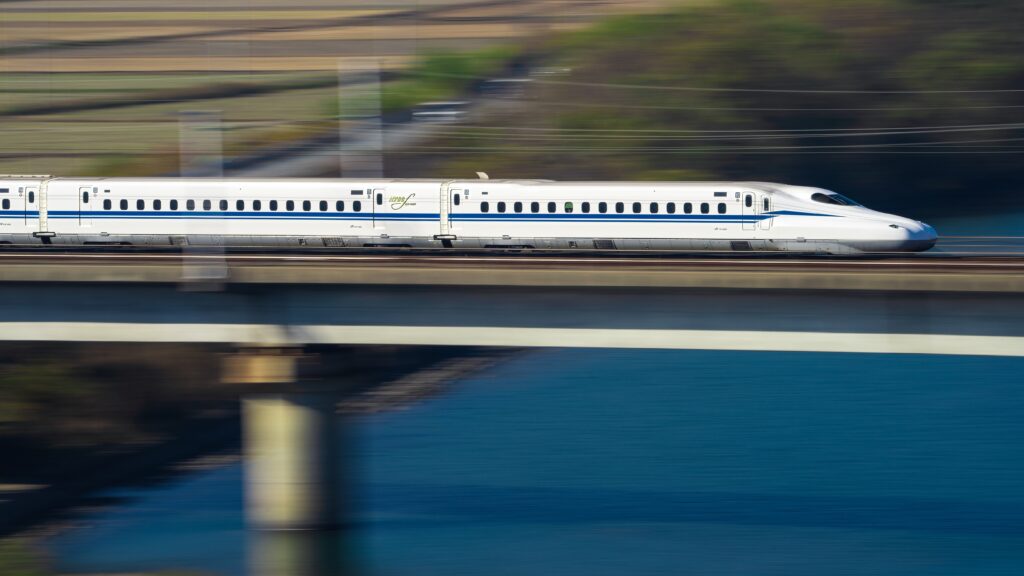
Swap a short flight for a train, and Europe’s skies should get a little cleaner. Not necessarily. Free up a slot at the airport, and it may simply go to a long-haul flight that pollutes even more. Brussels wants high-speed rail to replace short hops across the continent, but getting the shift right is trickier than it looks.
Tracks are only part of the problem. Trains, signalling, taxation, airport slots and national rules are all moving at different speeds, and none of them meets in the middle. The European Commission’s High-Speed Rail Plan, published in November 2025, is meant to change that. The European Parliament is now drafting its own report in support.
For Transport & Environment (T&E), this is a moment to turn high speed rail from an infrastructure promise into a real alternative to flying. But in a new position paper carries a warning: construction alone will not get Europe there.
Carlos Rico, T&E’s rail policy officer and lead author of the report, told EU Perspectives that Brussels’ ambition is not the problem. What is missing, he says, are the unglamorous systems that make cross-border rail actually work.
Your report argues that Europe needs more than infrastructure to make high-speed rail work. What is the biggest missing piece today?
ERTMS [the European Rail Traffic Management System] is definitely the main element that we are missing, not just for high-speed rail but for cross-border connectivity by rail in general. Fitting your trains with different signalling systems so they can cross from one country to another is very expensive and complicates the creation of new international routes. And the deployment is moving far too slowly, with just around 10 per cent of the Trans-European Transport Network having it.
The new EU budget will have to ensure that the pace accelerates and I believe this is one of the investments with a clear European added value that should be selected in the National and Regional Plans, while still counting with the support of the Connecting Europe Facility of course.
You warn that replacing short-haul flights with rail could backfire if freed airport slots go to long-haul flights instead. How should the EU make sure this modal shift actually cuts emissions?
The EU should start taking aviation emissions seriously. No other mode of transport is seeing such a fast growth in their emissions. The proposal to extend the ETS [Emissions Trading System] beyond Europe’s borders is a good first step, but we also have to look at ways to limit the growth of emissions within our airports.
And then we’ll find that the cure is worse than the disease.
— Carlos Rico, Rail Policy Officer at Transport & Environment
If we set a modal shift target based on replacing short-haul flights with rail alternatives, but do not set any sort of climate criteria for the allocation of slots in airports and to their expansion, what we’ll see is that all of those slots that used to be covered by short-haul flights will simply go to the much more polluting and profitable long-haul flights. And then we’ll find that the cure is worse than the disease.
This doesn’t mean that we simply have to cap flights with no conditionalities whatsoever. Airlines have the ability to bring down the emissions from their flights. The expanded ETS will be able to bring new revenues that can be reinvested in scaling up technologies like e-SAF that can effectively reduce those emissions. So if they use truly sustainable solutions and manage to reduce their pollution they will be able to use those slots.
Your report calls for a European railway industrial strategy. Is Europe at risk of losing its rolling stock industry the way parts of the car industry did to Chinese competition?
I think both operators and countries are starting to realise that the European rail sector isn’t immune to competition from third countries. The purchase of Chinese trains by the Austrian operator Westbahn and the threat from Spanish operator Renfe of doing the same have sparked alarm all over Europe.
We saw the same overconfidence with automakers, and now they’re struggling to defend their turf.
— Carlos Rico, Rail Policy Officer at Transport & Environment
Most rail operators don’t want the EU to take measures that are too protectionist because they want to be able to compete in third countries without retaliatory actions. But we saw the same overconfidence with automakers and now they’re struggling to defend their turf. We need to act before it’s too late by simplifying national rules, moving towards standardised rolling stock that can be mass-produced like the Chinese and speeding up the homologation process.
Some cross-border pilot routes have stalled because operators cannot secure trains. Which EU-level tool would make the biggest difference: guarantees, public leasing schemes, joint procurement or easier access to second-hand rolling stock?
It really depends. For many national operators or for new entrants with a strong financial backing guarantees may not be needed because they can easily prove that they will be able to return the investment. But they could be quite useful for smaller operators aiming to acquire trains for services that may take a while to become profitable.
Public leasing schemes would make a lot of sense on a national level but it’s not clear who would coordinate this at EU level and whether it would be a good use of limited resources. Joint EU procurement of rolling stock is also a complicated matter. Easier access to second-hand rolling stock by comparison is a much more enforceable option.
It’s not ideal to have old trains running for longer than they should, but it can be a good stepping stone for new operators to enter the market, move towards profitability and buy new trains once they reach a situation of financial stability.
For passengers, many high-speed rail projects will take years, even decades, to complete. What can the EU do before 2035 to make cross-border rail feel like a real alternative to flying?
It can continue to enable the creation of new cross-border services between the main cities in Europe. The cross border pilot route programme was successful in helping to create really long direct services such as Prague–Copenhagen or the upcoming Naples–Berlin and Berlin–Oslo. All of these services will benefit from future megaprojects like the Fehmarnbelt Tunnel or the Brenner Base Tunnel which will cut hours from their journey times.
But by not waiting for them to be completed passengers are getting the option to take the train right now. And the demand for international trains is continuously growing, so there is clearly a lot of interest for these services. The EU should therefore expand the pilot project programme to 2035, provide financial support to the selected operators so that they can purchase the trains that they need and continue to publicise these new routes so that citizens become aware of them.