One in five homes across the EU sits empty, yet rents and prices keep climbing and finding somewhere to live has become a fight. The EU’s own advisers just told Brussels to act. Its answer, so far, is a law about Airbnb.
Across the EU, close to one in five homes sits vacant. A flat above a shop that never closes. A holiday home used three weeks a year. An inherited apartment nobody has got round to selling. Meanwhile renters queue for viewings. Students sleep four to a room. Couples put off having children because there is nowhere affordable to raise them. It is a strange kind of shortage: the housing exists. Getting to live in it does not.
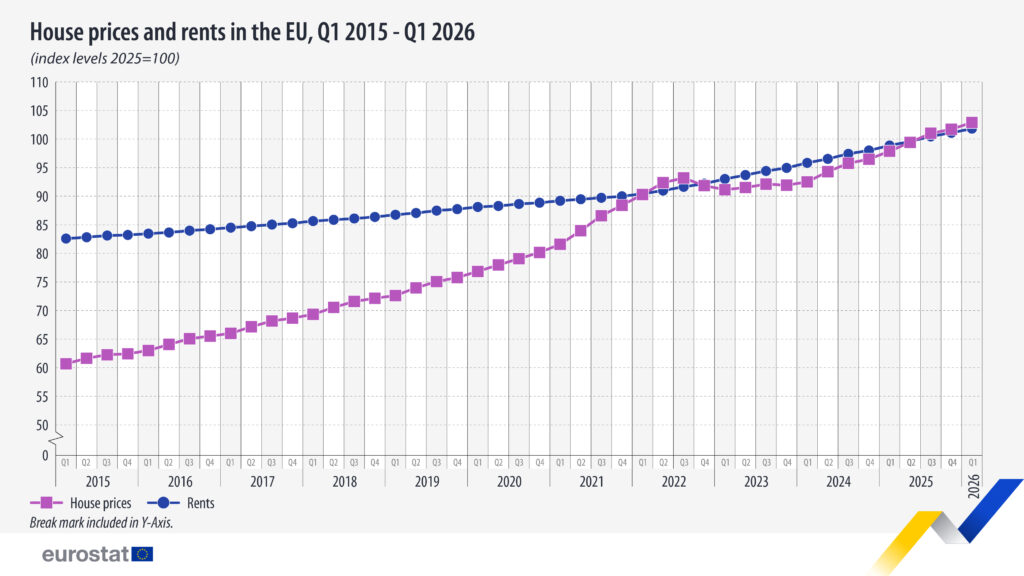
On 23 July, the European Economic and Social Committee (EESC) published a blunt verdict on the Commission’s housing plan. The EESC is the EU’s advisory body for workers, employers and civil society. Its report warns of a shortfall of around 650,000 homes a year across the bloc. Rents are up by almost 30 per cent since 2010. Prices have climbed by more than 60 per cent since 2013. Its rapporteur, Thomas Kattnig, did not mince words. He called on Brussels to deliver “homes that families, young people and workers can actually afford”, not luxury developments.
Numbers behind the frustration
The figures back up the frustration. House prices across the EU have climbed for a decade. The pressure has not eased this year, either. In the first quarter of 2026, prices rose by 5.1 per cent and rents by 3.0 per cent compared with the same quarter of 2025, according to Eurostat. The steepest increases came in Portugal, Bulgaria and Slovakia.
People have noticed. Eurobarometer polling from autumn 2025 found that 13 per cent of EU citizens rank housing among the two most pressing issues facing their country. That puts it on a par with security and defence. More than a quarter want the EU budget to spend more on it. In Ireland, where the issue bites hardest, that figure reaches 65 per cent. Housing has become one of the few things that unites Europeans across borders. Everyone, it turns out, is annoyed about the same thing.
A crisis outside Brussels’ control
Housing policy is, constitutionally, a national, regional and local matter. Brussels has no direct power over zoning, construction permits or social housing. What it can offer instead is money, coordination and political pressure.
In December 2025, the Commission unveiled its first ever European Affordable Housing Plan. It is championed by Dan Jørgensen, Commissioner for Energy and Housing. The plan rests on four pillars: boosting supply, mobilising investment, supporting reforms in member states, and protecting the groups hit hardest by rising costs. It also promised a new European Housing Alliance and the EU’s first ever summit of national leaders dedicated to housing. That is a grand gesture for a problem Brussels cannot simply legislate away.
Big promises, slow delivery
Some of it has already moved. The European Investment Bank (EIB) plans to lift its annual housing lending to €6bn from 2026 onward. The Commission says this should help deliver around one million additional affordable homes by 2030. Revised state aid rules will let governments fund social housing projects without seeking prior approval from Brussels. A new pan-European investment platform is meant to pool public and private financing.
But the plan’s most visible political moment has already slipped. EU leaders have pushed the Housing Summit to November. Once billed as a chance to put the crisis on leaders’ agenda, it has also been relocated to Dublin. A wider package meant to cut red tape around housing projects will not arrive before 2027. European Council President António Costa played down expectations. He said no single solution exists, and that mayors and local governments would need to lead the way. It is, in short, a plan long on ambition and thin on deadlines. That is exactly what the EESC’s advisers complained about this month.
The one law on the table targets Airbnb
Of the plan’s ten strands of action, only one is set to become binding EU legislation this year. That is the Affordable Housing Act, and it targets short-term rentals. It would let national and local authorities designate areas under housing stress. There, they could apply measures ranging from caps on the nights a flat can be let out each year to seasonal restrictions, or even a ban on new short-term licences.
Europe must collectively take responsibility for the housing crisis affecting millions of our citizens.
— Dan Jørgensen, European Commissioner for Energy and Housing
Commissioner Jørgensen made the same point when the wider plan was unveiled. “Europe must collectively take responsibility for the housing crisis affecting millions of our citizens,” he said. It is a sweeping claim for a law that, in practice, reaches a narrow slice of the market. Platforms such as Airbnb fall under the EU’s single market rules. That is squarely Commission territory. Construction, permitting and social housing are not. This is the real reason short-term rentals are the one piece Brussels can touch directly. It is not necessarily because they are the biggest part of the problem.
A mismatch in scale
The Commission’s own research service, the Joint Research Centre (JRC), puts short-term rentals at just 1.2 per cent of the EU’s housing stock. By contrast, the Commission’s own housing plan estimates that close to 20 per cent of EU dwellings sit unused as anyone’s primary residence, whether vacant, occasional or seasonal. Yet the legislative attention falls on the smaller number. MEP Borja Giménez Larraz steered Parliament’s own housing report through committee. He put the scale of the shortfall more bluntly, saying Europe was short “10 million homes, and young people and families are paying the price”.
Cities that already tried curbing short-term rentals offer a mixed lesson. Lisbon lifted its own citywide moratorium on new licences in 2025. Officials concluded it had done little to slow rent growth. It mostly pushed hotel prices up instead. Edinburgh’s licensing scheme followed a similar pattern. Local authorities there have since admitted they hold no evidence the restrictions delivered any measurable housing benefit. Millions of Europeans are counting on the Affordable Housing Plan to ease their monthly bills, and on the EESC’s advisers to actually be heard. For them, the lesson is a sobering one. The flat sitting empty above the bakery is likely to stay that way for a while yet.