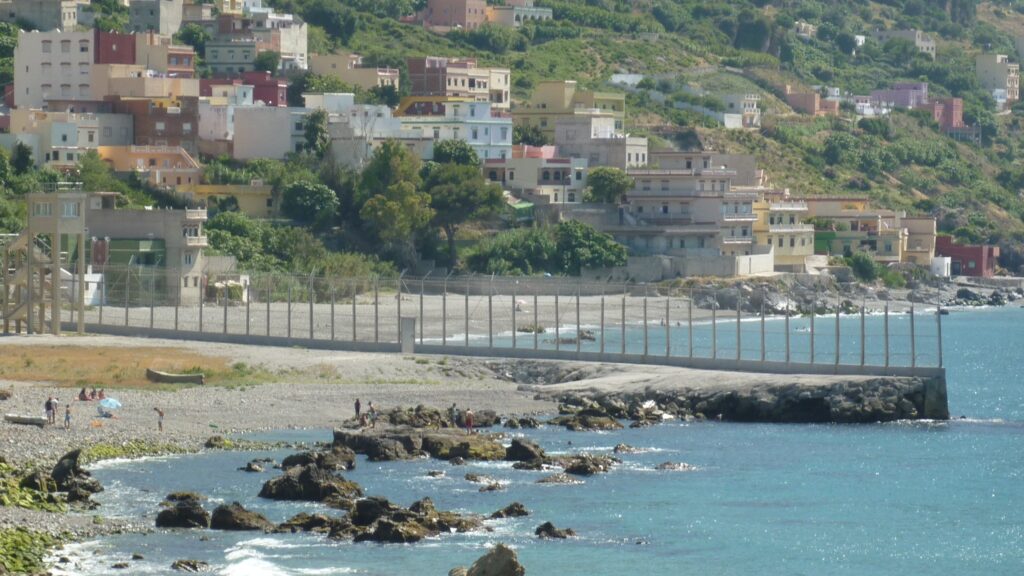
Thousands of migrants crossed from Morocco into the Spanish enclave of Ceuta within hours, triggering a political storm across Europe and reviving memories of the 2021 border crisis.
On Thursday, on the occasion of Moroccan King’s Day, thousands of migrants entered the Autonomous City of Ceuta by swimming or bypassing the Tarajal sea barrier. The massive influx of women, children, and men required a deployment of the national police and the Guardia Civil, who joined local officers.
Ceuta, together with another Spanish enclave Melilla, represents one of the EU’s only land borders with Africa. The president of the city Juan Jesús Vivas described the situation as a “humanitarian and social emergency” on a par with the firefighting efforts and called for urgent support from Madrid. Interior Minister Fernando Grande-Marlaska is due to travel to the enclave.
The EU together with Frontex have offered to provide support to the Madrid government. Italy wants to suspend the Schengen Agreement with Spain, and France is meanwhile strengthening its borders.
A small enclave under pressure
According to Mr Vivas, the arrivals “equivalent to almost 2 per cent” of the population. Approximately 700 are unaccompanied minors under the care of the local authority. Over a thousand people are waiting to enter the Temporary Migrant Detention Center (CETI), which is overcrowded with its capacity of approximately 500 places.
The Ministry of the Interior explained that Civil Protection legislation does not allow the activation of the “national emergency” mechanism for migrant flows, but only in the event of natural disasters or technological risks. The government confirmed that Rabat “is cooperating loyally and permanently with Spain” and that Moroccan security forces are intercepting numerous migrants before they reach Spanish waters.
Spain and Morocco have agreed to strengthen coordination to address the current situation. They are committed to reviewing and implementing measures for the rapid repatriation of all those who have entered Spanish territory irregularly.
Why now?
The same emergency already occurred in 2021, when between 12,000 and 15,000 people crossed the very sea barrier between Spain and Morocco. This time, several factors may have contributed to the renewed pressure on the enclave: Recent ruling by the Spanish Supreme Court and the meeting between Spain and Algeria, a historic enemy of Morocco, which took place a week ago.
The judges ruled that the so-called devoluciones en caliente immediate repatriations to Morocco provided for those who directly cross the fences of Ceuta and Melilla, cannot be automatically applied to people intercepted at sea while attempting to swim to the two enclaves. These migrants must be identified and granted access to asylum procedures and the guarantees provided by law. Mr Grande-Marlaska claims that criminal networks have exploited the ruling to fuel the perception that entry by sea guarantees permanence on Spanish soil.
Regarding relations with Algeria and Morocco, however, the government in Madrid rejects speculation. “Relations with Morocco are excellent and are in no way affected by the good relations with Algeria,” Foreign Ministry sources stated. They dismissied suspicions that the incident could be Morocco’s retaliation for Spanish Prime Minister Pedro Sánchez’s recent visit to Algiers.
The 2021 crisis
The arrival of over 10,000 migrants in Ceuta in May 2021 occurred when Rabat loosened border controls amid the crisis with Spain. Morocco had expressed outrage after Madrid granted medical treatment to the leader of the Algerian-backed Saharawi separatists of the Polisario Front. The diplomatic crisis ended in 2022, when Spain reversed its stance on the sensitive issue of Western Sahara, abandoning its neutrality and recognising Rabat’s autonomy plan for this former Spanish colony.
The emergency, however, also fits into a broader context: the extraordinary regularisation promoted by Mr Sánchez government. The measure, launched in 2026, allows foreigners who have already been living in Spain for a certain period to apply for a residence and work permit. Applicants must have no criminal record and meet a set of requirements.
Applications have exceeded one million, well above the initial estimate of around 500,000 beneficiaries. This is not, therefore, an automatic granting of Spanish or European citizenship, but rather an administrative regularisation that allows one to reside and work legally in Spain.
The Popular Party and Vox, the main opposition forces, have accused the government of creating a “pull factor”. However, there’s not a direct connection between the regularisation and the events in Ceuta because the programme concerns people already residing in Spain within the established timeframe, not those arriving after the measure came into force.
EU steps in with support for Spain
Just hours after the images of Ceuta circulated on social media, the EU also weighed in. According to Commissioner for Home Affairs and Migration Magnus Brunner, “the protection of the European Union’s external borders is a fundamental component of our efforts to combat irregular immigration”. Mr Brunner communicated to Minister Grande-Marlaska “the European Union’s willingness to increase its support to Spain, including through Frontex, to help manage the situation”.
European Commission President Ursula von der Leyen called the images from Ceuta “unacceptable” and stressed that dangerous crossings must stop. “We cannot allow anyone to come to our Union without abiding by our rules,” she wrote on X, adding that she remained confident that the EU’s partnership with Morocco could help deliver results.
The Commission has therefore offered Spain additional operational and financial support, including the possible strengthening of Frontex’s presence, to address the influx of thousands of migrants into the Ceuta enclave. However, until Spain formally requests it, this mechanism cannot be activated.
Frontex is reportedly present in Ceuta and provides assistance to national authorities with border controls at the port. It is not directly involved in current events, as these occurred at the border, outside its scope of operations.
France and Italy call for action
France has ordered an immediate strengthening of controls at the Spanish border. Italy has issued the strongest reaction among European counries: the government of Prime Minister Giorgia Meloni is considering suspending the Schengen Agreement, a founding principle of the EU.
“Irregular and uncontrolled immigration represents a danger to national security,” said Deputy Prime Minister Antonio Tajani, arguing that the images from Ceuta demonstrate the negative effects of Madrid’s decision to regularise hundreds of thousands of migrants.
The European People’s Party, of which Mr Tajani is also a member, has announced that it must “receive answers at the next plenary session of the European Parliament” regarding the situation. The European Pact on Migration and the Regulation on Returns cannot wait. “We urge Spain to act now to protect our external borders and the European Commission to take appropriate measures.” Patriots for Europe ask for the same.
US conservatives seize on Ceuta
Images of hundreds of migrants crossing the border from Morocco to the Spanish enclave of Ceuta were also published by two White House officials. They use it to defend US President Donald Trump’s repressive immigration policies, warning of a possible Democratic return to power.
“The Democrats did this to America every single day for 4 years under (President Joe) Biden and will do it again instantaneously, but orders of magnitude greater, if they are given any form of national power,” Stephen Miller, a close adviser to Trump, wrote on X.
White House communications director Steven Cheung also expressed outrage. “Your home will be destroyed and looted by invaders, and the Democrats will rejoice. This is what happened under President Biden. Thankfully, President Trump was elected, so none of this could happen under his administration”. Trump already expressed many times in the past that the EU management of migration is “weak”.
The human cost
Beyond political declarations, the crisis also has a growing human cost. In the previous days, several migrants had died while swimming, while local authorities had reported the recovery of dozens of bodies along the coast since the beginning of the year. The streets of Ceuta transformed into an open-air dormitory overnight, while the crossing of people from Morocco continues.
Moroccan authorities have used riot control equipment, including tear gas and water cannons, to disperse the hundreds of Moroccan migrants crowding at the border. Thousands continue to flock to the Moroccan town of Castillejos, near the border with the Spanish enclave, intending to cross, forming a human column over five kilometers long.