Europe’s sanctions are biting but Russia’s oil keeps flowing. The practice may be finally—even if slowly and belatedly—coming to an end.
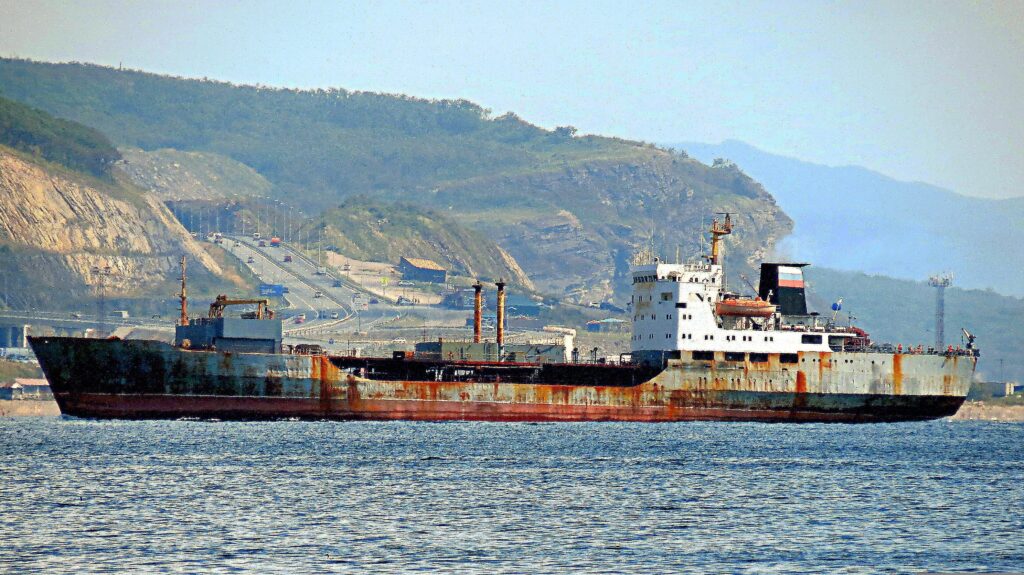
On the morning of Sunday, 1 June the French navy boarded an oil tanker more than 400 nautical miles west of the tip of Brittany. The vessel, the Tagor had sailed from Murmansk. It was subject to international sanctions and suspected of flying a false flag. After inspectors confirmed the irregularity of the flag, the ship was diverted for further checks.
French President Emmanuel Macron announced the operation on X, with characteristic directness. “It is unacceptable for ships to circumvent international sanctions, violate the law of the sea, and finance the war that Russia has been waging against Ukraine for more than four years,” he wrote.
A pattern, not an exception
The operation did not happen in isolation. In March, French and allied forces stopped the Deyna in the Mediterranean. Earlier this year, a vessel nicknamed the Grinch was boarded on suspicion of flying a false flag. Last year, the tanker Boracay was intercepted off France’s Atlantic coast for failing to provide proof of its nationality.
British Prime Minister Keir Starmer announced in March that he had granted permission for UK military forces to board shadow-fleet ships. The Tagor operation took place with British support; a signal that Franco-British maritime enforcement is becoming a pattern, not an exception.
Yet for all the drama of ships boarded on the high seas, the broader picture remains sobering. Shipping data shows that dozens of sanctioned vessels linked to Russia continue to cross UK waters. Russian oil, for the most part, keeps flowing.
The shadow fleet is vast. Open-source tallies converge on between 800 and 1,200 tankers in the broad network. Ukraine’s War & Sanctions portal had verified 534 vessels as of 7 May 2026. Ukrainian officials count a core of roughly 400 ships that sailed from Russian ports at least three times in the past 12 months.
A fleet built to evade
The Kyiv School of Economics’ January 2026 Oil Tracker identified approximately 178 tankers that actually loaded Russian cargoes that month—105 crude, 73 products—a useful proxy for vessels that are both sanctioned and operational. Combined, their lift capacity exceeds 100 million deadweight tonnes, roughly 17 per cent of the global tanker fleet.
The fleet is old. About 90 per cent of Russian-linked shadow tankers are more than 15 years old, with a median build year of 2005. More than 70 per cent sail without verifiable protection-and-indemnity insurance. That matters beyond the immediate sanctions question: any major spill from one of these vessels would likely become a public-sector liability rather than a private one. An oil spill off the Kerch Strait in December 2024 killed more than 500 birds and put the environmental risk of the ageing fleet into sharp relief.
When EU and allied pressure tightens on one route, Russia finds another. Baltic crossings through the Danish Straits remain the primary corridor for cargoes from Primorsk and Ust-Luga. Danish authorities recorded 292 crossings by sanctioned tankers in 2025, at a similar pace so far in 2026. But usage of the Arctic’s Northern Sea Route exploded from 13 vessels in 2024 to roughly 100 in 2025, as operators sought to avoid European chokepoints altogether.
More packages, partial results
The EU has now adopted 20 sanctions packages since February 2022. The G7’s $60-per-barrel price cap, introduced in December 2022, worked briefly in the first quarter of 2023. Since then, Urals crude has traded well above the cap for most of 2025 and 2026.
Russia replaced Western shipping services with the shadow fleet; the Western service share of Russian oil exports has fallen to 39 per cent. In March 2026, 194 shadow tankers departed Russian ports in a single month, helping Russia net $19bn in oil revenues. That amounts to almost a doubling month-on-month, partly driven by the Hormuz crisis.
It is unacceptable for ships to circumvent international sanctions, violate the law of the sea, and finance the war that Russia has been waging against Ukraine for more than four years. — Emmanuel Macron, President of France
Vessel listings have accumulated. The EU listed 557 tankers by October 2025 and roughly 600 by December 2025, denying them EU ports and services. Yet 143 of those listed tankers still loaded Russian oil in February 2026.
Momentum, but no breakthrough
Compliance costs have risen and re-flagging has accelerated—70 vessels switched to the Russian International Register by February 2026, with another 120 in the queue—but the fleet has not been broken. Seizures of the Nora, Ethera and Deyna in the first quarter of 2026 represent growing enforcement momentum. Russia has responded by deploying naval escorts for some tanker transits, raising the political stakes of any interception.
The ACLED research group estimates the shadow fleet carries approximately 80 per cent of Russia’s seaborne crude exports. In the second half of 2025, Russia earned roughly $0.55bn per day from oil, according to the Centre for Research on Energy and Clean Air. Sanctions have contained fleet growth and raised costs. They have not cut the revenue lifeline.
The draft 20th EU sanctions package—expected later in 2026—aims to go further. It would impose a blanket maritime-services ban on any Russian-origin oil cargo and introduce export controls on spare parts critical to tanker class surveys. If adopted and enforced, the survey-lapse mechanism could idle 10 to 15 per cent of today’s operable tonnage by mid-2027, as ageing vessels fail to secure the certifications they need to trade.
What is to follow
Russia will not wait passively. Re-flagging to the Russian International Register will accelerate. Purchases of 20- to 25-year-old very large crude carriers exiting OECD fleets will continue. The Arctic route will expand: with ice receding, the Northern Sea Route season now runs from May to November, and up to 150 shadow tankers could use it by 2027.
India and China remain the anchor markets. If either were to restrict shadow-fleet berthing—an unlikely but not impossible scenario—Russia would reroute through ship-to-ship transfer hubs off Indonesia or Sri Lanka.
The age profile of the fleet creates a risk that compounds over time. With a median vessel age of roughly 21 years, accident probability is nearly double that of a standard commercial fleet. The Kerch spill was a warning. A larger casualty—in the Baltic, the Bosphorus, or the North Sea—would force a political reckoning that no sanctions package has yet managed to trigger.
France’s boarding of the Tagor is a signal that Europe might be willing to act on the high seas, and that enforcement is perhaps becoming more than rhetoric. But one tanker diverted is not a fleet dismantled. Until the 20th package closes the services gap and spare-parts loophole, Russia’s shadow fleet will keep sailing.