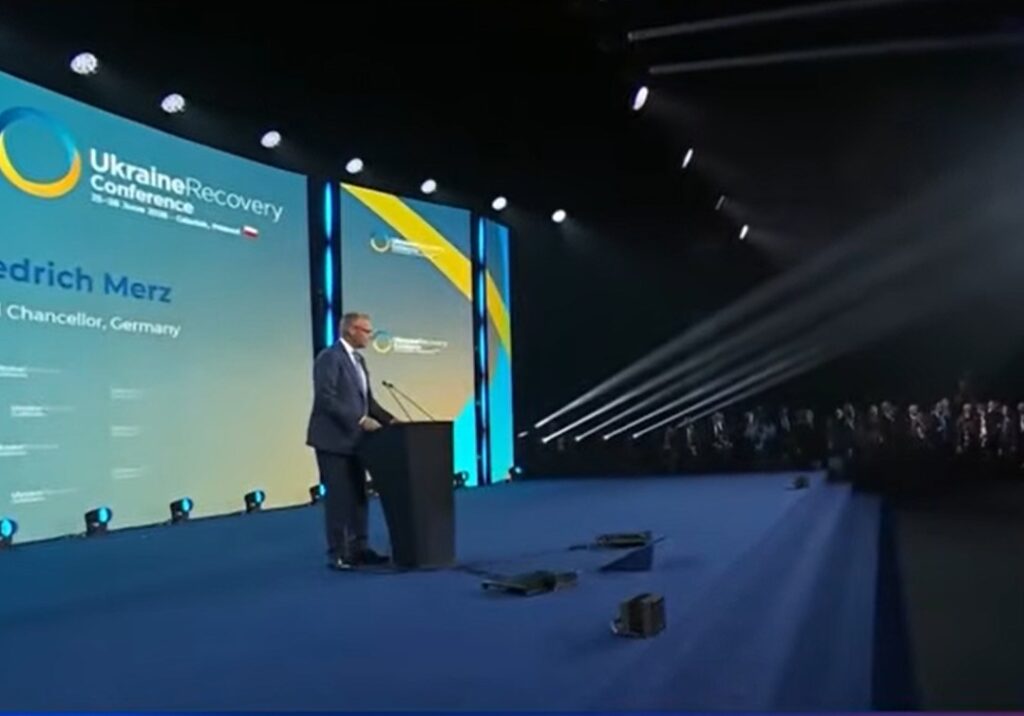
The Ukraine Recovery Conference concluded in Gdańsk on June 26 with a tangible financial outcome. The two-day event saw 160 agreements signed, including a €3.2bn tranche from the European Union.
For someone who did not show up, Volodymyr Zelenskyy did not have the worst of fundraisers. The conference brought some €10bn to his country’s war-drained coffers. The main outcomes of the conference included a broad package of financial and reconstruction initiatives. Among them are a €3.2bn first tranche under a new EU financial instrument, a $3.4bn agreement with the World Bank, and the launch of the European Flagship Fund for Ukraine’s reconstruction.
The event featured Polish Prime Minister Donald Tusk and Ukrainian Prime Minister Yulia Svyrydenko as hosts. It also enjoyed attendance by various dignitaries: European Union delegates, the G7, the World Bank, and numerous global corporations.
Contrary to original plans, Presidents Volodymyr Zelenskyy of Ukraine and Karol Nawrocki of Poland snubbed the gathering as a result of their recent diplomatic skirmish over their respective countries’ WWII legacies. Ms Svyrydenko announced the results. “160 agreements worth over €10bn are the result of the daily work of President Volodymyr Zelenskyy and the entire Ukrainian team,” the PM was quoted as saying anyway.
The European package
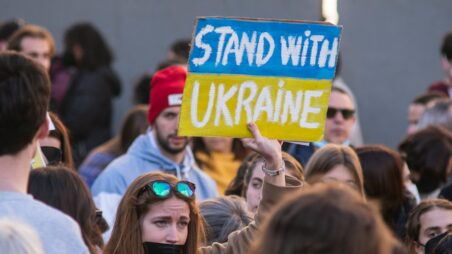
Other results include the establishment of the Ukraine Transport Support Fund, €140m allocated for housing programmes, and an agreement with the European Investment Bank on rebuilding and protecting roads in frontline regions. Ms Svyrydenko highlighted the conference underscored Ukraine’s long-term integration with Europe. “This day once again confirmed that Ukraine and Europe share a common path, common values, and a common future,” she said.
Just a day earlier, the European Commission signed agreements worth more than €1.1bn under the Ukraine Investment Framework and officially launched the European Flagship Fund for Ukraine’s reconstruction. The initiative—implemented in cooperation with the European Investment Bank and the European Bank for Reconstruction and Development—aims to channel critical financial support toward municipal rebuilding, stabilisation of the energy sector, and financing for businesses, particularly in frontline regions. The European Bank for Reconstruction and Development has deployed nearly €10bn in Ukraine, with support reaching more than 22.4 million people.
The EU is Ukraine’s largest recovery donor. As of February 2026, €36.8bn had already seen mobilisation under the Ukraine Facility out of a total €50bn package. Private-sector financing could cover 40 per cent of the country’s total recovery costs—bringing capital, innovation, technology, and jobs. EU companies met financing partners for investment projects in Ukraine at a side-event of the conference.
The funding package is part of a wider international support effort, which also includes a separate $3.39bn agreement between the Ukrainian government and the World Bank. That arrangement comprises a $1.04bn development policy loan, backed by $500m from the United Kingdom and $540m from Japan, as well as $2.35bn in grant financing from the F.O.R.T.I.S. Ukraine FIF fund. The financing will support Ukrainian small and medium-sized enterprises, including start-ups and businesses employing veterans .
War and energy
The US and European allies pledged at least €375m in fresh funding to rebuild Ukraine’s power infrastructure and reinforce the country’s Energy Support Fund, First Deputy Prime Minister and Minister of Energy Denys Shmyhal announced on June 25. The financial commitments were secured during the high-level ‘Energy Ramstein’ meeting convened on the sidelines of the conference. Ukraine is set to receive €234m from the United Kingdom to guarantee stable nuclear fuel supplies for its atomic power plants over the next two years.
Mr Shmyhal confirmed the nuclear-fuel funding agreement, which reached finalisation during the conference. The initiative involves UK Foreign Secretary Yvette Cooper, UK Export Finance, and the British-based nuclear fuel company Urenco. “These are important agreements that will allow us to continue ensuring the reliable operation of Ukraine’s nuclear generation. It is the basis for the stable and predictable operation of our energy system,” Mr Shmyhal stated.
Previously, the British government considered selling 98,000 tons of seized Russian crude oil from a detained shadow fleet tanker to fund Ukraine’s military needs. The cargo, valued at approximately $46m, was held aboard the vessel SMYRTOS after Royal Marines stopped it in the English Channel on 14 June.
The political cost
Finland will provide an additional €40m to the PURL initiative, a programme aimed at purchasing US-made weapons for Ukraine, Finnish Prime Minister Petteri Orpo announced during the opening of the conference. According to European Pravda, Mr Orpo said Finland remains committed to supporting Ukraine’s defence efforts and highlighted the country’s continued military assistance since the start of Russia’s full-scale invasion. Helsinki has already delivered 33 military aid packages.
Apart from cold cash, the meeting was pretty big on diplomatic resolve. German Chancellor Friedrich Merz called for immediate negotiations to end the war in Ukraine, declaring that the time has come to freeze the front line and end the killing, German news agency dpa reported on June 25. Mr Merz asserted that Europe and the transatlantic alliance remain prepared to ramp up economic pressure on Russia’s struggling economy. (He did not elaborate on what the allies have been waiting for.)
This day once again confirmed that Ukraine and Europe share a common path, common values, and a common future.
— Yulia Svyrydenko, Ukraine’s prime minister
“Russia won’t win this war,” the Bundeskanzler stated. Despite urging a diplomatic opening, Mr Merz emphasised that backing Ukraine remains an “unwavering commitment” for Germany as Kyiv continues to defend its territory after more than four years of full-scale war, according to dpa. “The time has come to start negotiations, freeze the front line and put an end to the killing,” he said.
The fossil paradox
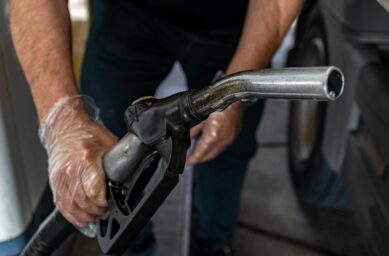
The money from Europe may help balance the fact that the EU is also a significant contributor to Russia’s war effort. The Union ranked as the fourth largest buyer of Russian fossil fuels in May 2026, spending €2.3bn and accounting for approximately 12 per cent of Moscow’s export revenues.
According to the monthly analysis by the Center for Research on Energy and Clean Air, Hungary led European imports by happily purchasing €674m worth of Russian gas and oil. Not to be outdone, Slovakia followed at €497m, which included €121m in piped gas and €376m in crude oil. The list of countries engaging most extensively in the questionable practice also features Spain, which even doubled its intake from Russia, France, and Belgium. The latter two, however, decreased their consumption of Russian LNG by 29 and 31 per cent, respectively.
Ukraine’s total reconstruction bill, meanwhile, remains staggering. Mr Shmyhal put the financial requirements for reconstruction at $750bn. The pledges made in Gdańsk, however substantial, represent only a fraction of what rebuilding Ukraine will ultimately cost.