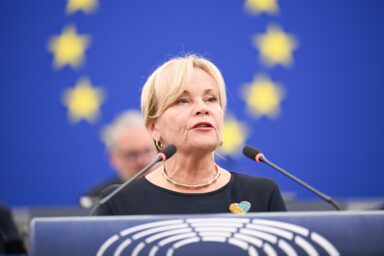
Two European Parliament committees have moved to delete the Biotech Act’s most contested measure: a proposed 12-month extension of market protection for biotech medicines.
The EP’s environment committee (ENVI) debated its draft opinion on Tuesday and wants the extension gone. The legal affairs committee (JURI) takes the same line in its own draft opinion. Both rapporteurs are Socialists, Nicolás González Casares (S&D/ESP) in ENVI, Tiemo Wölken (S&D/DEU) in JURI. In both rooms, the European Commission defended the measure. The two committees that will write Parliament’s final position, public health (SANT) and industry (ITRE), debate their joint draft report on Monday 29 June.
The certificate has split Brussels for months. As EU Perspectives reported earlier, the same 12-month extension drew three different verdicts: the Commission put its net cost at roughly €615 million a year, the research-based industry argued a broader version could attract over €45 billion in investment, and the environment committee valued it at nothing. Tuesday’s debate showed which way ENVI is leaning.
“European biotechnology leadership will not be based on ad infinitum extensions to intellectual property.”
— MEP Nicolás González Casares (S&D/ESP)
At the heart of the dispute is a simple question: should biotech drugmakers receive an extra year of protection from generic and biosimilar competition?
Under the Commission’s proposal, eligible biotech medicines would benefit from a 12-month extension of regulatory data protection, delaying the point at which competitors can rely on the original clinical trial data to bring cheaper alternatives to market. Supporters argue the incentive would make Europe more attractive for biotech investment and help keep innovative companies from moving elsewhere. Critics counter that it would increase healthcare costs, delay patient access to more affordable medicines and offer little evidence that it would actually boost innovation.
More monopoly doesn’t equal more innovation
Nicolás González Casares (S&D/ESP) put the argument plainly. “More years of monopoly do not guarantee more innovation,” he told the committee. His draft opinion therefore removes provisions creating the new intellectual property incentives. It deletes the proposed 12-month extension of supplementary protection certificates (SPCs) for eligible human medicines, scraps the equivalent one-year extension for veterinary medicines targeting zoonotic diseases, and strikes the entire chapter of the Biotech Act that introduces those measures.
At the hearing he pressed a point that does not appear in that written text. An extension granted without restriction, he warned, “may benefit non-European actors.” He said he would “defend innovation, which is European, not boosting innovation in third countries.” It is the strategic-autonomy argument, the case for the Act itself, turned against one of its own measures. “European biotechnology leadership will not be based on ad infinitum extensions to intellectual property,” he said.
His written objection still stands behind the speech: the extension, he argues, “lacks a proper econometric impact assessment.” The Commission has in fact published one, a staff working document dated 26 May, which put the measure’s net cost at around €615 million a year, as EU Perspectives reported. The complaint has shifted. Critics no longer say the evidence is missing; they say it does not go far enough.
Shared scepticism
The scepticism was not his alone. MEP Martin Häusling (Greens/EFA, DEU) backed the rapporteur on the certificate directly. “Article 27, extension of the protection certificates. I agree with the rapporteur. We reject an extension,” he said. Longer monopolies, he argued, would make important medicines more expensive, delay care, and block competition from biosimilars.
MEP Stine Bosse (Renew/DNK) welcomed the rapporteur’s “progressive approach,” though her attention fell mainly on food biotechnology and novel foods rather than the certificate.
MEP Vytenis Andriukaitis (S&D/LTU), the Public Health committee’s rapporteur on the Act, said he was “really positively inclined,” praised the rapporteur and the shadows, and called the work “very constructive.” He did not address the certificate. His focus was the wider ecosystem: faster clinical trials, accessible data, and pan-European strategic projects across all 27 member states.
The extension is a very targeted and conditional tool, not an unconditional reward.
— European Commission representative
Commission holds the line
A Commission official defended the SPC. The extension, the Commission said, is “just one of the tools” in the Act’s “overall toolbox.” The official called it “a very targeted and conditional tool,” not “an unconditional reward.” It carries conditions: clinical trials in at least two member states, and manufacturing that takes place “at least to a significant extent” in the EU, among the four cumulative conditions set out in the proposal.
The Commission also answered the biosimilars argument head-on. The measure, it said, “helps to create the pipeline from which future biosimilars can emerge,” and so “contributes to affordability over time.”
A second committee says scrap it
ENVI is not alone. The Committee on Legal Affairs (JURI) has reached the same verdict by a different route. Its rapporteur, Tiemo Wölken (S&D/DEU), could not attend the committee’s exchange of views earlier in June. René Repasi (S&D/DEU) read his text on his behalf.
Wölken’s opinion deletes the SPC extension outright, the same three cuts Casares makes. His case turns on the Commission’s own evidence. Repasi quoted the staff working document back at it: the extension’s “main effect,” it reads, is “the temporary postponement of additional product entry, implying fewer available treatment options and delayed expansion of supply for patients during the extension period.” On that basis, he said, the Commission “has not provided a sufficient justification to retain such a measure.”
He added a legal objection ENVI did not make. “There is no plausible reason to grant an SPC extension solely to biologics,” he said. Breakthrough medicines that meet an unmet need “are not exclusive” to the industry. The proposal “singles out a specific area of research and fails to adopt an inclusive horizontal approach to reward genuine innovation.”
JURI also swaps the extension for its opposite. Wölken is examining amendments to the SPC manufacturing waiver, letting EU biosimilar makers stockpile for longer so they can launch the day a patent expires. “It simply does not make sense,” Repasi said, “that we allow companies to produce within the EU for the export of medicines outside the EU but do not grant them the necessary stockpiling duration to also produce biosimilars for distribution within the EU.”
In JURI, the Commission defended the measure again. The SPC extension, the Commission said, is “well documented in the staff working document,” a “robust estimate” built on European Medicines Agency data on eligible products and market data from the firm IQVIA. The official called it “a quite targeted incentive”: open only to a genuine alternative for patients, “not another me too,” and to products “developed and partly manufactured in the EU.”
The industry’s counter-case
The research-based industry is pushing the other way. A European Federation of Pharmaceutical Industries and Associations (EFPIA) analysis published on 18 June makes the case for the certificate as part of what keeps biotech investment in Europe. According to the industry, extending patent-related incentives encourages research spending and foreign investment, and countries with stronger intellectual property protection tend to host more clinical trials, especially for biologic medicines
By that logic the SPC extension is one of the few measures in the Act that strengthens protection. Europe, the analysis adds, is already losing ground: EU firms drew 7% of global health biotechnology venture capital investment from 2015 to June 2025 against 63% in the United States. Additionally, 66 out of 67 EU biotech companies that went public since 2020 listed outside the EU.
It attacks the route JURI wants to widen. It argues that the general pharmaceutical legislation already weakens intellectual property protection by allowing generic manufacturers to do more preparatory work before patents expire. Where Wölken wants biosimilar makers to start stockpiling earlier, industry sees that pre-expiry activity as eroding the protection it wants the Biotech Act to reinforce.
A reading, not a ruling
The ENVI text is a draft opinion, not a decision. Its deadline for amendments is 25 June. Once adopted, the opinion passes to the lead committees, Public Health (SANT) and Industry, Research and Energy (ITRE), which hold the pen.
SANT and ITRE will debate their joint draft report on 29 June, meeting under the joint committee procedure. Members will exchange views and set out their priorities before the deadline to table amendments, set for 7 July. The SANT vote on the file is expected in September.
That leaves the file pulling in different directions. Industry wants the extension widened. Two opinion committees, ENVI and JURI, want it deleted. The Commission wants it kept as designed — with the ITRE committee taking a similar stance.