Ordering ammunition across borders used to mean months of paperwork. The Council and European Parliament agreed on 10 June to fix that, striking a deal to cut red tape across Europe’s defence industry at a time when the continent is racing to rearm.
Under the new rules, defence authorities have 102 working days to approve a permit for a new facility. Miss that deadline, and the permit goes through automatically. Two new transfer licences will cut the paperwork for companies shipping military equipment across borders. And smaller firms will find it easier to tap the European Defence Fund for research money.
The changes matter because Europe’s rearmament drive has been running into its own rulebook. A company wanting to build a new munitions plant could wait years for permits. Sending equipment to a partner in the next country meant navigating a different set of national rules in every member state. The EU has been spending more on defence every year since 2022, but the bureaucracy has not kept pace with the ambition.
Faster and simpler
Cross-border transfers of defence equipment within the EU have long been a weak point. Companies exporting military goods to partners in other member states often faced overlapping national rules and lengthy approval chains. The deal, part of the broader defence readiness omnibus, introduces two new automatic transfer licences: one for certified suppliers and recipients, and another for partnerships between European companies.
With today’s agreement, we are simplifying rules for defence-related projects and providing greater support to Europe’s defence industry.
— Marilena Raouna, Deputy Minister for European Affairs, Cyprus
For procurement, the agreement raises the thresholds above which the most burdensome rules kick in, giving defence authorities more time to focus on major contracts rather than routine purchases. It also allows for occasional joint procurement between member states and introduces more flexibility in framework agreements.
Eyes on 2030
The deal fits into a wider pattern. Since Russia’s full-scale invasion of Ukraine in 2022, EU member states have sharply increased defence spending, reaching an estimated €381 billion in 2025, up more than 60 per cent compared to 2020. It is the fifth in a series of simplification packages the Commission has been rolling out since early 2025. The target is readiness by 2030, and the omnibus is designed to ensure that money can be spent quickly and efficiently.
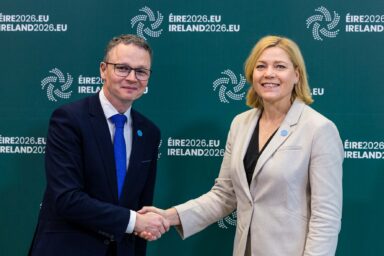
“With today’s agreement, we are simplifying rules for defence-related projects and providing greater support to Europe’s defence industry,” said Marilena Raouna, Deputy Minister for European Affairs of Cyprus, which currently holds the Council presidency. The deal is provisional and both institutions must still give it formal endorsement before it becomes law.