How the art of fine diplomacy allowed Türkiye and the European Union to sidestep sticky issues to keep focus on mutually beneficial business.
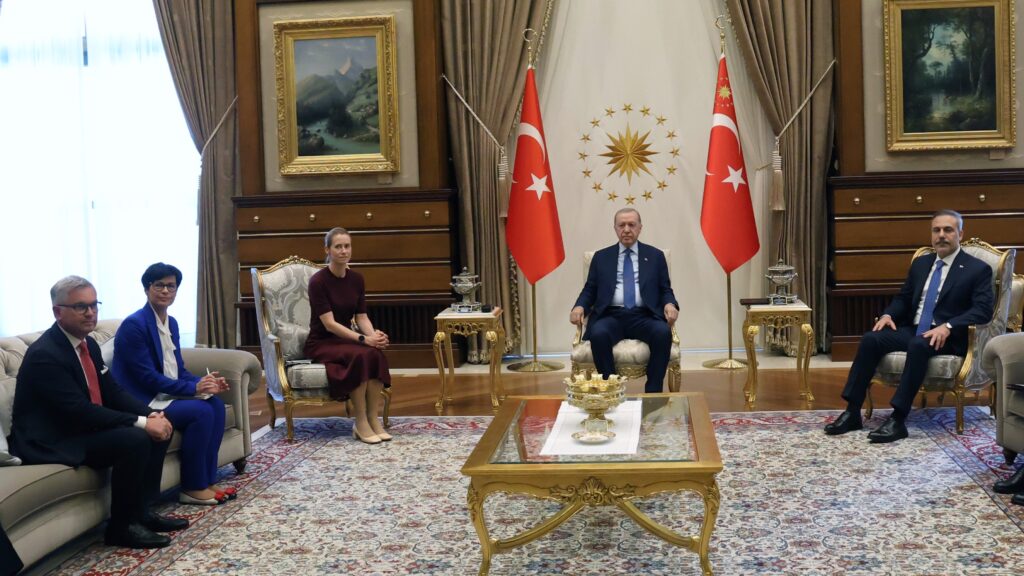
The mere lineup of a foreign-policy dignitaries meeting is not always what raises eyebrows. But when four senior officials met in Ankara on the last day of June, it did. On one side sat Turkish Foreign Minister Hakan Fidan. On the other: EU High Representative for Foreign Affairs and Security Policy Kaja Kallas, EU Commissioner for Enlargement Marta Kos, and EU Commissioner for Internal Affairs and Migration Magnus Brunner. The joint press release they issued is brief. Read carefully, it is also quite revealing.
The document’s opening framing is telling. The four officials discussed “Türkiye–EU relations in a global perspective, recalling Türkiye’s candidate status and acknowledging the strategic value of Türkiye–EU relations in promoting regional stability and economic resilience in a rapidly shifting geopolitical landscape”. The word “recalling” does quiet but significant work here. It does not say ‘reaffirming’ or ‘advancing’. It recalls, as one might recall a historical fact rather than an active process.
What the signals read
Türkiye has held EU candidate status since 1999. Accession negotiations opened in 2005 and stalled badly after 2016, following the attempted coup in Ankara and the subsequent crackdown on civil liberties. The European Parliament voted in 2017 to suspend talks. Formally, nothing has been reopened. The communiqué does not pretend otherwise.
What is unusual—and worth dwelling on—is the composition of the EU delegation. Sending three commissioners simultaneously to Ankara is not routine. Ms Kallas’s presence as foreign-policy chief is expected. “Türkiye is a key partner on security, migration, and energy, as well as an EU candidate country,” she wrote on X after the meeting. But flanking her with both the enlargement commissioner and the migration commissioner suggests a deliberate strategic calculation.
The enlargement angle provides astute diplomatic cover. It allows both sides to speak the language of a membership process without committing to its substance. The migration angle is more transactional. Türkiye hosts the world’s largest refugee population and has served since 2016 as the EU’s principal partner in managing irregular migration across the Aegean. Brussels needs Ankara’s cooperation on that front regardless of any accession dynamic.
Speculatively, the triple-commissioner format may reflect an internal EU negotiating logic: by bundling enlargement, migration, and foreign policy into a single visit, Brussels avoids the appearance of dealing with Türkiye purely on migration—which would look nakedly transactional—while also avoiding any commitment to genuinely reviving accession talks.
The Cyprus sentence
The communiqué features a particularly attention-worthy mention of Cyprus. “They (the participants) voiced support to the efforts by the UNSG on the Cyprus issue,” it reads. This is the most diplomatically compressed sentence in the document. Cyprus has been divided since 1974. Türkiye does not recognise the Republic of Cyprus, an EU member state. The unresolved dispute formally blocks several chapters of Türkiye’s accession negotiations.
The visit coincided with the last day of the Cypriot EU presidency, marked by heightened tensions due to the Israel/US–Iran war. The timing is likely to have played the role of a symbolic conciliatory gesture.
By attributing the Cyprus reference to “they”—meaning all four officials jointly—the communiqué implies Turkish agreement to support UN Secretary-General-led efforts toward a settlement. That is not nothing. Whether it reflects genuine movement or merely formulaic language is impossible to judge from the text alone. Speculatively, including it at all suggests both sides wanted to signal, however faintly, that the issue need not be a permanent veto on the broader relationship.
Rule of law? Noted, moved on
The EU side did raise democratic standards. “The EU side stressed, in the context of enlargement, the need for strengthening the rule of law, the protection of fundamental rights and ensuring high democratic standards,” the communiqué states.
The phrasing is careful. It attributes the point to “the EU side” only—not to both parties jointly—which is bordering on diplomatic honesty. Türkiye did not endorse that point as a shared position. Its placement is also instructive. It appears as a single paragraph, sandwiched between warmer language about “mutually beneficial relationships” and a broad foreign-policy exchange.
The EU side stressed, in the context of enlargement, the need of strengthening the rule of law, the protection of fundamental rights and ensuring high democratic standards. — Joint press release published by Türkiye’s foreign ministry and EEAS
Thus, the topic of rule of law is not quite absent. Brussels could not omit it without embarrassing Ms Kos, an observer may be forgiven for speculating. But the potentially sticky issue certainly does not dominate the document. This may well reflect a conscious choice to keep rule-of-law issue on the record without allowing it to derail a meeting whose primary purpose lay elsewhere. And it did.
A strategic partner by another name
The foreign-policy agenda the four officials covered—Ukraine, Russia, the Middle East, Africa, the South Caucasus—reads less like an enlargement checklist and more like the working agenda of a major strategic partnership. Türkiye borders several of these theatres directly. It has played an active mediating role in the Russia–Ukraine conflict. It controls the Bosphorus and Dardanelles straits, through which naval access to the Black Sea passes.
It is this where the communiqué‘s language is notably ambitious. The four officials reiterated “their shared interest and responsibility to address them through enhanced consultation and coordination, and their commitment to multilateralism and a rules-based multilateral order”. The phrase “shared responsibility” is strong. It implies not merely parallel interests but joint obligation.
Taken as a whole, the Ankara meeting looks like a strategic partnership reset conducted under the formal roof of an accession process that neither side expects to conclude in any near-term horizon. The accession framework provides legitimacy and a shared vocabulary. The real business—migration, foreign policy, economic resilience—sits underneath it.
Embarrassments avoided
Both sides could easily find this arrangement convenient. Like this, Türkiye avoids the humiliation of formally abandoned membership ambitions. Also, the mention of “the gradual resumption of the European Investment Bank’s (EIB) operations in Türkiye” must have made minister Fidan’s bosses in Ankara happy. On the other side of the table, the EU ducks the political difficulty of admitting it has given up on enlargement while still needing what Türkiye has to offer.
No honeymoon is going on between the Brussels-led bloc and its big eastern neighbour. But there is also too much at stake for both of them to let stalled accession talks stand in the way.