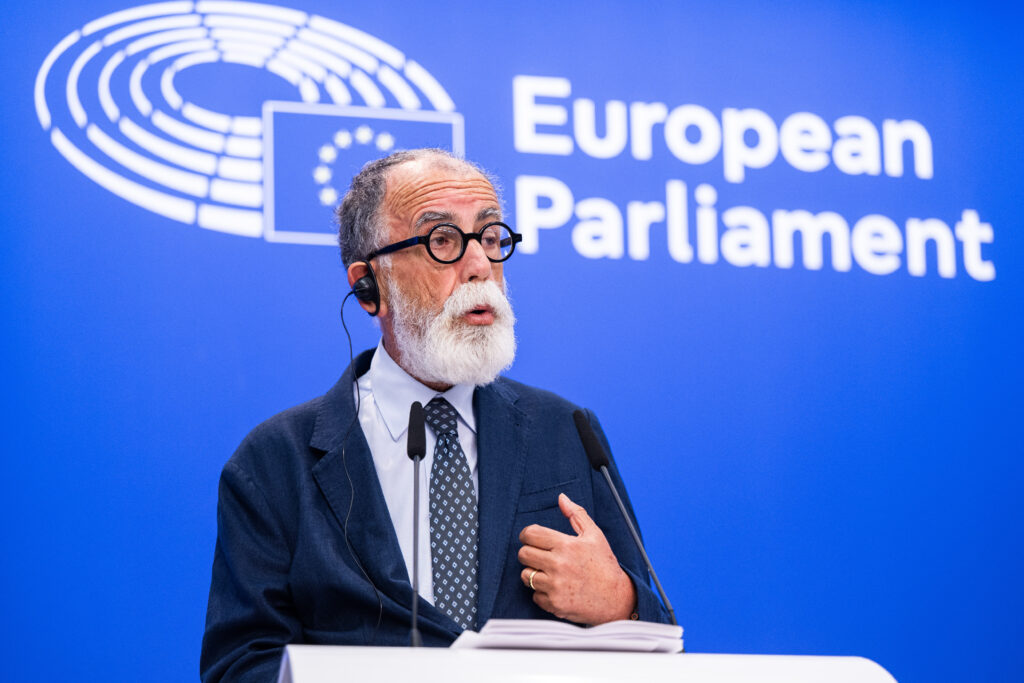
A safer online space for children start with changing how platforms are designed, argues Sandro Ruotolo. “A youth mode must never become an alibi for preserving an unsafe business model. Systems that deliberately exploit users’ vulnerabilities concern everyone,” he says in an interview with EU Perspectives.
Just after the European Commission’s special panel on child safety online recommended keeping children under 13 off social media, the European Parliament’s Culture and Education Committee approved Mr Ruotolo’s (S&D/ITA) report on the impact of social media and the wider online environment on young people.
EU Perspectives spoke with the rapporteur about whether Europe needs a common minimum age, how a proposed “youth mode” should work, the risks posed by AI companions and online games, and what the Digital Services Act (DSA) and the future Digital Fairness Act (DFA) still need to address.
Do you support an EU common minimum age for social media? Should it be 13, as the special panel on online safety recommends?
I support a common European framework. Today, children move through the same platforms, watch the same content and are exposed to the same algorithms across the Union, yet the rules can change from one member state to another. That fragmentation is neither effective nor understandable for families, and it allows platforms to operate within an environment of uncertainty. Europe needs a common approach.
In preparing the report, we deliberately chose not to establish an age threshold on the basis of political intuition alone. These decisions affect children’s cognitive, emotional and social development, so they must be based on scientific evidence and expert advice.
That advice has now arrived. The recommendation that children under 13 should not have independent access to social media is therefore a serious and credible basis for the next stage of our work.
I am particularly concerned about AI companions and conversational chatbots that simulate friendship or emotional intimacy. These systems can collect extremely sensitive information, create dependency and exploit moments of loneliness or emotional vulnerability.
But the discussion cannot end with a number. A minimum age is meaningful only if it is supported by effective and privacy-preserving age assurance.
We must also consider what happens after the age of 13. Access should become progressively more autonomous, but platforms must first demonstrate that their services are safe and appropriate for each age group. Otherwise, we risk moving the problem from twelve-year-olds to thirteen-year-olds without changing the environment in which they are growing up.
Your report mentions “youth mode” for minors. Don’t you fear that it can be used as an excuse for platforms to avoid making their services safe for everyone?
A youth mode must never become an alibi for preserving an unsafe business model. Platforms cannot design services around compulsive engagement, behavioural profiling and maximum attention extraction, and then claim that the problem has been solved by adding a protected setting for minors.
The first objective must remain the safety of the service itself. Certain practices, such as opaque manipulation, misleading design and systems that deliberately exploit users’ vulnerabilities, concern everyone. Adults also have a right to understand why content is being recommended to them and to have meaningful control over their digital experience.
At the same time, children and adolescents require a higher level of protection because they are still developing and are more vulnerable to addictive and persuasive mechanisms.
Youth mode should therefore be an additional, automatic layer of protection: no targeted advertising, maximum privacy by default, restrictions on the most addictive features, safer recommender systems and fewer intrusive notifications. It should be easy to understand, difficult to circumvent and active from the first moment a minor enters the service.
So the approach must be twofold: safer platforms for everyone, and stronger, age-appropriate safeguards for children.
The special panel on child safety online uses the broader term “social media+”. Outside social networks, what concerns you most?
The expression “social media+” reflects the reality experienced by young people. They do not divide their digital lives according to the legal categories used by institutions. For them, social networking, messaging, video-sharing, gaming, streaming and artificial intelligence are often part of the same continuous experience.
I am particularly concerned about AI companions and conversational chatbots that simulate friendship or emotional intimacy. These systems can collect extremely sensitive information, create dependency and exploit moments of loneliness or emotional vulnerability. A child may believe that they are speaking to a trusted companion, while in reality they are interacting with a commercial system designed to gather data and maintain engagement.
There is a clear need to reinforce transparency in influencer advertising. Children must be able to understand immediately when content is sponsored or commercially motivated.
I am also concerned about online games and applications that combine social interaction with mechanisms that resemble gambling, such as loot boxes and randomised rewards. These systems can encourage compulsive behaviour from a very young age, often without children or parents fully understanding the commercial mechanisms involved.
Then there are messaging functions, livestreaming, immersive environments and unsolicited contact from adults or other users. The risks do not stop at the border of a traditional social network. This is why regulation must follow the experience of the child, rather than the label chosen by the company for its service.
You call for banning harmful addictive features, but the DSA already addresses such risks. What is still missing?
The DSA is an essential foundation, and the recent investigations involving TikTok and Meta show that it can be used to challenge business models based on addictive design. The Commission’s preliminary findings on infinite scrolling, autoplay and highly personalised recommendation systems are politically significant because they establish that design is not neutral. A platform can be held responsible not only for individual pieces of content, but also for the architecture that encourages compulsive use.
What is still missing is, first of all, faster and stronger enforcement. Rules are not enough if the institutions responsible for applying them lack staff, resources, access to data or the capacity to investigate complex algorithmic systems. The Commission and national regulators must be able to act before the damage becomes widespread, not years later.
Secondly, we need greater clarity about which practices are unacceptable. In some cases, asking platforms merely to mitigate a risk may not be sufficient. The most harmful addictive practices should be phased out or prohibited, particularly when they target children. Users should also have a real and visible choice between different recommender systems, including options that are not based on profiling.
Finally, the DSA cannot work in isolation. We need coherence with consumer law, the GDPR, the AI Act, the AVMSD and the future DFA. The problem is not creating legislation for the sake of it. It is closing the gaps between existing instruments and ensuring that platforms cannot escape responsibility by moving a practice from one regulatory category to another.
Should the next Audiovisual Media Services Directive regulate influencers and online content creators?
The first step is to clarify whether the current rules already cover the new reality of the audiovisual landscape. Our report does not prejudge the outcome and does not automatically propose bringing all influencers or content creators within the scope of the AVMSD.
What it asks is more precise: the Commission should assess whether the Directive’s current definitions adequately cover relevant audiovisual media services provided by professional influencers and content creators on video-sharing platforms.
This distinction is important. We are not talking about regulating every citizen who publishes a video or expresses an opinion online. We are talking about professional actors who may reach millions of people, including large numbers of children and adolescents, and whose activity can be comparable in scale and economic impact to that of more traditional audiovisual media.
I expect concrete measures against addictive and manipulative design. It is not enough to provide a reminder telling a child that they have spent too much time online while the entire platform continues to encourage them to remain connected.
The future revision of the AVMSD is therefore an opportunity to examine whether there are regulatory gaps and whether some professional creators should fall within the existing definitions or be subject to analogous and proportionate responsibilities. The Commission must carry out that legal and policy assessment before drawing conclusions.
At the same time, there is a clear need to reinforce transparency in influencer advertising. Children must be able to understand immediately when content is sponsored or commercially motivated. Sponsorships should be clearly disclosed, and professional creators addressing minors should respect appropriate ethical and child-protection standards.
The objective is not to limit freedom of expression. It is to ensure that the protection offered to young audiences reflects the way they actually consume audiovisual content today.
What do you expect from the Commission’s announcement in September?
I expect a comprehensive European proposal, not simply the announcement of an age threshold. The age question is important, but it must be part of a broader strategy covering platform design, age assurance, privacy, parental tools, recommender systems, harmful content and effective enforcement.
The proposal should establish common rules across the Union and translate the experts’ recommendations into a gradual, age-appropriate approach. Under 13, independent access should not be permitted. After 13, greater autonomy should be linked to the ability of platforms to demonstrate that their services are safe and appropriate for adolescents. The burden of proof must move from families to companies.
I also expect concrete measures against addictive and manipulative design. It is not enough to provide a reminder telling a child that they have spent too much time online while the entire platform continues to encourage them to remain connected. The architecture itself must change.
Age verification must be effective but also respectful of privacy. Protecting children cannot become an excuse for the mass collection of identity documents or personal data. Europe should develop solutions that verify age without creating new forms of surveillance.
Finally, the Commission must explain how these rules will be enforced, by whom and with what resources. The proposal after the summer should open a legislative process in which Parliament, the Commission and the member states work towards a common European solution. Technology is evolving rapidly, and we cannot continue to intervene only after children have already suffered the consequences.