Moscow’s shadow airlines sustain its African proxies, evade EU sanctions, and funnel instability toward Europe’s borders. Brussels still lacks the tools to ground them.
Russia is running a covert air bridge to the Sahel. It props up authoritarian juntas, extracts African resources to fund its war economy, and exports weapons, fighters, and instability toward Europe’s southern neighbourhood. Brussels has the legal architecture to act. It has not yet used it fully.
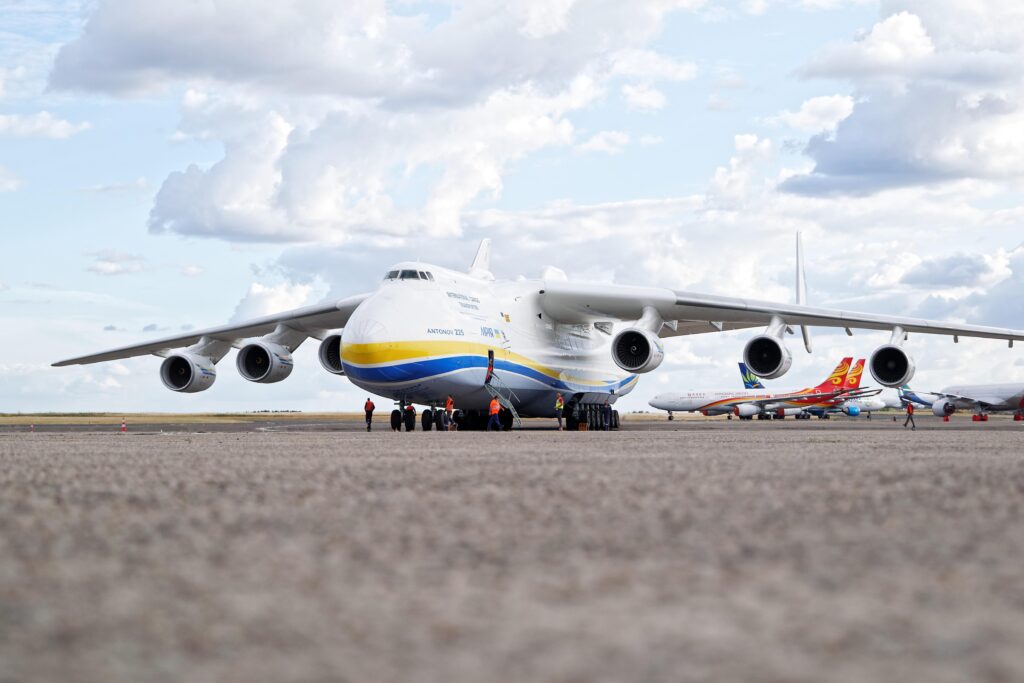
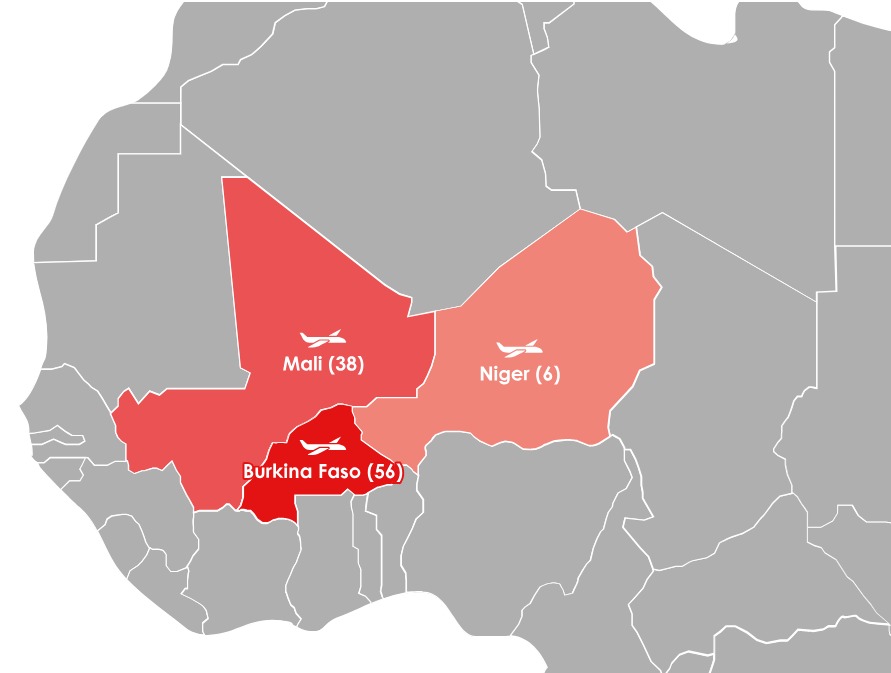
Between January 2025 and July 2026, Russian military-linked aircraft conducted at least 75 flights into Mali, Burkina Faso, and Niger, according to flight-tracking analysis by the Center for Advanced Defense Studies (C4ADS), a Washington-based research organisation. The aircraft are mainly Soviet-era Ilyushin and Antonov cargo models. They carry troops, ammunition, and supplies to sustain the Africa Corps, the Kremlin’s restructured successor to the Wagner Group.
VIP defence flights
Burkina Faso received the most flights, 56 in total. This is partly because of its role as a transit hub between Mali and Niger, and partly because of the intensity of jihadist attacks it faced throughout the period. The network is not simple to track.
State-owned operators fly through Russian-controlled bases in Syria and Libya. Private carriers prefer commercial hubs in the United Arab Emirates, Algeria, and Türkiye. Some switch off their transponders, others file false flight plans. The result is a logistics chain that is opaque by design.
The most active single operator is Flight Unit 224, a Russian Ministry of Defence airline that the United States sanctioned in May 2023 for supporting the Wagner Group and facilitating ballistic-missile shipments to North Korea. Its aircraft, particularly the RA-82030, consistently stopped at Khmeimim air base in Syria and at Al-Khadim in Libya before continuing to Sahel capitals.
The Russian Special Flight Squadron (which normally transports the president and senior officials) conducted 14 flights, suggesting high-level political and military coordination. Russia’s Ministry for Emergency Situations, nominally a humanitarian agency, carried out 12 flights, despite prior reporting linking it to military cargo deliveries in Mali, Syria, and Iran.
The toothless West
Private carriers fill the gaps. Kyrgyzstan-registered Sapsan Airlines and Belarus-registered Rubystar Airways have both been linked to Russian military logistics. The United States sanctioned Rubystar in August 2024. Sapsan remains unsanctioned by Washington, Brussels, or London. This is despite French armed forces alleging it likely carried Wagner fighters aboard a flight that crashed in Mali in September 2023.
Liz Aviation has not been sanctioned either, though journalists identified its aircraft as likely violating arms embargoes in Bangui and documented its ownership history by sanctioned entities linked to Russian private military contractors.
The consequences for the European Union are concrete and compounding. The air bridge sustains Russia-aligned regimes that generate the instability driving irregular migration toward EU Mediterranean and Atlantic routes. It moves weapons and fighters that raise cross-border terrorism risks affecting EU citizens and assets in the region.
Europe pays the price
It channels gold, bauxite, and uranium concessions back to Moscow, funding a war economy that EU sanctions were designed to strangle. And it proliferates advanced military hardware — including, reportedly, Su-57 stealth jets delivered to Algeria — that may re-enter circulation in breach of EU export controls.
The financial dimension is equally corrosive. Proceeds from resource-for-security barter deals flow through networks that infiltrate EU property markets and banking systems. The air bridge also undermines EU leverage in Africa: by providing security guarantees that Western partners cannot match, Moscow has helped expel UN missions and French forces, eroding the diplomatic foothold Brussels spent years building.
Disrupting Russian forces’ access to intermediate transit hubs could, over time, degrade Russia’s ability to sustain troops on the ground in Mali, Burkina Faso, and Niger.
— C4ADS report
The EU already has the tools it needs to act. Under its Russia sanctions regime (Council Regulation (EU) No 833/2014 and Council Regulation (EU) No 269/2014), it can blacklist individuals and companies and restrict their access to services, finance and transport. It can also ban airlines from operating in the EU (Regulation (EC) No 2111/2005) and control the export of goods and technology that could have both civilian and military uses (Council Regulation (EC) No 428/2009).
The legal gap
The EU also has rules governing arms exports and financial flows. Its arms-export rules (Council Common Position 2008/944/CFSP) set common criteria for deciding which weapons can be sold abroad, while anti-money-laundering rules (including Directive (EU) 2018/843 and Directive (EU) 2015/849) require checks to prevent illicit money from moving through the financial system. At the border, EU customs rules (Regulation (EU) No 952/2013) allow authorities to inspect and seize prohibited goods.
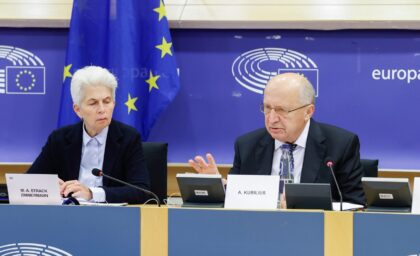
The problem is not the absence of law. It is the absence of listings. Sapsan Airlines, Liz Aviation, and Russia’s Ministry for Emergency Situations remain outside EU and UK blacklists. EU Council working groups are pressing for additions following the C4ADS findings. At the same time, Czech lawmakers have raised the issue in the European Parliament. But the process is slow, and the aircraft keep flying.
The C4ADS analysis points to a structural vulnerability in the Russian supply chain: the dependence on intermediate transit hubs. State aircraft rely on Russian-controlled bases in Syria and Libya. Private carriers depend on commercial airports in Algeria, Türkiye, and the UAE. Libya is identified as a particular pressure point. With Russia’s position in Syria less certain under the new al-Sharaa government, Moscow increasingly depends on Commander of the Libyan National Army Khalifa Haftar.
What to do
“Disrupting Russian forces’ access to intermediate transit hubs could, over time, degrade Russia’s ability to sustain troops on the ground in Mali, Burkina Faso, and Niger,” the C4ADS report concludes. If Haftar’s relationship with Moscow frays, the supply chain frays with it.
Brussels has several options in the near term. It can expand its Russia sanctions regime (Regulations (EU) No 833/2014 and No 269/2014) to cover Sapsan, Liz Aviation and EMERCOM, restricting their access to EU financial infrastructure, insurance markets and ground-handling services. Under the EU’s air-safety rules (Regulation (EC) No 2111/2005), it can also add Russian military-linked carriers to the EU’s banned-carrier list
While aviation is not the only route for Russian military supply logistics in the region, it provides a more reliable and secure alternative to land routes in these landlocked countries.
— C4ADS report
It can tighten end-use checks and upstream screening under Regulation 428/2009 to close the dual-use leakage channel. It can strengthen anti-money-laundering due diligence on African commodity imports (gold and minerals in particular) under the EU’s anti-money-laundering framework. And it can coordinate with the United Kingdom and the United States to close the gap between respective sanctions lists, denying operators the ability to exploit jurisdictional arbitrage.
The AFRICOM 2026 posture statement warns that Moscow is “insulating, extracting and exploiting” African resources while undercutting Western access. The C4ADS data shows how the air bridge makes that possible — flight by flight, cargo hold by cargo hold. Brussels has the law. What it still lacks is the political urgency to enforce it.