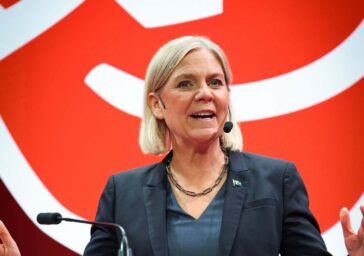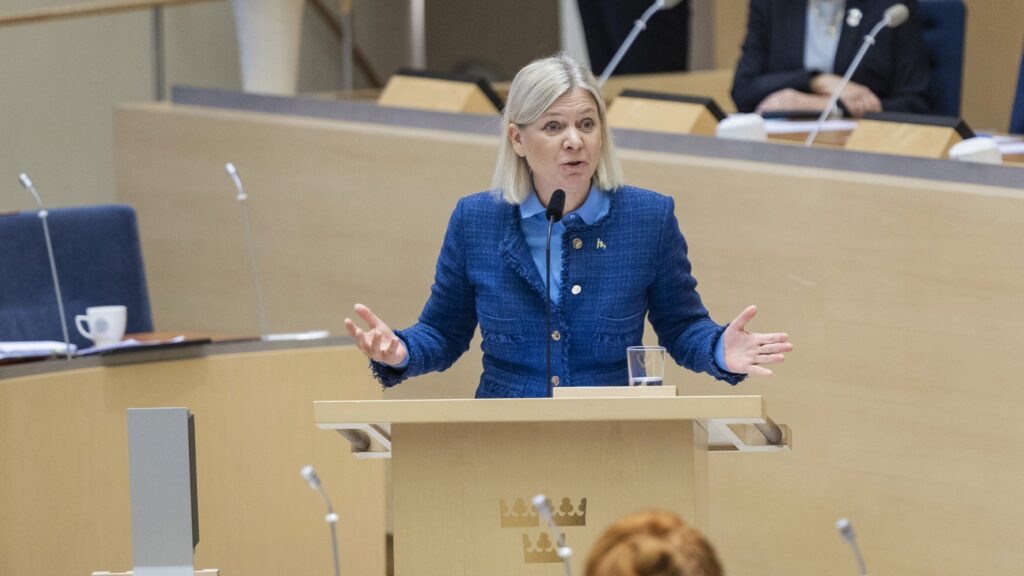
After four gruelling days of counting, the result arrived. Sweden’s centre-left opposition, led by Magdalena Andersson, has beaten Ulf Kristersson’s governing right-wing bloc by just two seats. The fight over what comes next, however, is only just beginning.
Thursday afternoon finally brought an end to the wait. The opposition wins 176 seats in the Riksdag, Sweden’s parliament, while the four parties in the governing bloc take 173 of the 349 seats. Some 50,000 votes separated the two sides. Turnout, traditionally high in Sweden, topped 84 per cent, with voters turning out in large numbers for a closely fought election.
All votes have now been counted, but the result remains preliminary until the county administrative boards complete their final checks and the Swedish Election Authority formally confirms the result.
The numbers puts the Social Democrats, who won 28 per cent of the vote, back in a position to try to form a government.
But it does not mean a simple return to the Sweden of old. Four years of right-wing rule have reshaped the country’s politics, particularly on migration and crime. The far-right Sweden Democrats, which backed the government from outside, also retain considerable influence despite their electoral setback.
Just two seats make the difference
The result was still up in the air on Monday. The gap between the two blocs was so small, fewer than 30,000 votes, that attention turned to the last batches of ballots.
These included late-arriving advance votes and ballots cast by Swedes living abroad. There were an unusually large number of them this year, almost 300,000, according to the election authority. In 2022, the figure was around 227,000. And it was exactly those overseas votes that helped tip the result towards the right at the time.
For four days, everyone was therefore waiting to see whether the gap between the blocs would disappear. In the end, it did not. On Wednesday, with more than 99 per cent of votes counted, Swedish public broadcaster SVT said: “The likelihood of a turnaround at this stage is so low that we can confidently state that the opposition will secure the most seats in this election.”
The opposition can now start preparing for a return to power. But it is already clear that Ms Andersson has a difficult job ahead.
A week after the AfD triumph, Sweden went the other way
The Swedish election came at a striking moment for Europe. Just a week earlier, the AfD had won 43.8 per cent of the vote in Germany’s Saxony-Anhalt, more than doubling its result from the previous state election. The CDU came second with 17.2 per cent.
That raised the question of whether another European country was about to deliver another breakthrough for the far right. In Sweden, the issue was not just whether Mr Kristersson’s government would stay in power. It was also whether the Sweden Democrats would move into government for the first time after four years of supporting it from the outside.
The party’s origins make that prospect particularly significant. The Sweden Democrats were founded in 1988 out of a nationalist movement that included far-right, fascist and Nazi activists. A 2025 party-commissioned white paper documented links to Nazi organisations, antisemitic ideas and racial ideology, particularly in the party’s early years.
The party embarked on a long process of distancing itself from those roots, publicly apologised for its past and tried to move into the political mainstream.
From supporting the government to taking cabinet seats
Mr Kristersson promised before the election that, if the right-wing bloc won a majority, he would bring the Sweden Democrats into a joint government. A party that stood outside the political mainstream only a few years ago could therefore have gained not just influence over government policy, but its own cabinet ministers.
That will not happen now, at least not as a result of this election.
The roots of this year’s showdown go back to the 2022 election. Mr Kristersson then formed a government of the Moderates, Christian Democrats and Liberals. The Sweden Democrats stayed outside the cabinet, but their support became essential to the right-wing bloc’s ability to govern.
That arrangement produced the Tidö Agreement. It gave the Sweden Democrats significant influence over migration, integration, crime, energy, healthcare and education policy.
Over the following four years, the Swedish right moved towards a much tougher migration policy and built a large part of its political agenda around tackling gang crime.
The Sweden Democrats lose ground for the first time
The Sweden Democrats now take around 17.5 per cent of the vote, down from 20.5 per cent in 2022. They have fallen from second to third place among Sweden’s political parties.
It is their first electoral setback since 2010, when they first cleared the four per cent threshold and entered the Riksdag.
But the drop in support does not mean the end of their political influence.
Political scientist Cas Mudde argues that the party is now part of the political mainstream. Its strategy, he says, worked over the past four years: it gained influence without having to carry the full responsibility of government. “The Sweden Democrats is now completely normalised within the right bloc,” Mr Mudde wrote.
He also argues that nativist politics has spread into other major parties, “albeit in lighter form”, from the Moderates to the Social Democrats.
Ann-Cathrine Jungar, a political scientist at Södertörn University, makes a similar point: “We focus a lot on the extreme and radical right parties, but the key to their influence is what the other parties do.”
That may be the biggest paradox of Sweden’s election. The Sweden Democrats lost ground, but the politics they helped push forward did not disappear from the ballot box.
The election was not just about migration
So why did the party lose support? There is no single answer yet. Swedish voters were not focused on one overriding issue this time.
The right could point to falling gang crime and a record-low number of asylum seekers. The opposition, meanwhile, put more emphasis on the economy, healthcare and the problems facing the welfare state.
There was also a striking generational divide. Left-wing and Green parties performed significantly better among younger voters than across the population as a whole. The Sweden Democrats, by contrast, lost noticeable ground among the youngest voters in post-election data.
Mr Mudde points to another difference from 2022. Migration and the question of whether it was acceptable to bring the Sweden Democrats into power dominated that campaign, he argues. Both issues remained important this time, but neither took over the entire election.
Controversies over the party’s anti-migrant campaign, alleged links to Russian influence and the leader Jimmie Åkesson’s conduct towards Ms Andersson also dogged the final stretch of the campaign.
Even so, the party retained most of its 2022 voters. According to Mr Mudde, around 78 per cent of its previous voters stayed with the party — a better retention rate than those of the Moderates or Social Democrats.
Migrants did not decide the result on their own
The result has also raised questions about how Swedes with an immigrant background voted. Mr Åkesson himself claimed towards the end of the campaign that Muslim voters could decide the election. Magdalena Andersson replied that the outcome could just as well be decided by “Norrland voters”.
Norrland, Sweden’s vast northern region, has traditionally been a Social Democratic stronghold. But the party has been losing ground there in recent years, with voters increasingly turning to other parties. In this election, the Social Democrats again suffered some of their sharpest losses in several northern counties, including Västerbotten, Jämtland and Norrbotten.
The data do show that the Social Democrats were the strongest party among Swedes with a non-European background. According to Cas Mudde’s post-election analysis, they won 38 per cent support in this group. That alone, however, does not justify claiming that migrants “stopped the right”.
Andersson won the election. Now she has to win the negotiations
Winning the centre-left bloc is not the same as having an easy government. Ms Andersson will have to find common ground with three smaller parties: the Greens, the Left Party and the Centre Party.
The Centre Party presents the biggest headache. It does not want to enter government alongside the Left Party, which in turn insists that its electoral gains should translate into corresponding political influence.
The Greens are hardly an effortless partner for the Social Democrats either. The parties differ over migration, nuclear power and energy policy more broadly. Some Green tax proposals could also prove difficult for parts of the Social Democratic camp to swallow.
Ms Andersson knows all too well how hard it is to govern without a stable parliamentary majority. Her previous government repeatedly had to operate without the backing of its own budget.
Mr Kristersson, meanwhile, conceded on Monday that if the opposition really secures a majority, Ms Andersson will have the right to try to form a government. At the same time, he described the negotiations ahead as “a complicated government formation process”.
Opposition leaders are also keen to prevent the differences between the parties from ending in another election.
The result has therefore settled which bloc came out on top. It has not yet settled what Sweden’s next government will look like.