Beijing faces unprecedented pressure in the Indo-Pacific. At the same time, Germany is turning up the volume in trade dealings with the Asian giant. Hardly a coincidence.
Friedrich Merz has never been a man in a hurry. The Bundeskanzler spent months after taking office publicly warning about the risks of a trade war with China, dampening Brussels’ appetite for confrontation and frustrating allies who wanted Berlin to lead. Now, something is shifting. Slowly, carefully, and with the instinctive caution of a lawyer who knows the value of a well-timed concession, Mr Merz is inching Germany toward a harder line on Beijing.
“For a long time, we underestimated China’s power and economic strength,” Mr Merz said last week in Cologne. “We’re facing a major strategic turning point.” Whether that shift reflects a cool reading of China’s changing strategic position or simply the grinding pressure of German deindustrialisation is not yet clear. But the timing is striking. Europe’s largest economy is finding its voice just as a loose coalition of Indo-Pacific powers quietly encircles China’s strategic perimeter.
The cost of doing nothing
The numbers have become impossible to ignore. Germany loses more than 10,000 manufacturing jobs every month. German auto exports to China cratered in 2025. The country runs the EU’s largest bilateral trade deficit with Beijing by far. And the product mix that once made Germany indispensable—precision machinery, premium cars, industrial equipment—is being undercut by Chinese competitors backed by state subsidies and, Mr Merz argues, an artificially weak yuan.
He has zeroed in on the currency with unusual specificity. After the EU summit in June, he proposed revisiting the logic of the 1985 Plaza Accord, when the United States, Japan, Germany, France, and the United Kingdom coordinated to weaken the dollar.
Mr Merz believes the yuan is undervalued by as much as 30 per cent. Last week he urged eurozone finance ministers to act. “We can do what we want,” he was quoted as saying. “But if we don’t correct this, we will always feel the disadvantages.”
That is a remarkable statement from a chancellor whose government has, until recently, resisted almost every Brussels initiative that risked provoking Beijing. It suggests that Mr Merz has concluded, at least privately, that the cost of inaction now exceeds the cost of confrontation.
Cracks in the coalition
The shift is real, but it is not clean. Mr Merz’s own government is divided. The foreign ministry backs a tougher approach. The economy ministry, headed by Katherina Reiche, worries about retaliation and remains wary of market intervention. That split reflects a wider fracture in German business. Carmakers, still dependent on Chinese sales and scarred by Beijing’s critical-mineral export restrictions last year, counsel restraint. Machinery makers and small and medium-sized enterprises, which together account for the bulk of German employment, want action.
We need the courage to tell China that (…) we’re going to tighten the screws a little now.
— Oliver Richtberg, Machinery and Equipment Manufacturers’ Association
The political pressure is mounting, too. “Germany’s China shock is increasingly felt in constituencies across the country,” said Johannes Volkmann, Mr Merz’s fellow Christian Democrat lawmaker. “More and more small and medium-sized enterprises are reaching out to pressure their members of parliament on this,” he added, noting that “Germany as Europe’s largest economy has a leadership responsibility.”
Business is on board. “We need the courage to tell China that it’s playing unfairly and that we’re going to tighten the screws a little now,” said Oliver Richtberg, head of foreign trade at the Machinery and Equipment Manufacturers’ Association, known as VDMA. “Then we’ll see how China reacts. No one can predict that with complete certainty,” he told Bloomberg.
A fence tightens around Beijing
It would be too neat and too speculative to suggest that Mr Merz’s recent push is a direct response to China’s changing strategic position in the Indo-Pacific. He has not said so. His aides have not said so. But the geopolitical backdrop against which his cautious repositioning is taking place deserves attention.
George Friedman, chairman of Geopolitical Futures, argues that a new and consequential structure is forming around China’s perimeter. Indian Prime Minister Narendra Modi’s recent tour of Australia, New Zealand, and Indonesia, combined with deepening defence ties between Japan, Australia, Vietnam, and others, amounts to something qualitatively new. “What this was about was something substantial,” Mr Friedman said. “It was not just a visit. It created a structure of countries built around each other and now, including India as a defensive force, obviously primarily against China.”
The geography matters enormously. Indonesia’s island chains block Chinese naval access between the Pacific and the Indian Ocean. Australia and Papua New Guinea have signed new defence pacts. Japan has dramatically increased defence spending. India (which has already fought and won small border battles against Chinese forces) has now joined what Mr Friedman calls a coalition defined by a single common interest: limiting China.
A fundamental problem
“When you put these countries together and you use the geography of these countries, the axes on which they can act, this creates a fundamental problem for China,” Mr Friedman said, “and that’s what it was meant to do.”
This is not an alliance in the NATO sense. No article commits any of these countries to defend the others. But Mr Friedman’s point is subtler: the mere possibility of coordinated response forces Beijing to plan for multiple simultaneous threats across a vast theatre. A power that must disperse its forces is a power whose reach is constrained. And a power whose reach is constrained is, at the margins, easier to confront.
Surrounded by adversaries
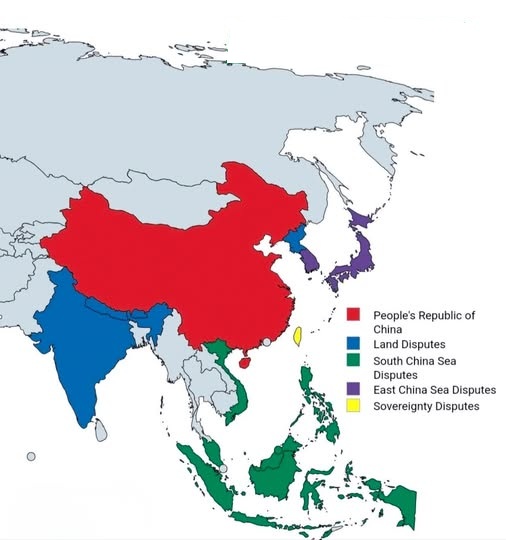
This is where the European story and the Indo-Pacific story quietly intersect, though the connection is less than direct. Politicians rarely think in tidy geopolitical terms, and chancellors under domestic pressure rarely need exotic strategic rationales to explain why they are listening to their manufacturers.
The boldness that constraint enables
And yet. A China that faces a tightening cordon in the Indo-Pacific. It must weigh the responses of India, Japan, Australia, Indonesia, and a US-backed island chain before it acts. It inevitably means less bandwidth for economic coercion in Europe.
Beijing’s critical-mineral gambit last year, which nearly froze German production lines, demonstrated real leverage. But leverage has limits. A country managing strategic encirclement on its eastern and southern flanks may calculate differently about how hard to squeeze its western trading partners.
Mr Friedman puts it plainly. The emerging coalition “limits China in some ways,” he argues, and “imposes a kind of new need for caution by the Chinese.” That caution, if real, creates space—not much, but some—for Europe to push back without triggering the full weight of Chinese retaliation.
The October test
Whether Mr Merz sees it that way is unknowable. What is observable is that he is moving, and that he is moving at a moment when China’s adversaries, from Delhi to Canberra, are also moving. Coincidence is not causation. But in geopolitics, timing is rarely accidental.
The moment of truth is approaching. EU leaders meet in October, when the European Commission is due to present a reinforced trade toolbox that could include countervailing duties, quota systems, and new instruments to reduce dependency on Chinese inputs. Commission President Ursula von der Leyen may signal direction in her state-of-the-union address in September.
When you put these countries together (and) the axes on which they can act, this creates a fundamental problem for China.
— George Friedman, Geopolitical Futures
France is pushing hard for a tougher line and has lobbied Berlin at every level. Italy is watching and willing to move if Paris and Berlin align. Spain remains resistant. The outcome may hinge on whether Mr Merz—mercurial, lawyerly, and acutely aware of the risks on both sides—decides that Germany’s leadership responsibility, as his own backbencher put it, finally outweighs its fear of retaliation.
A question of will
The EU has been here before. It has fought trade battles with China over textiles, fasteners, solar panels, and rare earths. It has learned, over two decades of clashes, that Beijing responds to legal and economic pressure when that pressure is sustained and credible. The question has never been whether the tools exist. It has always been whether the political will does.
We are not quite there yet. Mr Merz’s views, according to people familiar with the discussions in Berlin, are not yet settled. But he has made it clear that confronting Beijing is not off the table; and the geopolitical timing could hardly be better.